Sal Flowers For Summer
First published in Sanctuary Asia,
Vol. 46
No. 6,
June 2026
By Soham Kacker
On a recent drive from Delhi to Dehradun, I noticed how starkly the low, terai floodplain forests announce themselves with a singular tree – the sal. Spanning a huge swathe of northern India from the Himalayan foothills through the upper Gangetic plain, Central India, West Bengal, Odisha, and right down to northern Andhra Pradesh, sal or Shorea robusta is a keystone of dry deciduous forests. Forming naturally mono-dominant stands in the sub-Himalaya, where it constitutes over 80 per cent of the forest canopy, sal defines these ecosystems.
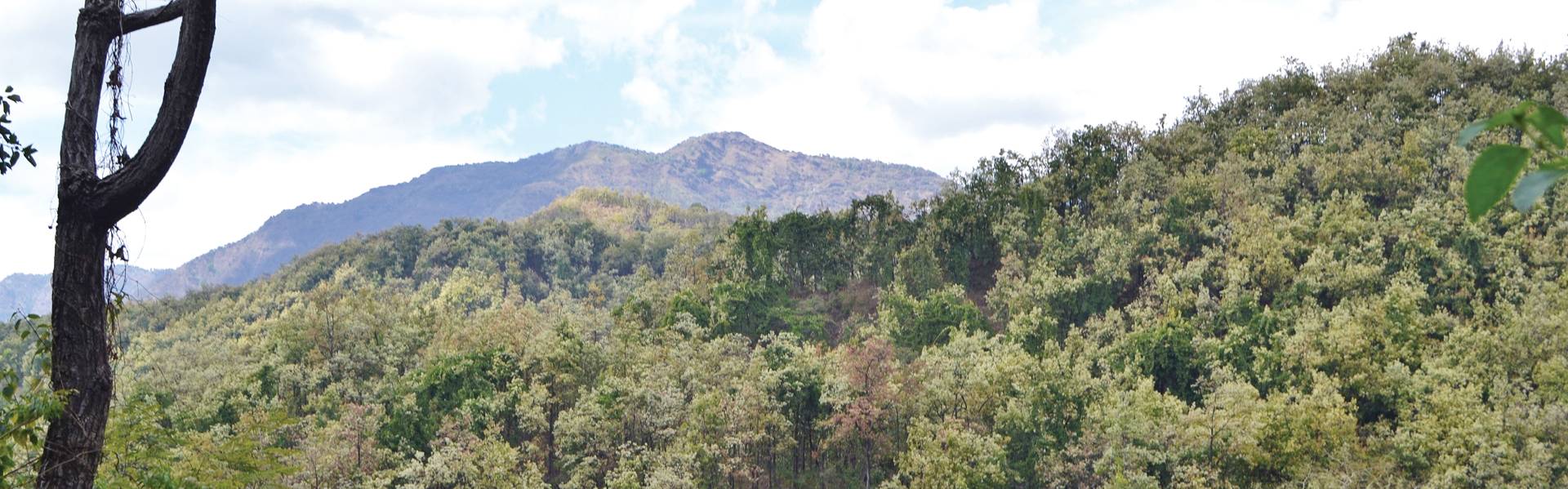
On this particular drive, the entire forest seemed to be in bloom. Pale, effulgent clusters of minute flowers hung from practically leafless branches on both sides of the road, and we gasped at the glory of these regal forests in their early-summer garb. What we were experiencing, was in fact a flowering event of legendary proportions, the product of a specific reproductive strategy, and the precursor of one of the most iconic tropical phenomena anywhere in the world.
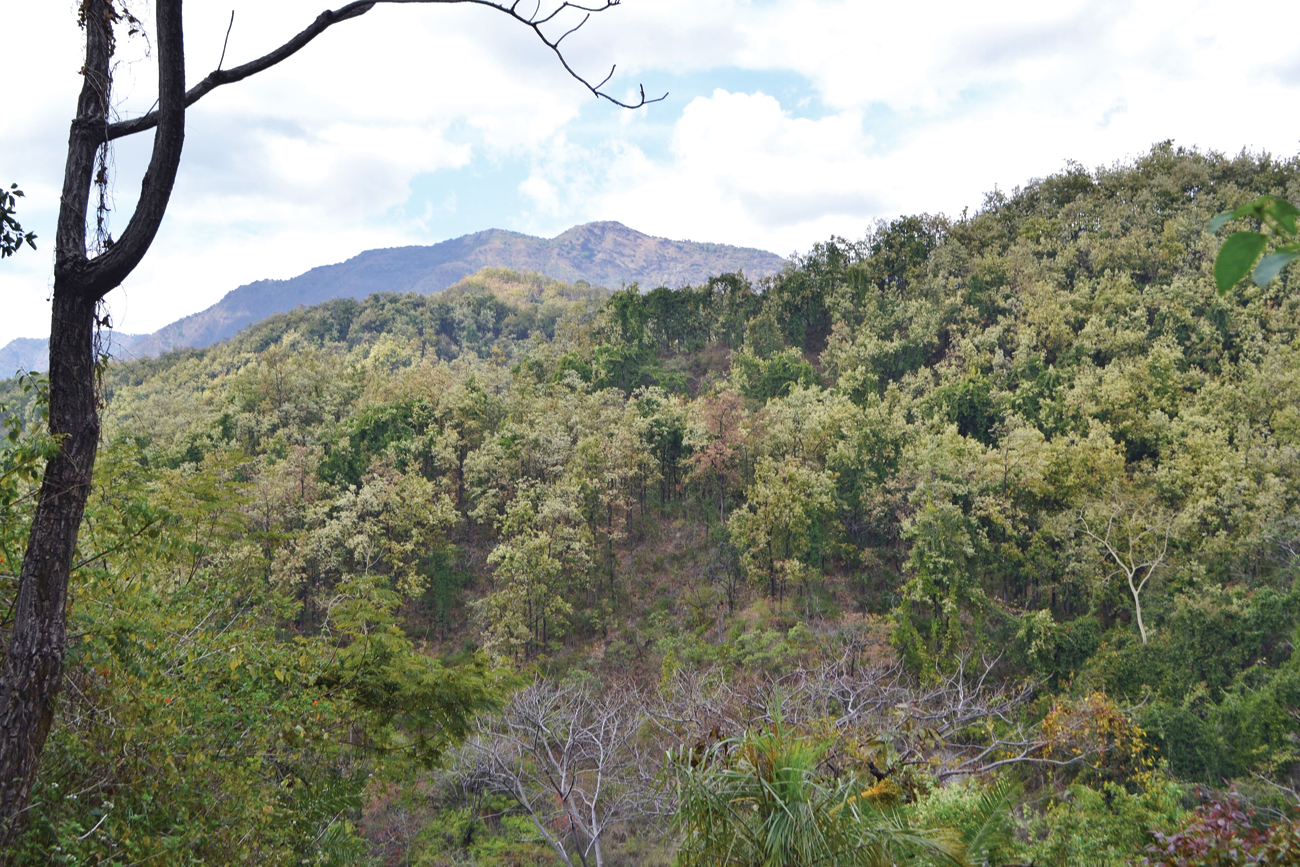
Photo: Delonix/CC-By-SA-4.0.
Sal blooming begins in late February, progressing through March and April, usually lasting between 30 and 40 days. There is little variation in flowering time between individual trees such that entire tracts of forest flower simultaneously, a phenomenon known as ‘mass-blooming’. The predominantly wind-pollinated flowers release a massive amount of pollen – nearly 60,000 pollen grains per blossom – directly into the air. Pollination is also assisted by tiny insects called thrips, which feed on the immature buds and also visit mature flowers and effect pollination. Although sal flowers every year, typically flowering follows a multi-year cycle with an extra-abundant flowering season every few years. Foresters report that sal sets seeds very heavily every three to four years. Although the environmental driver of these cycles has been the subject of debate, it is thought that it is determined by cues such as higher daytime temperatures prior to flowering and a drier spring such as one caused by a strong El Niño.
These multi-year rhythms of the sal have evolutionary echoes in faraway Southeast Asia as well. Sal belongs to a family of tropical trees known as the Dipterocarps (Dipterocarpaceae), which often comprise the majority of canopy species in lowland tropical rainforests in Asia. As the Dipterocarp family spread eastwards from India, species in Southeast Asia developed far more pronounced synchronous flowering than the sal. In the case of Asian Dipterocarps, massive, synchronised flowering occurs only every few years, and is followed by a super-abundance of seeds – known as mast seeding. This is an evolutionary strategy to overwhelm would-be seed predators such as rodents, other small mammals, and insects to ensure that a good proportion of seeds survive and germinate. It also allows plants to store energy until conditions are optimal for seeding, or in other words, invest in reproduction only when it is likely to offer the highest returns. These mass flowering and mast seeding events are so significant that the populations of several other animals actually decline in non-masting years, owing to a lack of food resources.
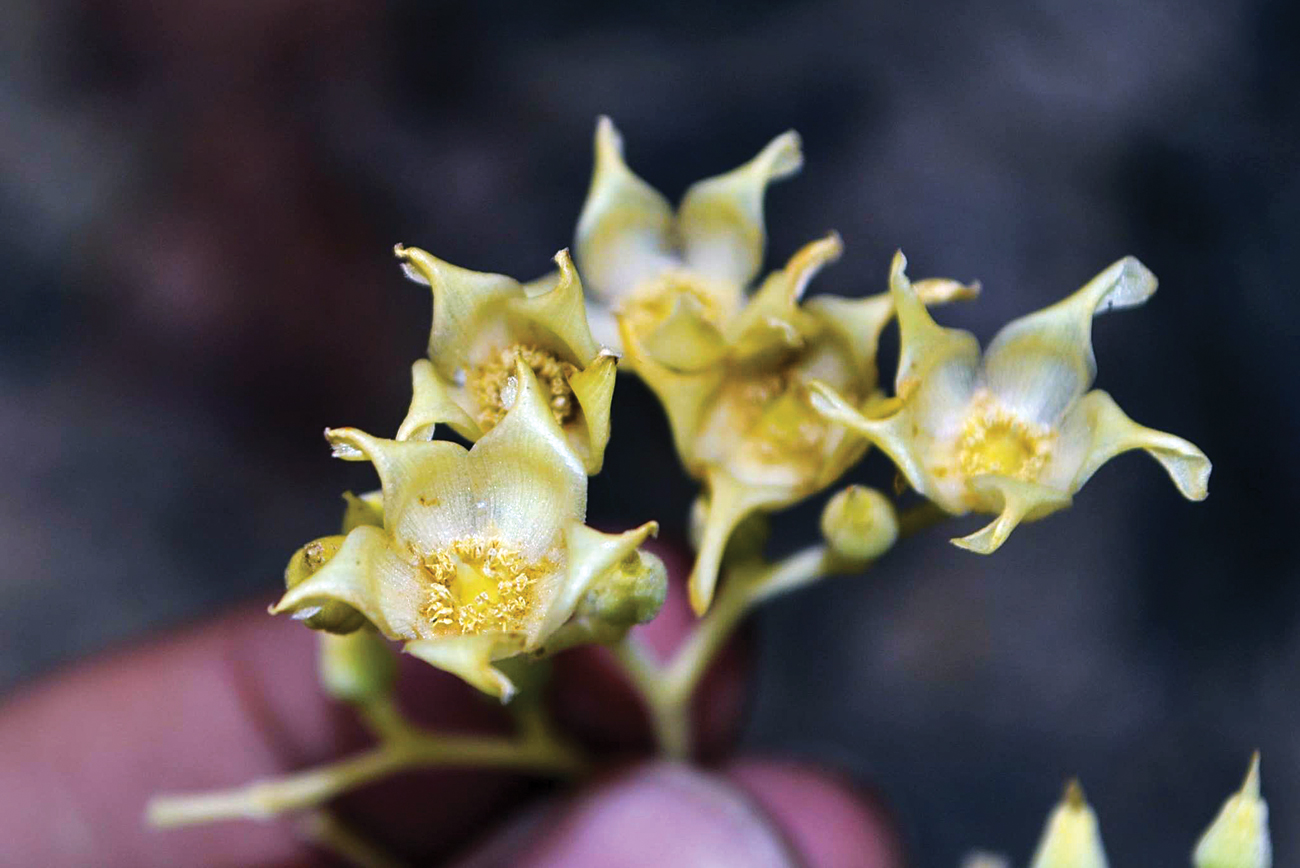
The predominantly wind-pollinated sal flowers release a massive amount of pollen directly into the air – around 60,000 pollen grains per blossom! Photo: Delonix/CC-BY-SA-4.0.
The fine-tuned evolutionary correlation between environmental conditions and Dipterocarp flowering means that often, flowering events can be used to read larger climatic patterns, and the behaviours of other species too. A heavy flowering year is likely to mean a dry spring and late monsoon – conditions associated with heavier fruiting in food crops such as mangoes, jackfruit, durian and garcinia. A heavy sal flowering may predict a good mango season later in the year! However, attunement to environmental cues also means that Dipterocarps are particularly vulnerable to climate change. Changing seasonal patterns could interfere with flowering and fruiting cycles. As Dipterocarp seeds cannot withstand drying out, an especially delayed monsoon following a mast-seeding year could mean a significantly reduced regeneration rate. For the time being, sal populations and distributions are stable, and witnessing the blooms again this year gave me a renewed appreciation for the hidden yet all-pervasive rhythms of the plant world.
Soham Kacker is a plant ecologist and horticulturist from New Delhi. His research looks at plant conservation and ethnobotanical landscapes in the Indian Himalaya and beyond.