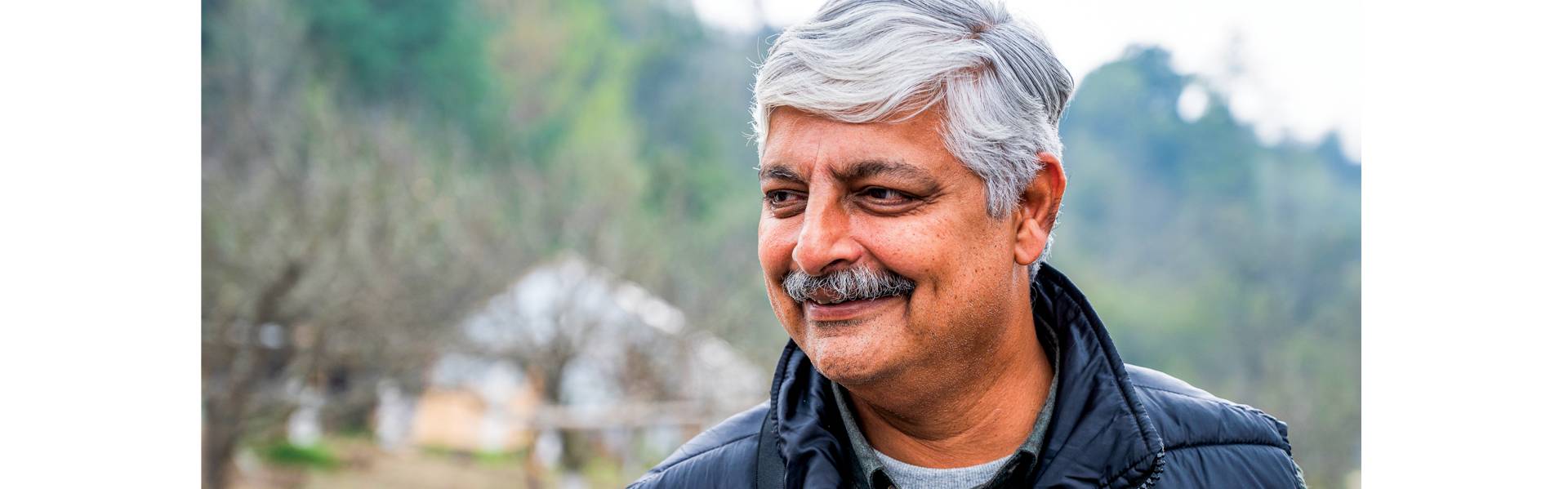
Meet Vivek Menon
First published in Sanctuary Asia,
Vol. 46
No. 6,
June 2026
Vivek Menon, Founder of the Wildlife Trust of India (WTI) and Chair, IUCN Species Survival Commission (SSC), reflects on a career spent at the intersection of wildlife, policy, and people-led action. Shatakshi Gawade speaks to him about his early activism and its evolution that helped shape large-scale species recovery and community-based conservation initiatives in India.
What set you off on your journey to become a voice for the wild?
Some very famous people, including Sir David Attenborough, have asked me about my inspiration. Frankly, I have no idea! I’ve done this since childhood. My mother, a doctor, and my father, an engineer, had no connection to animals, but they were very supportive. I even kept animals in my room without my father knowing! Books were my primary inspiration. I read E.P. Gee’s Wildlife of India, Ian Douglas-Hamilton, everything I could lay my hands on. Later, trekking in the Himalaya during school gave me a deep connection with nature and showed me destruction that I felt driven to reverse. At 19, I wrote to Sálim Ali and started my first NGO, beginning my life as a serial entrepreneur in conservation.
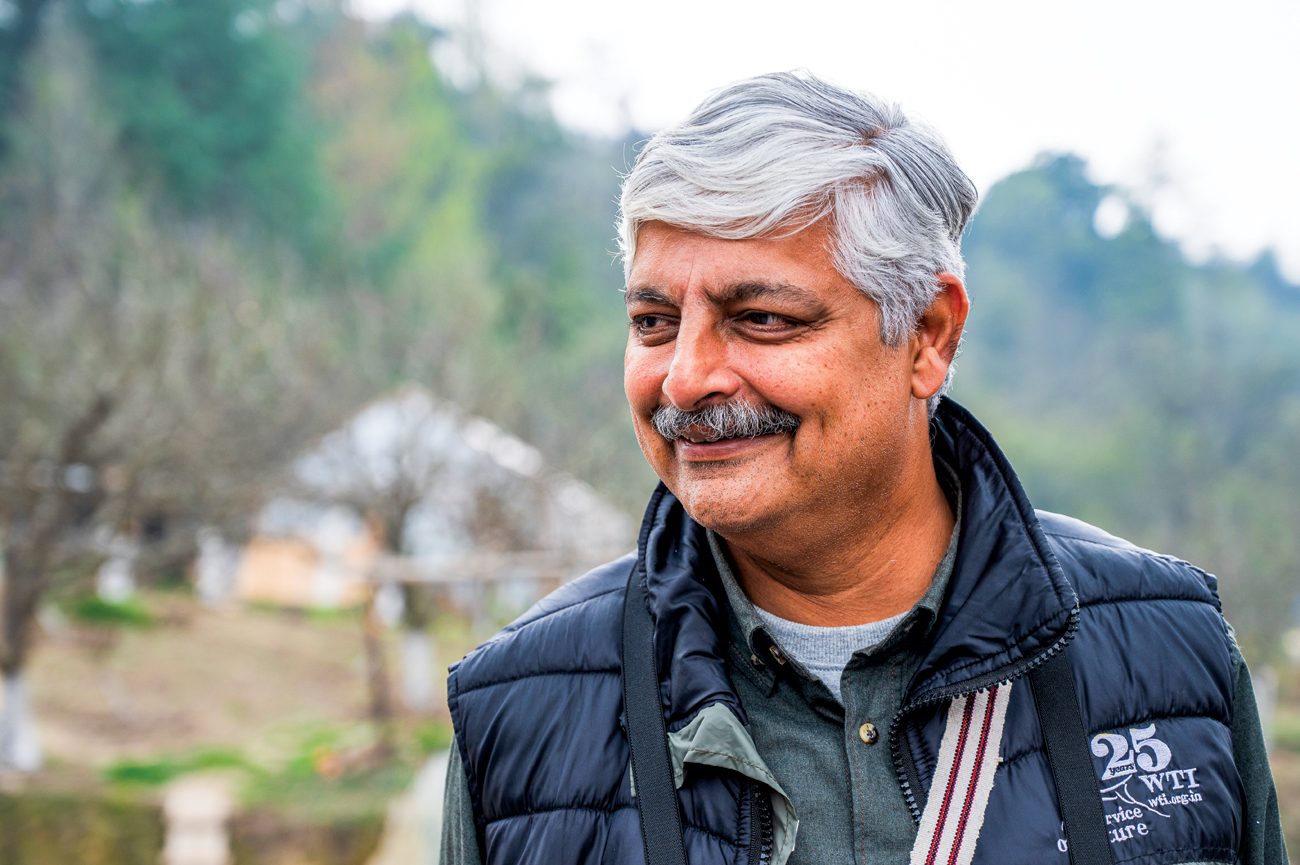
Vivek Menon is the Founder of the Wildlife Trust of India (WTI) and currently serves as Chair of the International Union for Conservation of Nature (IUCN) Species Survival Commission (SSC). In his 25 years with the IUCN, he has been a part of various species specific matters, including the Cat Specialist Group, Asian Rhino Specialist Group, Threatened Waterfowl Specialist Group, and the Medicinal Plant Specialist Group. Photo: Madhumay Malik/WTI.
I read that your foray into environmental activism began with the Aravallis.
It actually began after I saw a man stub out a cigarette in a pheasant’s eye at the Delhi Zoo, which I often frequented to photograph animals. I intervened, and the Zoo Director, an incredible IFS officer called Kamal Naidu, encouraged me to organise youth volunteers. This led to our activism in the Aravallis. We gheraoed (surrounded) a Delhi Development Authority official to stop plans to convert the ridge into a landscaped park, like Hyde Park in London, which is when I realised the power of youth.
While in college in Delhi, I set up Srishti. There was a lot of activism in me in the early days, which has been tempered down over the years, but my initial instinct was to catch a wrong-doer by the
collar. This activism was eventually imbued with science and data to contest destructive plans.
Is there still space for youth to take action in today’s times?
Absolutely! Young people bring in freshness, new thought, and energy. And politicians often respond to them differently, possibly viewing them as potential voters , not threats. Unlike many older activists, young India has not turned cynical. They energise me and infuse conservation issues with vitality and enthusiasm. I enjoy being surrounded by and mentoring young adults, particularly out in the field. My colleagues and wife encourage me to get out, because I’m not a happy camper indoors. When I’m on the move, I’m positive. I see things, I react, I do things.
Tell us about the Wildlife Trust of India!
It is the fifth NGO I launched, including TRAFFIC India, with the late Ashok Kumar, and the Delhi Bird Club. I’ve been a founding member of several non-profit organisations. WTI was born after a hiatus abroad in Sri Lanka, the UK, Kenya and other countries, where I was on my own for a few very happy years. I was somewhat disillusioned with the larger NGOs of the time in India. When senior conservationists urged me to address a vacuum in ground-level work in India, I returned to start WTI. It was quite a load, of course, as I’ve experienced close to 28 years, of which I was CEO for nearly 22 years. Now others have been taken on to run WTI’s day-to-day mission.
What is WTI’s key mission?
We focus on ‘conservation action’ – a term we helped define. For wildlife, that means field-level projects, to which we remain absolutely committed. For several years now, we have even collaborated with Bharati Vidyapeeth in Pune to offer a Master’s in Conservation Action. The aim is to produce new-age conservationists who are more prepared. Conservation Action was never a discipline, Conservation Science was. More than mere ecologists or biologists, conservation action requires liaisoning, fundraising, and communication. Conservation, in that sense is an art, with science playing a key role. There’s no subject called ‘conservation’ in school or college, so we chose to offer real training to those serious about turning conservation into a profession.
What are WTI’s guiding principles, current work, and future goals?
Our mission is to “conserve wild species and their habitats, working with governments and communities”. We don’t debate whether the government is good or bad, we work with it to get the best possible outcomes. Over the years, I’ve realised that neither governments nor communities can be excluded. In India particularly, successful conservation action is impossible without people.
Another core principle is our private-sector work ethic. We avoid what I call the ‘NGO culture’. People have targets, and their remuneration is linked to their performance. You could call it a private-sector discipline… with an NGO heart.
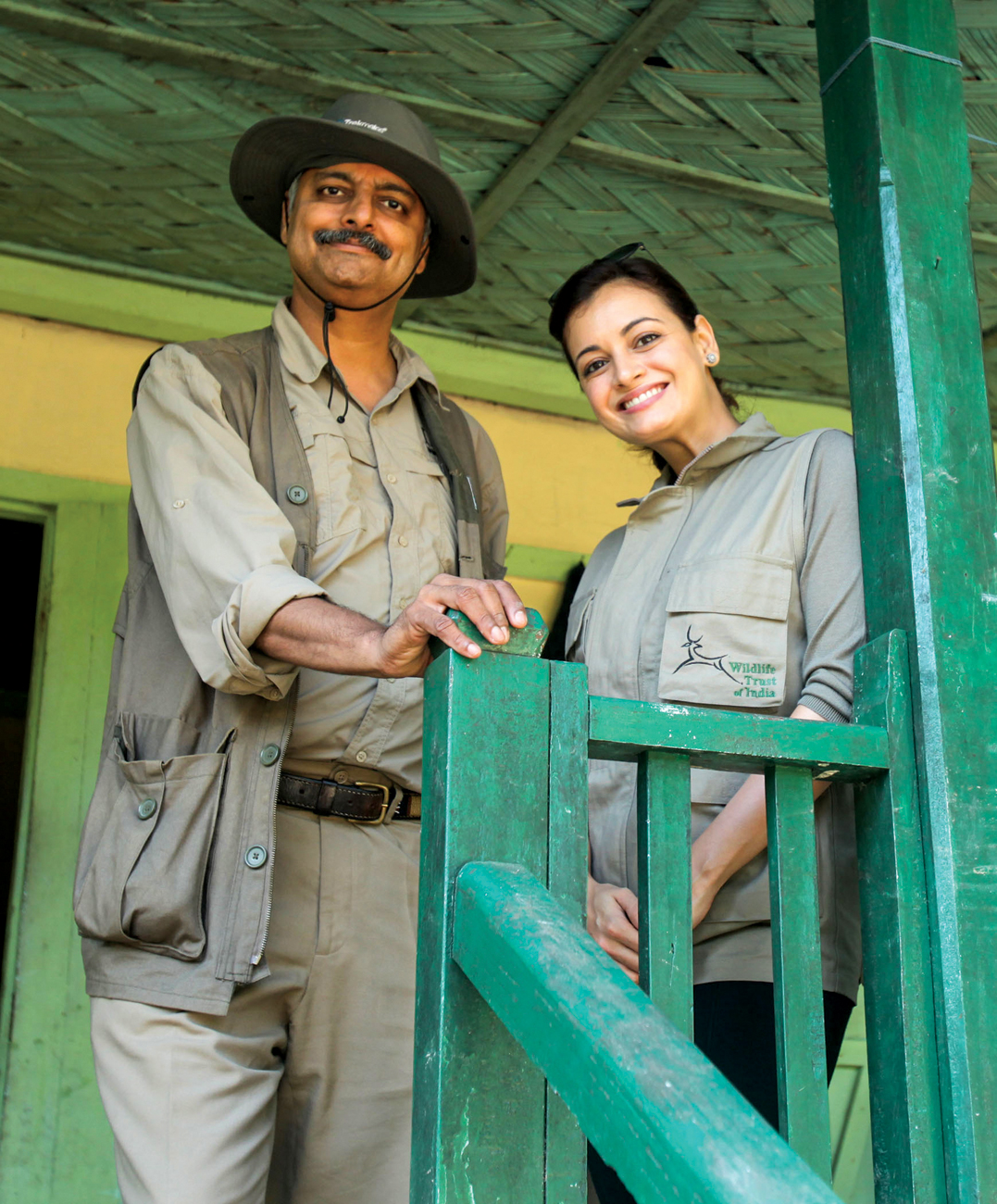
Vivek Menon with Dia Mirza, actor, climate champion and IUCN Environment Goodwill Ambassador, who also serves as the Brand Ambassador for the Wildlife Trust of India. Their collaboration has extended across several major environmental campaigns throughout India. Photo: Rupa Gandhi Choudhary/WTI.
That’s well put! How does WTI organise itself?
Our work rests on nine pillars, our Big Ideas: 1. Right of Passage 2. Conflict Mitigation and Coexistence 3. Wild Rescue 4. Natural Heritage Campaigns 5. Wild Aid 6. Protected Area Recovery, 7. Enforcement and Law 8. Species Recovery 9. Wild Lands.
And these are essentially skill sets, ranging from enforcement support and wildlife crime prevention, to species recovery and habitat restoration. We’ve run major campaigns, from protecting whale sharks, to helping to restore Manas and Valmiki. Manas, for instance, was one of the few parks that was brought out of the ‘Red List’, which won us a standing ovation at the United Nations. Over 25 years, our rescue and rehabilitation work has revealed that animals from elephants and clouded leopards to birds can be more successfully returned to the wild if hard science is part of the strategy.
Would it be fair to ask you to choose one of the pillars?
No no, very unfair! But I will tell you that my own focus was on enforcement. I began by trying to crack down on the ivory trade and rhino horn trade in TRAFFIC. I used to keep animals, so rescue-rehab has always been a deep interest because I did such things myself.
Is enforcement a dangerous job?
Enforcement is always dangerous. When Ashokji and I founded TRAFFIC, there was nothing called wildlife crime monitoring by non-government staff. Of course, forest staff have always done it, from the beginning of their careers, but they were not really trained in combating wildlife crime using a modern sense of crime fighting. They were foresters turned into accidental protectors. We had to find and train people. Ashokji and I wrote the first books on wildlife crime enforcement to train people, whether it was customs, coast guard, police, BSF or the Forest Department. Now it’s become more established.
You ensure safety by training them to avoid dangerous situations and how to defend themselves. And then hope also, because some of these are very unpredictable situations. Being a forest guard is possibly among the most dangerous professions that this country has, and India is possibly among the most dangerous countries to work in where people die invisibly every year. WTI does what it can by offering supplementary accident insurance, very quickly, without going through cumbersome bureaucracy. We have been able to distribute 574 ex-gratia payments so far. I hasten to add that the government is obligated to cover their employees with life insurance and ex-gratia payments for their families. States such as Maharashtra, Madhya Pradesh and Karnataka are responding to this imperative, but we need to speed and scale up action on this vital front.
Shifting gears, do tell us about WTI’s whale shark initiative. Could this peaceable shark do for our oceans what the tiger has done for India’s forests?
I hope so! It was one of the fastest conservation victories. Mike Pandey gave me a film to lobby for the species to be included in CITES in Santiago, where I was part of the Indian delegation. Back home in India, we roped in a hugely popular social reformer, Morari Bapu, and hired a stadium to accommodate over 5,000 people, and he said to them, “The whale shark is God, the Matsyavatar. And we are killing it.” In Gujarati, he reiterated that killing the marine animal is “Dev Hatiya, it is not killing fish.” That was it! The tide turned, and the killing virtually stopped overnight! Post that we turned to science and community outreach to ensure that the sentiment and momentum was sustained.
To follow its migratory patterns, we attached satellite tags to this, the world’s largest fish, and discovered that the Saurashtra population migrates to Africa (Somalia), not Australia as was once presumed. We put together a drama that said the whale sharks were like daughters coming back to give birth at their father’s home, and should not be killed. Fishermen are still very emotional about this. Over the years, we’ve documented pups in Gujarat, which is why we see so many whale sharks there. We did the science after we did the conservation. Which is why I believe that ‘conservation is an art’ that is greatly bolstered by science.
It helps that you are a story teller and author… and are active on social media.
Yes, I suppose. As an avid wildlife photographer, I primarily use Instagram to share my images. Years ago, I used to regularly publish in Sanctuary. My very first article appeared in Sanctuary Cub, when I was perhaps around 17 years old and my photograph graced the cover. Stories of hope are vital to conservation.
Your influence grows by the day. You are now Chair of the IUCN Species Survival Commission (SSC) for the 2025-2029 quadrennium.
Yes, it’s an honour and a HUGE responsibility. SSC publishes papers to measure the impact of conservation efforts and, while we know of many species that might well have gone extinct without direct conservation interactions, our data also reveals that conservation actions across the globe have slowed the rate of species extinction. We have by no means won the battle, but we continue to persist. For me, as an Indian, the philosophy of karma, which suggests that good deeds lead to good results, is important. Whatever the odds, we must try and do our very best.
You must feel accomplished as well as exhausted!
Yes, my life is hectic! I often work 15 hours a day, travel 25 days a month and am being pulled in every direction. But the SSC gives me both satisfaction and hope. It manages between 11,000 and 15,000 people, 220 groups, and spans diversity ranging from soil biota to elephants. The Guinness World Records lists the SSC as the largest voluntary network on Earth in nature conservation. And it’s all volunteer work. The SSC generates science and information on issues that I didn’t even know existed before I took on the responsibility. My job is to raise morale, and raise some funds. Take the big issues representationally and effectively to the highest levels of politics and to all member nations at the highest levels. The cycle of SSC states its mission as assess, plan, act! And the largest tool of species of assessment (The Red List), works to ensure this.
What does it mean to be the first Indian or South Asian person to Chair the SSC, for the region?
It’s a big responsibility for me. Since 1949, it has never been helmed by someone outside the Americas or Europe. So, yes, I’m the first Chair from the Eastern Hemisphere. I may come with a different upbringing and value system, but scientifically, we are all fashioned with a common knowledge base. The sensibilities I bring to it may have an Eastern connotation. I also bring pragmatism to the job and global forums, given as how, despite a population of 1.4 billion people, India has managed to protect species against all odds. In appointing Chairs now one objective is to ensure that the ‘rest of the world’ gets involved in leadership and has a say on issues that have naturally been skewed to the Western world, since that is where the IUCN was ‘born’. The previous IUCN Chair, my predecessor, John Paul, took conservation issues south to Venezuela. I guess I’ve taken them east.
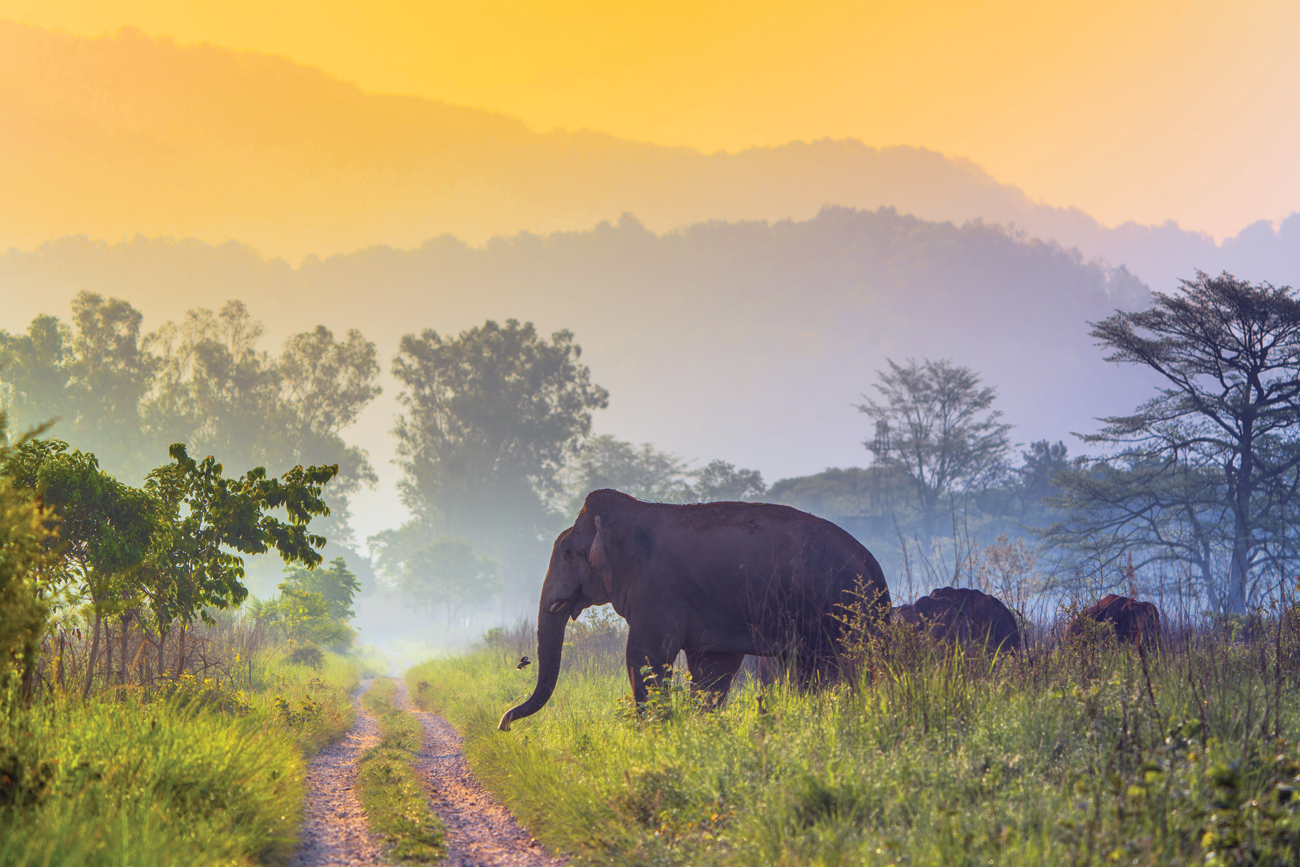
Menon’s passion for elephants has no boundaries: he helped establish Myanmar’s first elephant reserve, was a consultant to the Kenya Wildlife Services, and was Chair of the SSC Asian Elephant Specialist Group. The Wildlife Trust of India, founded by him, has been at the forefront of documenting and securing India’s elephant corridors. Photo: Kaushik Ghelani.
It must be tough coordinating so many collaborations and balancing opposing interests.
It is tough and there’s so much to be done, so many challenges. It requires pragmatism, which does not necessarily involve compromising values or morals. We have a vital job ahead of us, which literally protects all life forms on Earth. Clearly, where conservation involves geographies inhabited by communities, it’s not merely a question of partnering. The truth is those lands have been more ‘theirs’ than ‘ours’. Communities are not of a particular race or colour. Everybody is a ‘community’, where they live, where they’re born, where they have land, where they feel possessiveness and have stake in that area. So we need to win them over to have any hope of long-term success.
As for politicians, they are a representative of that community. I began interacting with the Government of India around 1990. I have paid a visit to the 25 or 27 ministers who have assumed the chair of Environment Minister. I’ve met and conveyed a common reality to them all… that I am an apolitical beast who’s there to help. I have no interest in the politics of which party has won. It is my duty to help the Ministry move the agenda of wildlife protection forward.
Your next challenge?
For now SSC is my main focus. Another term would mean four more years. A parallel challenge is the Wildlife Trust of India, which I have, in a sense, given over to my CEO, Jose Louies, for these four years. I am relying on him and the senior management team to helm what has become an important organisation in India, and I want it to be stable beyond me. It’s a great test.
How do you accomplish all you do within the same 24 hours everyone has?
Focus. Delegation. Giving up on things many people routinely do, including some things I should not have lost out on, like giving my family, as much time I should have. My focus has been work and wildlife. Virtually all my holidays are taken back to back with work, save for two to three days when I go to meet my parents on their birthdays. And then I’m back to work. I don’t switch off. It’s not considered the ideal way to live, by the way. But I manage to be productive.
Does this leave any time for hobbies?
I enjoy reading and writing. And as I grow older, I go birdwatching wherever I am. I travel across the world in search of birds and some mammals too. Ultimately, what may seem like a job to others is really my hobby too. I thoroughly enjoy my work.
Any new publications in the pipeline?
Yes, a new book on nature reserves of India is overdue, which is like my field guide Indian Mammals, but delayed because of SSC work. I’ve been working on it for about six years now but hope to finish it soon and get it ready for publication.