An Immense World
First published in Sanctuary Asia,
Vol. 46
No. 8,
August 2026
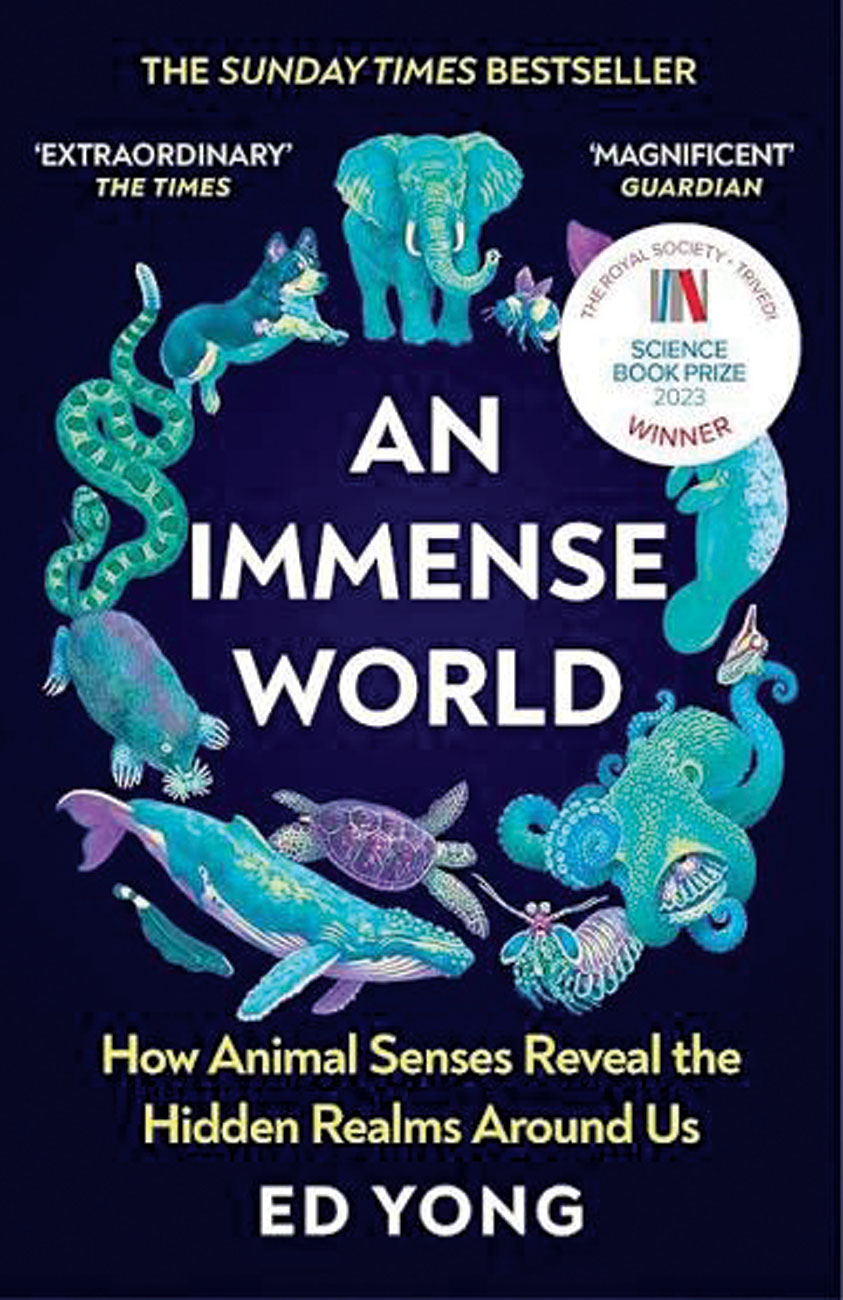
An Immense World
By Ed Yong, 2023
Published by Random House, New York
Paperback, 480 pages, Price: US$20
A stunning foray into animal senses, Ed Yong’s An Immense World is one of the best books on nature I’ve read. Virtually every page evoked a ‘wow’ in me, as the author describes the latest research into how animals – from tiny insects to blue whales – make sense of their world using taste, smell, sight, hearing, feel, echolocation, magnetic and electrical fields, and more. Even though I have been an amateur nature-buff for nearly half a century, this book surprised me to know how little I knew. But perhaps more importantly, every page was a reinforcement of my sense of wonder at the sheer innovativeness and magnificence of nature.
Yong describes the incredible echolocation skills of bats, and the sonar abilities of dolphins. In a chapter on electrolocation, we learn that the electric field of many marine animals is used not only for defense and attack, but more commonly, for making sense of their surrounds (just as we use sight, touch or sound) and for communication.
One of the most fascinating descriptions is about how birds use the Earth’s magnetic field for their astounding feats of migration. Apparently, light, entering through the eyes, causes an electron in one molecule to jump into another, and these two molecules then form a ‘radical pair’, which converts the magnetic field into a chemical stimulus that enables birds to use it for navigation. Kind of reminded me of quite a few ‘radical pairs’ in music who were able to magnify their talents manifold by collective work!
All of this and hundreds of other such revelations are packed into this book. It is not light reading, but nor is it so full of jargon and academic writing as to make it boringly pedantic. Complex scientific findings are presented without being simplistic, yet in ways that are understandable. An enormous body of literature (the bibliography is 45 pages long!) has been sifted to present the most telling facts. Also, the author brings in a sense of humour every once in a while: for instance, while noting that ladybird beetles lost their appetite when exposed to the heavy metal band AC/DC’s music, he says this ‘disproves the band’s hypothesis that “rock and roll ain’t noise pollution”’. Descriptions of his own reactions when confronted with some of the creatures he writes about – sticking his finger into an aquarium tank to be stunned by an electric catfish – enliven the narration. He generously quotes all the researchers and observers from whom he learns about the amazing abilities of animals.
Yong also notes how humans are biased towards sight over other senses, including in our use of language – for instance, he points out that “you agree with people if you see their point, or share their view”. In the chapter on echolocation, Yong meets Daniel Kish, who lost his sight completely before he was two years old. Kish has learnt how to make his way around using waves created by a clicking sound, much like bats.
One aspect I found disconcerting is that even though the sense of wonder is infused through the book, and though he even talks of the “miracle” of animal senses, Yong uses only evidence generated by modern science. Indigenous peoples and other local communities who have spent millennia amidst nature have their own knowledge systems (scientific, experiential, intuitive, and so on), and while obviously not all of what they say on the basis of these systems may be valid, surely a lot is. As modern science has also often found. For whatever reasons, he does not cite other such sources in describing the wonders of animal senses.
After 12 chapters, devoted to individual or multiple senses, Yong describes how human activity is making it harder for animals to continue doing what they’ve done for millennia. He pleads for us to bring back the dark, bring back the silence, and deal with the mess we have made of our planetary home. Otherwise, as he notes, “we are closer than ever to understanding what it is like to be another animal, but we have made it harder than ever for other animals to be.”
Unfortunately, the rather small section dealing with solutions in the last chapter was a dampener to my senses, after the rest of the book had succeeded in making them tingle. Yong only touches the surface of the problem, not confronting the structural roots of the ecological crises. Establishing areas free of damaging human activity, dealing with waste, using technology to help us better understand animal senses and so on, are necessary. But unless we challenge the very notions of development and progress that require perpetual economic growth, we will never regain the sense of wonder and respect towards the rest of nature. These notions have evolved with western colonialism and the capitalist economy, themselves founded on patriarchy, promoting the ideology that humans are somehow separate from nature. The last couple of centuries have seen the division of the world into hostile nation-states, with hard boundaries that disrupt natural and cultural flows, and conflicts that have devastating consequences for wildlife and humans. Enabling the rest of nature to sustain and revive its incredible diversity, necessitates challenging these roots of the crises, and evolving alternatives in politics, economy and society.
One crucial part of this is recognising the historical and continuing role of Indigenous peoples and other local communities in ‘living lightly’ on the earth, co-existing with the rest of nature as family rather than as material objects to be exploited, and evolving sophisticated systems of knowledge and wisdom that enable such co-existence. This is linked to the point I made above regarding Yong using only modern science as evidence. This also means that rather than blame an undifferentiated human species, we locate the problem in those sections that are driven by powerlust and financial profit, and solutions in those who have escaped succumbing to greed or are actively resisting it. Without such nuanced analysis and action that follows from it, we will continue to bemoan the loss of nature’s wonders, but not be able to stem this loss.
Reviewed by Ashish Kothari, Kalpavriksh and Vikalp Sangam in Pune.