Endemic Bats Lost in oblivion?
First published in Sanctuary Asia,
Vol. 33
No. 8,
August 2013
By Rohit Chakravarty and Rohit Jha
When we set out on our weekend search, we just had a few things in hand – a description of two specimens, incomplete GPS coordinates, which would land us in an unknown location near Kolar, and the bleak hope that we still have not lost the endemic bats which we were in search of.
The Kolar leaf-nosed bat Hipposideros hypophyllus was discovered in 1994 by taxonomist Dieter Kock and ecologist H.R. Bhat. Endemic to south India, the flying mammal is known from only two localities in the Kolar district (Hanumanhalli and Therhallli) and one in Mysore – both in Karnataka. Individuals were collected from a narrow subterranean cave in granite rocks and the roost was found to be shared with three other species – the fulvous leaf-nosed bat H. fulvus, Schneider’s leaf-nosed bat H. speoris and dusky leaf-nosed bat H. ater. In Bats of the Indian Subcontinent, Bates and Harrison provided morphological and anatomical descriptions of two specimens deposited at the British Natural History Museum. This was the only reference material available to date, apart from brief notes on the ecology of the species by Kock and Bhat. In 2002, the Conservation Assessment and Management Plan (CAMP) workshop, organised by Zoo Outreach, Coimbatore, came up with a detailed report on the status of South Asian bats, but little light was shed on the current status and distribution of the Kolar bat.
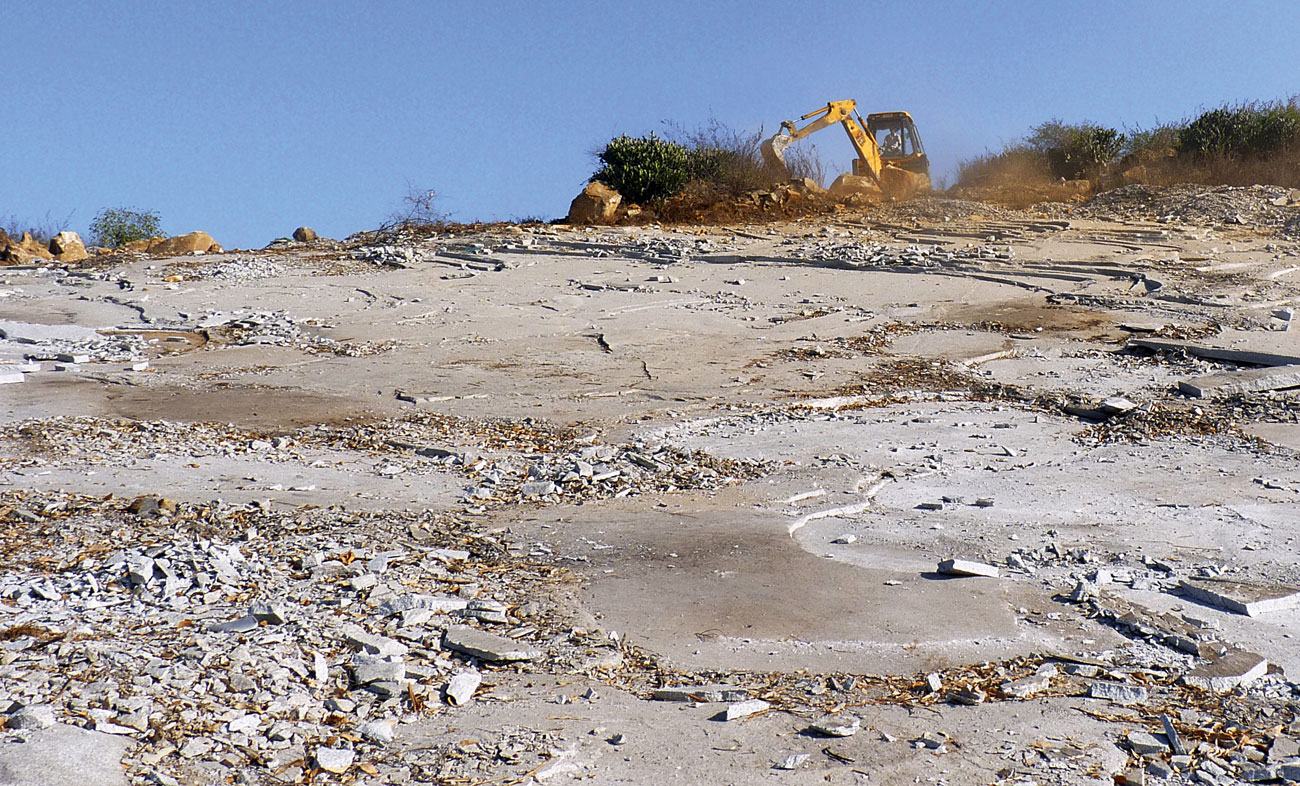
A JCB excavator near the caves at Hanumanhalli, a village about 15 km. from Kolar, exemplifies the threat of granite mining while the unaltered terrain on the far side of the mined surface, reveals a waterbody and the pristine landscape needed by the endemic Kolar leaf-nosed bat, known from caves in only two localities in the Kolar district Hanumanhalli and Therhalli and one in Mysore. Photo: Rohit Jha.
Does The Bat Even Exist?
It was to answer that question that we embarked on a trip in January 2013 to Hanumanhalli (15 km. east of Kolar town). This was the village where the Kolar bat had been found and described. After a few hours of walking through the countryside and enquiring with locals using what were the only two words we knew in Kannada – guhe (caves) and bavuli (bats), often literally having to enact a cave sequence, we arrived at a monolithic granite structure in the possession of granite miners. They pointed us toward two narrow subterranean caves from which the strong stench of guano suggested the presence of bats. As we belly-crawled along the sloping, guano-littered cave floor as far as the narrow width of the cave permitted, we spotted a colony of about 200 leaf-nosed bats in the beam of our torch lights. Most of the bats that we managed to photograph were fulvous leaf-nosed bats, but we knew that in such large colonies, assemblages of two or more species were likely, including Schneider’s, dusky and Cantor’s leaf-nosed bats H. galeritus.

A JCB excavator near the caves at Hanumanhalli, a village about 15 km. from Kolar, exemplifies the threat of granite mining while the unaltered terrain on the far side of the mined surface, reveals a waterbody and the pristine landscape needed by the endemic Kolar leaf-nosed bat, known from caves in only two localities in the Kolar district Hanumanhalli and Therhalli and one in Mysore. Photo: Rohit Jha.
However, the important question remained unanswered. After 19 years of non-discovery, did the Kolar bats still exist in these caves? More importantly, with granite miners at their doorstep, would they survive tomorrow even if they were rediscovered? Some labourers said bats used to be present a long time ago and added that granite mining had been going on for 35 years. We found it difficult to accept such a claim, since the mine would surely have been exhausted if extraction had been going on for that long!
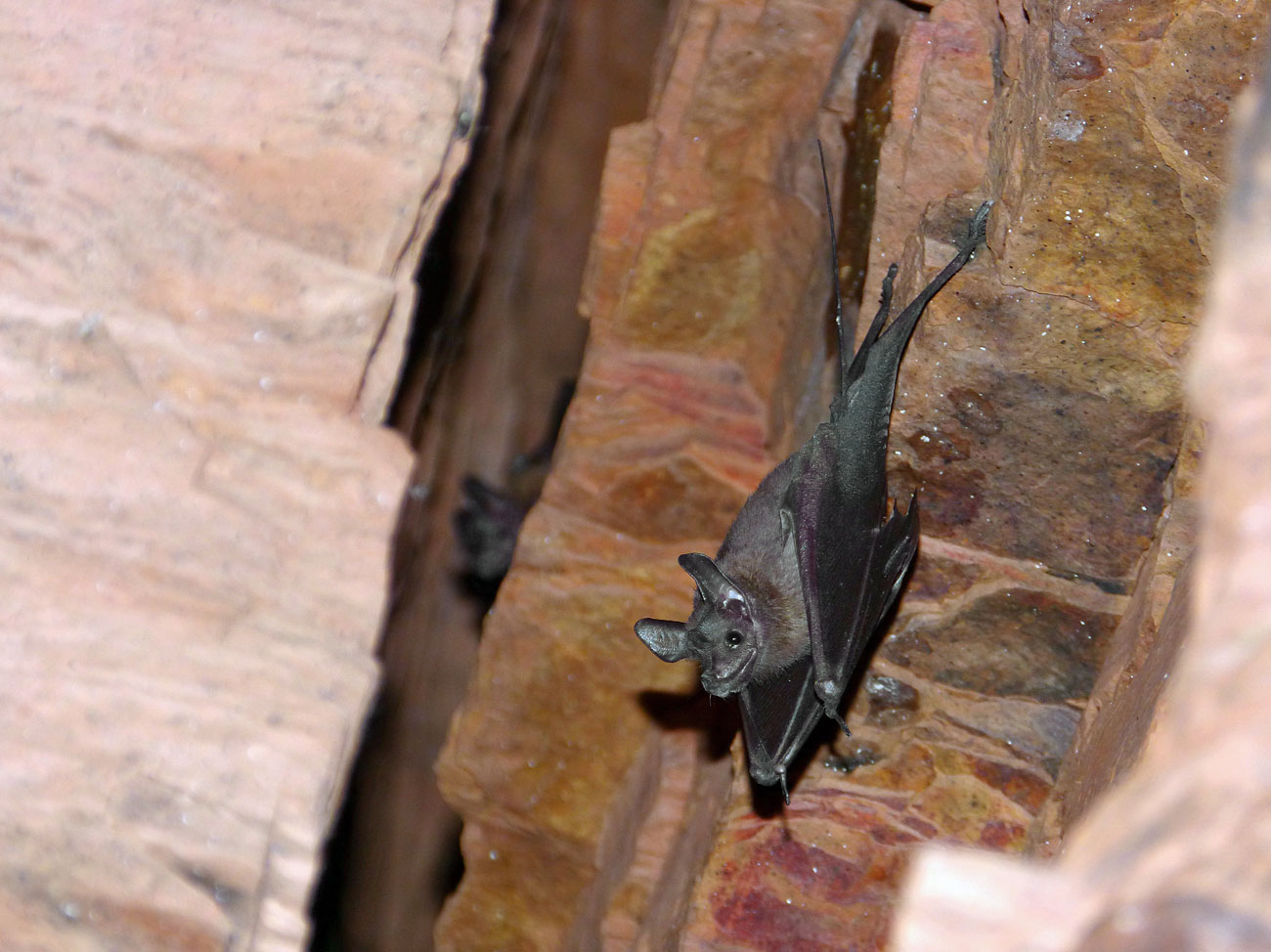
A lesser mouse-tailed bat Rhinopoma hardwickii seen by the authors, in one of the caves they explored. Photo: Rohit Chakravarty.
In any event, we could see that it would not be long before the miners reached the base of the hill and broke into the cave. If perchance the Kolar bat is rediscovered in these caves, urgent protective steps would be vital. Unabated granite mining should in any event be stopped to protect their diurnal roosts, and and other potential roosts need to be identified by further explorations.

This colony of rufous horseshoe bats Rhinolophus rouxii was photographed at Sakleshpur in Karnataka. Bat roosts, may consist of hundreds of bats of more than one species. They choose places away from light, noise and predators at sites such as caves, mines, cellars and service tunnels. Photo: Shashank Dalvi.
More Species In Danger
Despite being the most species-rich mammalian order in India, bats have received scant attention. And being forgotten is not a fate reserved for the Kolar bat. The Khajuria’s leaf-nosed bat Hipposideros durgadasi, was discovered in 1970 from the Katangi village in Jabalpur district (Madhya Pradesh). In 1980, Dr. H. Khajuria found another population near Richhai in the same district. The bats were found in artificial caves at an altitude of 200 m. and were also collected from narrow, dark passages between huge granite boulders. Dr. H. Khajuria estimated the population to be about 200 mature individuals. Since then, the species has remained in oblivion. Whether the habitat and colony still exist is anybody’s guess. The 1996 IUCN Red List categorised the species as ‘Vulnerable’. In 2008 it was pushed to ‘Endangered’ because of its restricted range. Despite such international recognition, it has failed to win the protection accorded to the famed Wroughton’s free-tailed bat Otomops wroughtoni and Sálim Ali’s fruit bat Latidens salimalii – the only two Schedule I species of bats under the Wildlife (Protection) Act, 1972.
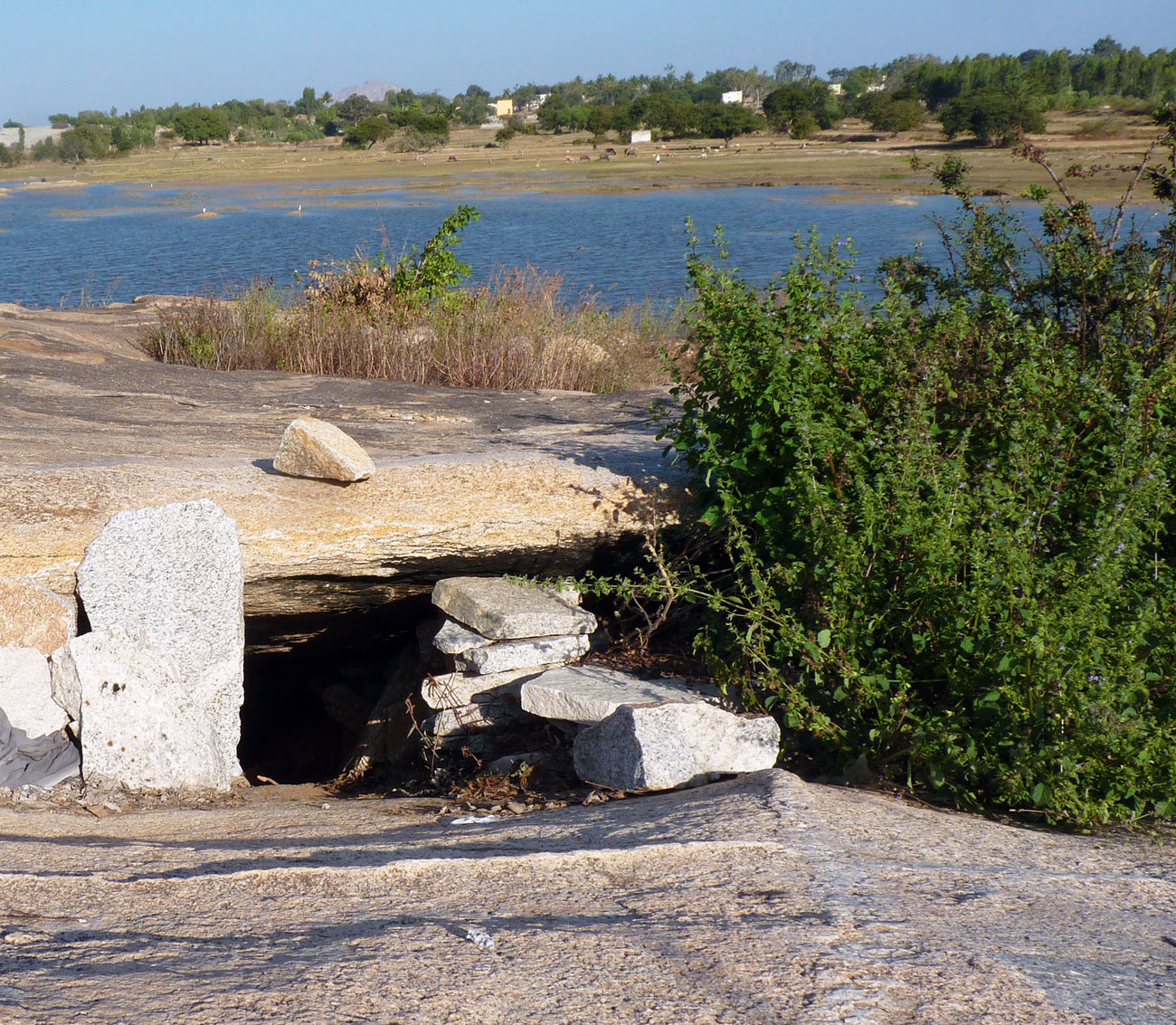
One of several subterranean granite caves at Hanumanhalli. The Kolar leaf-nosed bat has not been spotted for 19 years and the authors worry that even if they are found, granite mining might put paid to any hope of a recovery. Photo: Rohit Jha.
Similar, or perhaps worse, is the fate of the Peter’s tube-nosed bat Harpiola grisea. This is probably the rarest of all Indian bats, known only from the specimen collected in Jeripanee in Uttar Pradesh (now Uttarakhand) in 1872, at an altitude of c. 1700 m. The 2002 CAMP workshop report stated that its locality has undergone drastic development. It was proposed that Peter’s bat be listed as ‘Critically Endangered’ but it was subsequently categorised as ‘Data deficient’ under the 2012 IUCN Red List. Like the Kolar bat and the Khajuria’s bat, this species has not yet received protection under the Wildlife (Protection) Act, 1972.
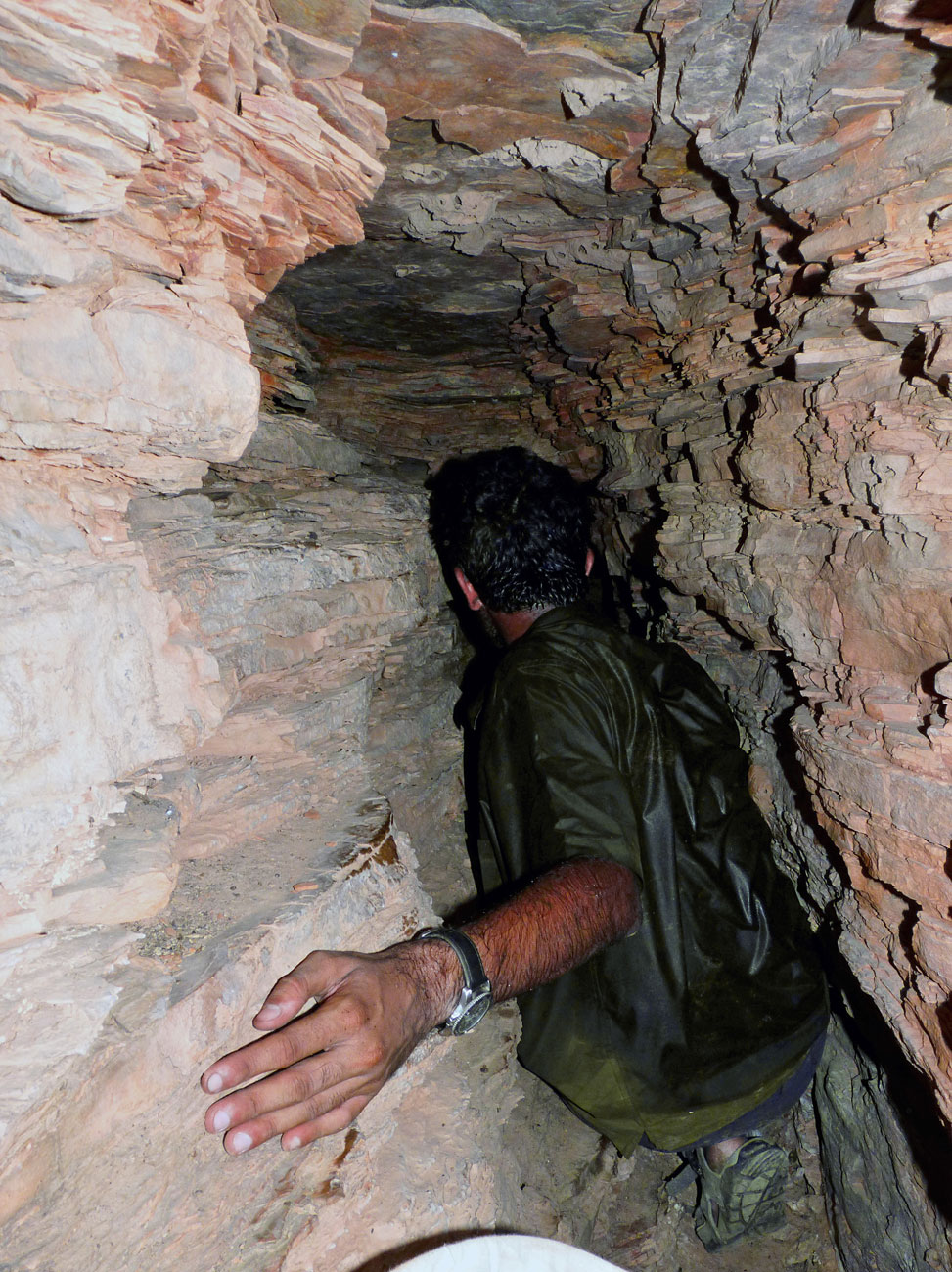
The author, Rohit Chakravarthy, is seen entering one of the narrow subterranean caves, in search of the Kolar-leaf nosed bat. Photo Courtesy: Rohit Chakravarty.
What we have described for the benefit of Sanctuary readers relates only to the fate of three of our endemic bats. But we fear this is a true representation of many other species which though discovered, remain unknown or ‘data deficient’ because they are out of sight and out of mind. If they have survived so far, it would take very little effort to nurture them back to some semblance of security. It would be unfortunate if these species were to go extinct. It is one thing to lose a species while you are trying to protect it, and somehow even sadder to lose it having never known it existed.
Rohit Chakravarty and Rohit Jha Students of MSc Wildlife Bilogy and Conservation WCS-India Programme of National Centre for Biological Sciences (NCBS) Bangalore. Chakravarty's interest lie in the study of bats and birds, while Jha is fascinated by arthropods.