Un-zoning Kaziranga’s Wilderness
First published on
October 05, 2026
By Anushka Kawale
Nature cannot be confined by boundaries. Animals move year-round and seeds disperse without regard for the land beneath them. That is what makes them wild. Kaziranga National Park and Tiger Reserve, a UNESCO World Heritage Site protecting a key floodplain of the Brahmaputra, is no exception. It holds the world’s largest population of greater one-horned rhinos, along with elephants, wild buffalo and the Bengal Florican. Communities also call this landscape home, depending on agriculture, eco-tourism, fishing and other nature-based livelihoods.
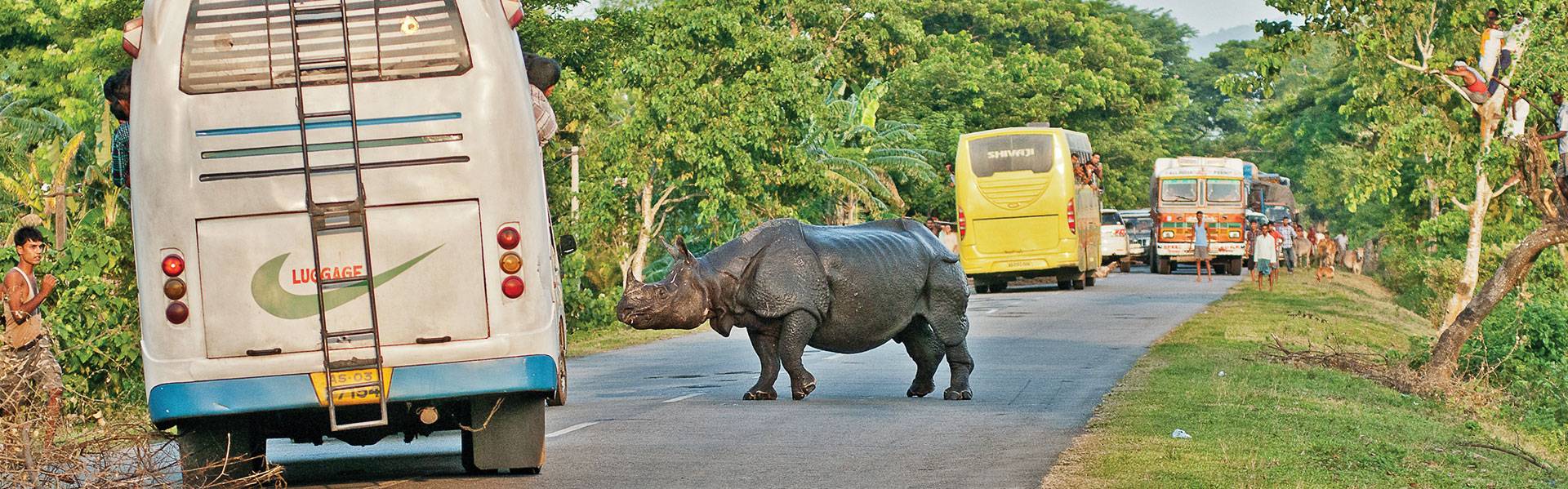
My introduction to it in 2024 was full of wonder. Great Hornbills fill the skies on a normal day and the melodic call of the hoolock gibbon, India’s only ape, which inhabits the adjacent Karbi Anglong Hills, reverberates at dawn. During the annual floods, animals cross National Highway 715 to reach refuge in those hills. As the state government rains changes upon a landscape already under tourism pressure, the fate of this complex, socio-ecological system hangs in the balance.
Defining Limits
The Environment (Protection) Act, 1986 recommends marking up to 10 km. around Protected Areas as an Eco-Sensitive Zone (ESZ), which prohibits destructive projects such as mining, quarrying, polluting industries, unsustainable tourism and the discharge of hazardous waste and untreated effluents. In Assam, the ESZ has been notified for Nameri National Park and Sonitpur-Rupai Wildlife Sanctuary. The state must also prepare a Zonal Master Plan (ZMP) for the ESZ, in consultation with local communities and government stakeholders, to keep activities eco-friendly and livelihoods sustainable.
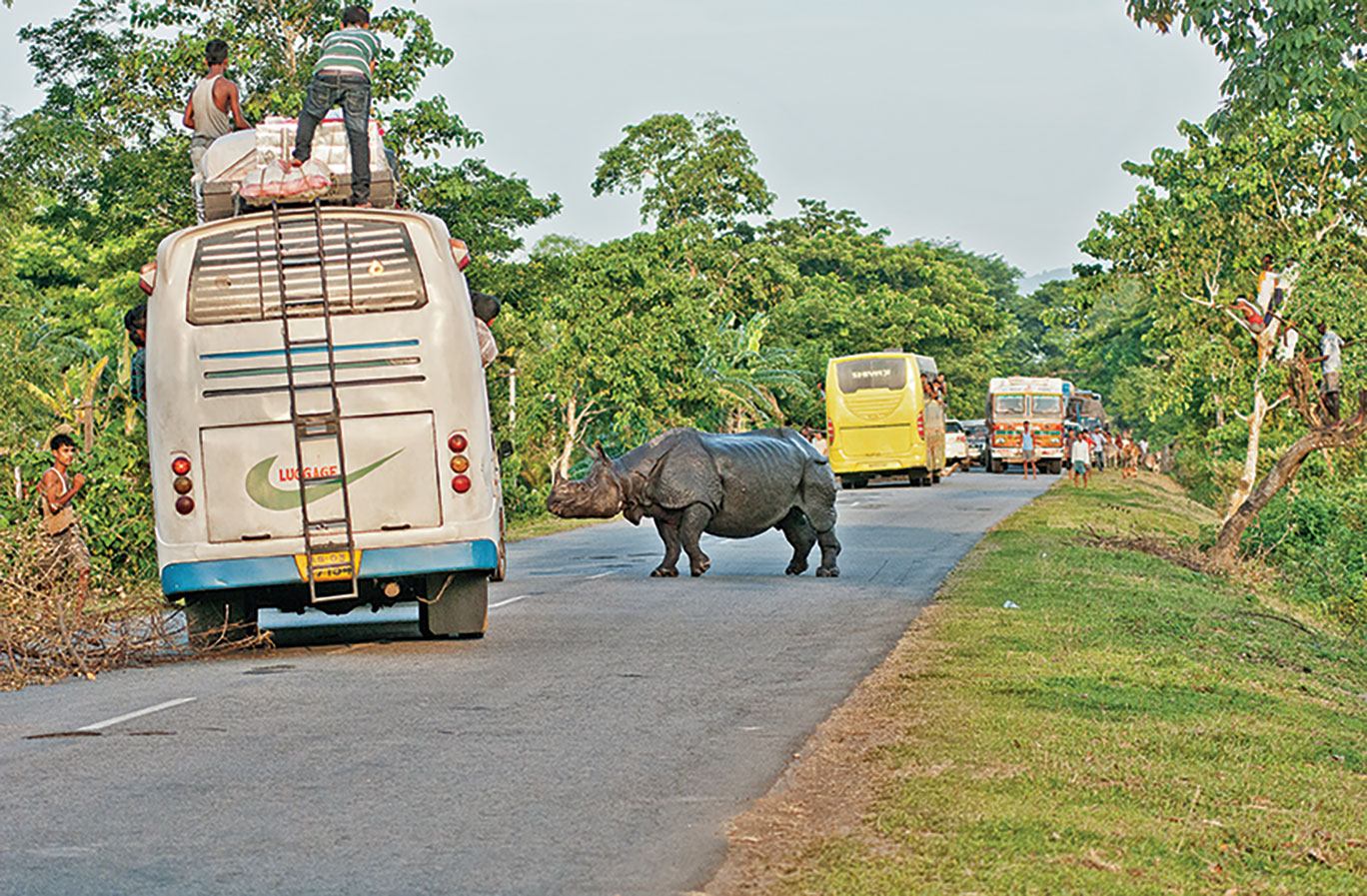
During the annual floods, animals cross National Highway 715 to seek refuge in the Karbi Anglong hills. Photo: Samsul Huda Patgiri.
Tourism For Conservation?
Tourism has brought revenue to sustain the Protected Area, but rising footfall threatens the ecosystem and local livelihoods. On July 13, 2026, Pranab Doley, a human rights activist with the Greater Kaziranga Land and Human Rights Protection Committee, was arrested for protesting a proposed five-star hotel by Juniper Hotels at Inglay Pathar, less than a kilometre from the park, where local communities have farmed for generations. The government acquired the land by evicting 20 families in 2024; ironically, an Adivasi heritage museum is planned alongside the hotel. In June this year, the Guwahati High Court issued notices to the Assam Tourism Development Corporation over the evictions and heard petitions, Down To Earth reported.
A day after he was granted bail, Doley was detained under the National Security Act (NSA) and remains in police custody. NSA detention is an administrative preventive measure: he cannot file a standard bail application and can be held for up to 12 months without formal charges. His fight against land acquisition for a hotel unlikely to benefit local people has run for years. Over 60 civil rights groups across India, along with international groups such as the International Land Coalition and the International Work Group for Indigenous Affairs, condemned his arrest.
Weeks after his arrest, the state government proposed to notify an ESZ of one kilometre. This decision received public scrutiny and was flagged by many environmentalists and organisations, including the IUCN. The state government later clarified that the ESZ area may vary based on ecological relevance and to balance economic development in the region, and that it will set up an expert panel to review the process. For instance, an urban town such as Bokakhat, which is situated within a kilometre away from the park, need not have an ESZ of 10 km. But this debate has drawn attention to the larger purpose of an ESZ in protecting the critical habitat, which areas it should aim to protect, and the impact of the expanding tourism industry on the landscape.
Doley’s detention brought Kaziranga’s troubles to national news, but they ran wider. Activist and independent researcher Saurav Patgiri says most hotels and resorts nearby flout environmental norms by discharging untreated sewage and lack robust waste management. Many are not locally owned, so tourism does not directly benefit local people, and luxury hotels outcompete local homestays, eventually hurting livelihoods. Illegal quarrying also threatens the Karbi Anglong hills less than a kilometre from the park, in areas frequently used by elephants and other wildlife. Patgiri says the ZMP must be prepared in rigorous consultation with communities and their needs. He and other activists are fighting for Doley’s release and demanding that Kaziranga be protected from unsustainable tourism.
Next Steps
Aaranyak, one of the most respected wildlife research and conservation NGOs in Northeast India, recommends that the ESZ should be determined scientifically and be legally compliant, taking into account Environment (Protection) Act, 1986, and the Environment (Protection) Rules, 1986. Since Kaziranga is a tiger reserve, the areas under the ESZ must form a legal and ecological baseline and comply with the Supreme Court’s judgement of November 2025 on including the buffer and fringe areas of tiger reserves. Aaranyak strongly suggests that the ESZ must consider various social aspects such as existing settlements and civic requirements, tourism-related activities, development aspirations of local communities, and human-wildlife coexistence needs. It also highlights the landscape's unique hydrology as it is a floodplain ecosystem, and that the government should swiftly accommodate its varying nature.
Dr. Varun R. Goswami, Co-Founder and Director of Conservation Initiatives (CI), a non-profit dedicated to science-based, participatory wildlife conservation in Northeast India, says the social or ecological role of areas adjacent to Kaziranga National Park varies. “Long-term plans must consider the Kaziranga-Karbi Anglong landscape as a continuous, critically important system. A scientific and objective process of identifying the ESZ can prioritise locations that are vital to sustaining the ecological health and integrity of Kaziranga,” he says.
In a paper published in 2019 based on a collaboration with the Assam Forest Department, Dr. Goswami and colleagues estimated over 1,700 Asian elephants in the park and adjoining areas, and showed that Karbi Anglong forests as far as 14.5 km. south of the Protected Area support them. “This underscores the need to consider a large ESZ for areas of high ecological priority, such as the forests of Karbi Anglong,” he said. A 2021 paper led by him, built on intensive wildlife surveys along the park’s southern boundary, to locate critical areas for wildlife movement to and from Karbi Anglong in both the dry and flood seasons. Maps produced for most large herbivores of Kaziranga identify priority locations for movement, in addition to the designated animal corridors. "CI is ready to offer technical support to incorporate such insights and help plan an ESZ that ensures a win-win outcome for Kaziranga’s people and wildlife.” he added.
What You Can Do
The ESZ could determine Kaziranga’s future. Protecting it will ensure prosperity for the human and non-human world. We implore you to share your concerns with the Environment Minister (mefcc@gov.in), Environment, Forest & Climate Change Department, Government of Assam (efcc-dept@assam.gov.in) and Chief Minister of Assam (cm@assam.gov.in), and politely request them to:
Establish the ESZ through a science-backed approach that ensures ecological connectivity beyond the boundaries of the park, in consultation with scientists and organisations who are willing to offer support and technical advice for its conception.
Monitor tourism activities, ensure appropriate waste management measures, and strengthen locally-led tourism initiatives.
Regulate destructive activities such as illegal quarrying.
Release Pranab Doley, consider the genuine requirements of the people of Kaziranga, and strengthen life-saving wildlife corridors.
The Assam government has objected to a PIL in the Guwahati High Court, stating that the ESZ is still under consideration. Activists and experts fear a rampant rise in illegal quarrying and now mining, after the Geological Survey of India discovered rare earth minerals in the Karbi hills. If ecologically crucial areas are left out of the ESZ, it may invite such activities and fail to secure the ecological connectivity the landscape has ensured since the park’s establishment.