Protecting Gujarat’s Pride
First published on
August 06, 2026
A Sanctuary Report, Compiled by Shatakshi Gawade
The far western end of our country is the only home of the Asiatic lion Panthera leo leo. Yet, the majestic cat is not safe here. Here a people’s campaign is brewing quietly, for the rights of the lion and the enforcement of appropriate legal procedures.
Three concerns have emerged recently in the Asiatic Lion Landscape. One, a mining contract is to be allegedly awarded to a cement factory in the Reserve Forest in Babarkot, which is home to one of the nine satellite populations of lions mentioned in the 16th Lion Population Estimation 2025 Report. There are 21 lion corridors mentioned in the Gir National Park and Wildlife Sanctuary Management Plan, a legal document prepared under the framework of the Wildlife Protection Act, 1972. This area is corridor number 20. The official records note about 50 lions (including cubs and lionesses) in this 75 ha. region of Gir East in Amreli district, making it a ‘satellite IV lion population’ according to the official document of lion population estimation 2025, published by the Wildlife Division, Sasan Gir. The proposed mining approval will uproot about 5,500 trees, many of which are mature and ecologically valuable species such as khejri, karanja, peepal, neem and banyan. Mining in this area is also likely to trigger saline water ingress. Yet, the Deputy Conservator of Forests (DCF) has submitted a positive report for the mining proposal and sent it to higher authorities. Under the provisions of the Forest (Conservation) Act, 1980, the Principal Chief Conservator of Forests (Land) can approve the diversion of Reserve Forest land, based on the report of the concerned DCF, by allocating compensatory land elsewhere, but only if the diversion is in public interest. However, according to sources, forest land cannot be diverted for mining by a cement company. The DCF’s report has reportedly stated that the area is “not a lion corridor,” sources added. For almost a decade, say sources, previous DCFs had refused permission for such a disastrous proposal; however the current DCF has sadly allowed it to proceed, report multiple sources.
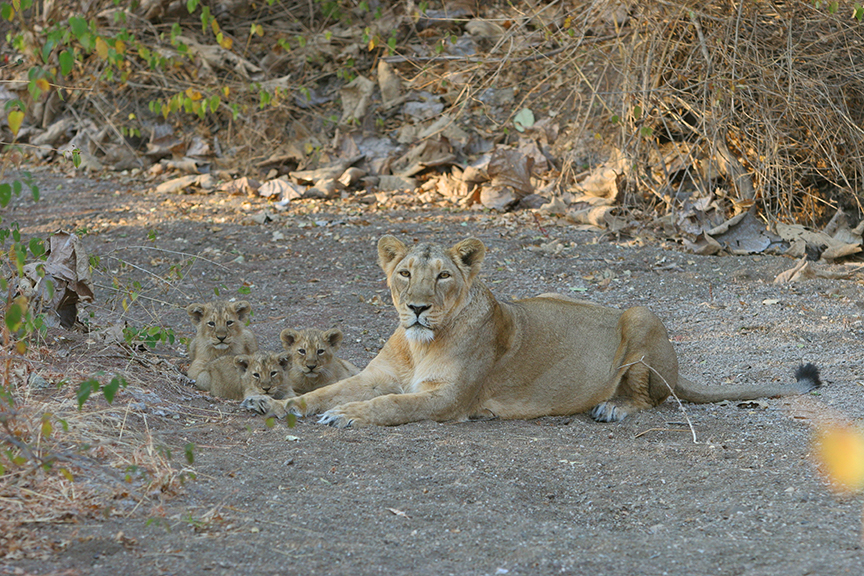
A lioness and cubs rests together. The lions are doing well for now, but when these cubs grow to adulthood they will need a secure home in which to live. Photo: Bhushan Pandya.
The diversion of a thriving lion habitat and also an active corridor will displace the lions, pushing them into life-threatening situations of human-animal conflict. If the lions move towards Jafrabad or Pipavav Ports, they would be susceptible to collisions on railway tracks, or would be exposed to accidents on the coastal national highway. If they overlap with other lions’ territories, they will be exposed to conflicts. Environmentalists have appealed that the Reserve Forest in Babarkot not be disturbed. The conflict, in fact, has already reached people’s doors. Mayank Bhatt, the Founder of the voluntary organisation ‘Save Lion’, shared that lions have been entering villages and can be seen right outside people’s homes. In a tragic incident in early June 2026, a lioness and her two cubs, whom she appeared to be training to hunt, picked up a six-year-old boy of labourer parents from a field. The standard operating procedure to manage lion-human conflicts should involve local communities, insists Bhatt, who has created an exhaustive document to address such tragedies. MLA Hirabai Solanki and the Sarpanch of Babarkot village have also spoken in favour of the lions and objected to the land diversion at Babarkot. What activists say is simple: “It is both our sentiment and demand that this habitat should not be disturbed.”
Another issue, the possible return of the Maldharis, an Indigenous pastoral community, in the Protected Area has also raised some worries. The Maldhari relocation was a contentious issue when Gir was declared a national park. In the 1970s, the government began the plan to voluntarily resettle Maldharis from the Gir National Park and Sanctuary by providing compensation. In a 1996 article Down to Earth reported that “there has neither been an attempt to assess the impact of the people on the ecosystem, nor have the traditional rights of the people been recognised, before embarking on the project.” Maldharis live in a ness, a traditional pastoral settlement of four or five households, and earn a living by rearing livestock for the sale of milk products. However, some sources, who wished to remain anonymous, shared that an affluent member of the community plans to go back to living in his ness. Some activists fear that this could be an attempt to tap into ‘ness tourism’ and believe that the entry of even one person could open the gates for many to return to their settlements inside the Protected Area, impacting the current dynamics. According to The Gir Management Plan, there is no provision to issue permit/s to Maldharis to return to Gir. Accordingly, the permission given by the DCF is illegal, suggest sources.
The third issue is the expansion of resorts into the PA, and the related sound and solid waste pollution. One particular resort near Dhari, within a Reserve Forest area near Khicha village has allegedly been built on land approved for non-agricultural use, such as residential purposes, yet is being used commercially as a resort. Activists allege that a new road was constructed through Reserve Forest land for its benefit, damaging the rewilding efforts of the Forest Department in 2024-25. The boundary wall of the forest was allegedly demolished to facilitate access by vehicles, they say.
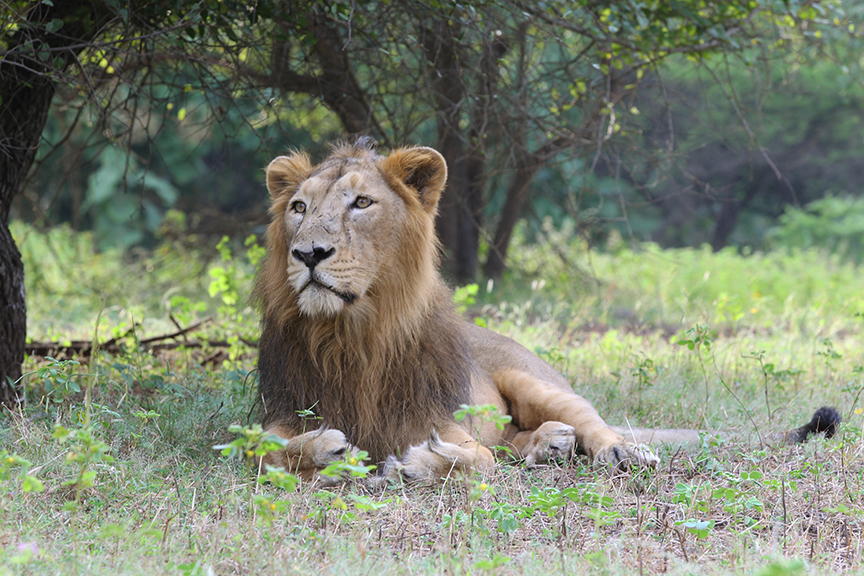
A lion surveys his habitat in Gir. Photo: Bhushan Pandya.
The Asiatic Lion Landscape
By Dr. Anish Andheria
Globally, large carnivore populations have declined rapidly in the past two decades. However, the growth in Asiatic lion population in India during the same period is one of the most phenomenal conservation success stories on Earth. Until the late 1980s, Asiatic lions were restricted to the Gir Protected Area (1,800 sq. km.), however, by 2020 they dispersed to occupy approximately 30,000 sq. km. of Saurashtra. This dispersal in the areas adjoining the Gir PA led to the coining of the term Greater Gir Region to focus attention on lions outside the PAs.
Today, the lion population is characterised by source-sink dynamics with the Gir PA and the adjacent Pania Wildlife Sanctuary serving as a source while seven satellite populations: 1) Girnar Wildlife Sanctuary, 2) Mitiyala Wildlife Sanctuary, 3) South-western coast (Sutrapada-Kodinar-UnaVeraval), 4) South-eastern coast (Rajula-JafrabadNageshree), 5) Savarkundla-Liliya and its adjoining areas of Amreli,
6) Bhavnagar mainland and 7) Bhavnagar coast, acting as a sink.
The connectivity between these habitats is maintained through corridors of semi-contiguous forest patches, fallow lands that enable lion movement at night and riparian habitats. The entire landscape encompassing the Gir PA and Greater Gir Region is termed the Asiatic Lion Landscape, covering nine districts in Saurashtra.
Lions are not restricted to the boundaries of the Gir Protected Areas, they are now found in the extended Asiatic Lion Landscape (ALL). A management plan exists for the Protected Area, but not for this extended territory that the lions occupy. In 2020, senior wildlife photographer Bhushan Pandya, then a member of Gujarat’s State Board for Wildlife (SBWL), had recommended to the SBWL that a Management Plan be made for Greater Gir. Mayank Bhatt has now filed a PIL in the High Court asking for a management plan that encompasses the entire Gir Lion Landscape, but no action has been taken yet.
These three issues are the tip of the iceberg. They are a representation of the alleged malpractices of the Forest Department, shared concerned citizens, adding that such permissions will trigger a chain reaction for further habitat loss because of fragmentation. A suo motto PIL 284/2014 in the Gujarat High Court is ongoing, and all these matters are contempt of court, add activists. Five present and two former members of the SBWL have written to all concerned authorities at Centre and State, including the Prime Minister of India and Chief Minister of Gujarat regarding these three serious matters. Activists hope the matter will be incorporated soon in the PIL proceedings.
These three issues could become a gateway for the painful degradation of Gir by a thousand tiny cuts. We urge Sanctuary readers to write to the India’s Environment Minister (mefcc@gov.in), Gujarat’s Forest Minister (min-forest@gujarat.gov.in), Forest Department (pccf-forest@gujarat.gov.in), and the Chief Minister of Gujarat (sec2cm@gujarat.gov.in) and politely request them to:
. Protect lion corridors by opposing development projects that fragment or destroy critical habitats.
. Support stronger enforcement of environmental and wildlife laws before approving projects in ecologically sensitive areas.
. Advocate for a management plan that safeguards the entire Asiatic Lion Landscape, not just the Protected Areas.
. Promote community-based conservation to reduce human-lion conflict and encourage coexistence.
. Encourage responsible development and tourism that minimises disturbance, pollution, and habitat degradation.
Shatakshi Gawade is the Senior Editor at Sanctuary Asia.