Trees Of Life
First published on
June 23, 2026
By Kedar Gore
My fondest memories are from childhood summer vacations spent in Dorle, my maternal village in Ratnagiri. Nestled in the densely forested hills of Konkan, Maharashtra, Dorle is wrapped in towering trees and lush vegetation that form a rich emerald canopy. In those days, travel meant boarding a state transport (ST) bus from Parel in the evening and arriving in the village at dawn.
The first thing to greet us was a magnificent peepal tree Ficus religiosa, often hosting a pair of Malabar Pied Hornbills Anthracoceros coronatus. Happily, the tree still stood strong during my 2025 visit, just as it had during my first trip in the early 1980s. I have never passed it without touching its trunk and quietly thanking it for being a trusted companion and for the countless ecological services it has provided over the decades.
This grand old tree fascinated me and sparked a lifelong love for trees. The journey of nature exploration that began in Dorle has since taken me across many of India’s forested landscapes. My hippocampus is filled with vivid memories from the ancient forests of sacred groves in the Western Ghats and the salt-tolerant mangroves of the Sundarban, to the towering deodar-oak forests of the Himalaya, the old deciduous forests of the Aravalli Mountains, the rainforests of the Northeast, and the thorny savannahs of the Deccan Peninsula. Every tree stands as a custodian of the health and well-being of these landscapes and their people.
From swinging on the hanging roots of a giant banyan Ficus benghalensis in Dorle, to resting against the massive buttress roots of a red silk-cotton Bombax ceiba in Nameri; from watching the whirling seeds of sal Shorea robusta drift onto the forest floor in Kanha, to walking through the dense stilt roots of myristica trees in Hewale village, Maharashtra, every ‘tree moment’ has been special and unforgettable.
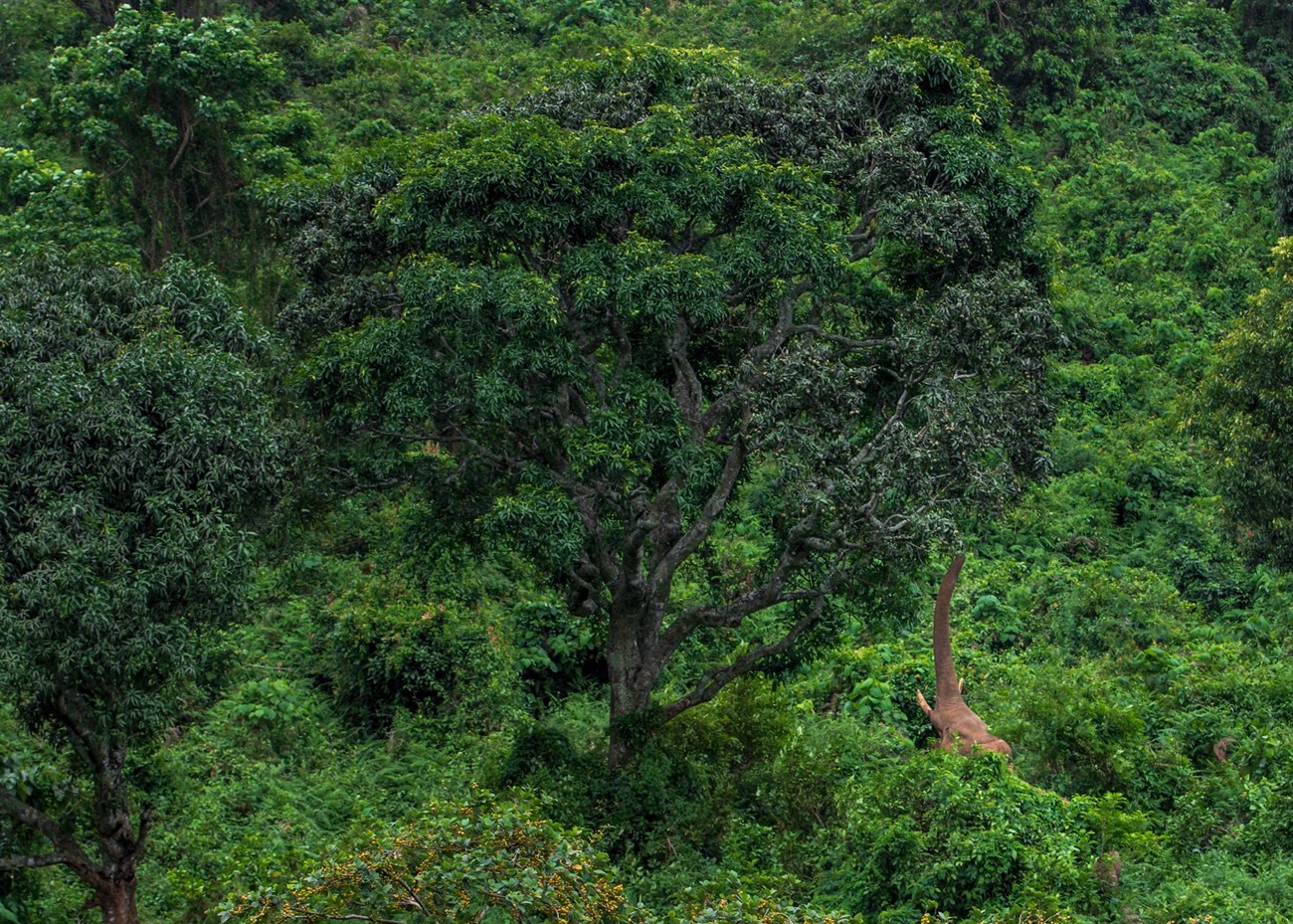
An elephant feeds on fruit from a wild mango tree in Nelliyampathy, Kerala. Trees are far more than silent backdrops, they sustain forests and the intricate web of life they support. Without trees, these ecosystems would simply collapse. Photo: Anish Achuthan/Sanctuary PhotoLibrary.
Which Tree Was That?
In India, a land of exceptional ecological diversity, trees have nurtured civilisations, sustained ecosystems and supported cultures for millennia. They complete landscapes aesthetically and ecologically, and connect the air, soil, water and all living beings into an intricate web of ecological interdependence. Trees form the backbone of forest ecosystems, creating structural complexities with multiple layers of canopy and the understorey that support biodiversity, most of which depend directly or indirectly on trees for food, shelter or breeding. Every tree species stamps its signature on the landscape with its peculiar shape, branching pattern, bark texture, flower, fruit, and seasonal transformations. The bright pink-red foliage of the kusum Schleichera oleosa, fiery vermilion inflorescence of the palash Butea monosperma, the magnificent drooping yellow flowers of the amaltas Cassia fistula, the coppery young leaves of the mahua Madhuca latifolia and the eerie white leafless branches of the ghost tree Sterculia urens are some striking examples. Sal, red silk-cotton, chir pine Pinus roxburghii, teak Tectona grandis, and palmyra palm Borassus flabellifer trees rise tall and straight; while banyan, mango Mangifera indica, haldu Adina cordifolia, and deodar Cedrus deodara spread their branches generously like a wide, warm embrace. Mid-canopy trees such as ber Zizyphus mauritiana, kanchan Bauhinia purpurea, dhonk Terminalia pendula, wild guava Careya arborea, and bael Aegle marmelos add structural complexity that sustains a complete microecosystem. Some trees of evergreen forests adorn large buttress roots (e.g. Dipterocarpus indicus), while tall stilt roots of Myristica magnifica provide a unique habitat to rare species of tree frogs, damselfies and crabs. Arjun Terminalia arjuna and jamun Syzygium cumini occupy riparian niches and act as agents of water catchment, improving the groundwater recharge.
The canopies of different trees with the climbers they support (some notable examples are Butea superba, Phanera vahlii, Entada rheedii and Getonia floribunda) and shrubs that grow beneath, intertwine to create innumerable niches for fauna. Large fruiting and cavity-bearing trees are fundamental building blocks that sustain diversity of species. Keystone species of genus Ficus anchor food webs, supporting frugivorous species such as hornbills, barbets, green pigeons, bats, and giant squirrels, which in turn aid seed dispersal. Hollows in trees are vital for owls, civets, lorises, bats and flying squirrels; and flowering trees sustain pollinators such as sunbirds, white-eyes and bees that are essential for agricultural productivity. The orb-weaving giant wood spiders lay large webs across trees to capture insects and help in biological pest-controlling. Trees are equally crucial for arboreal mammals. The survival of the red panda Ailurus fulgens, golden langur Trachypithecus geei, binturong Arctictis binturong, western hoolock gibbon Hoolock hoolock, clouded leopard Neofelis nebulosa and ornate flying snake Chrysopelea ornata are unimaginable without intact forests with large trees.
Yet we seldom appreciate the role trees play individually or in forests. Without trees, forests would not be forests, and all these intricate ecological relationships would collapse.
Lakhs of tourists visit Protected Areas each year to experience wildlife – mostly mammals and birds, sometimes other faunal species, but rarely for trees. People wait for hours at one location hoping to have a glimpse of a tiger. Seldom is this waiting time used productively to appreciate the trees that made this forest liveable for the tiger. A mere glance across the trees would reveal hidden worlds and exciting interactions: colourful orchids clinging to branches, sunbirds feasting on the nectar of the blazing red semi-parasitic mistletoe Dendrophthoe falcata flowers peeping over the canopy, camouflaged bark gecko Hemidactylus leschenaultii and two-tailed spider Hersilia sp. patiently waiting to prey on unsuspecting insects, nuthatches foraging for insects on the bark, squirrels chasing each other, hornbills feeding on banyan figs, flocks of minivets, drongos and babblers forming hunting parties in trees, and a lone Crested Serpent-eagle Spilornis cheela atop a tree scanning for a snake snack.
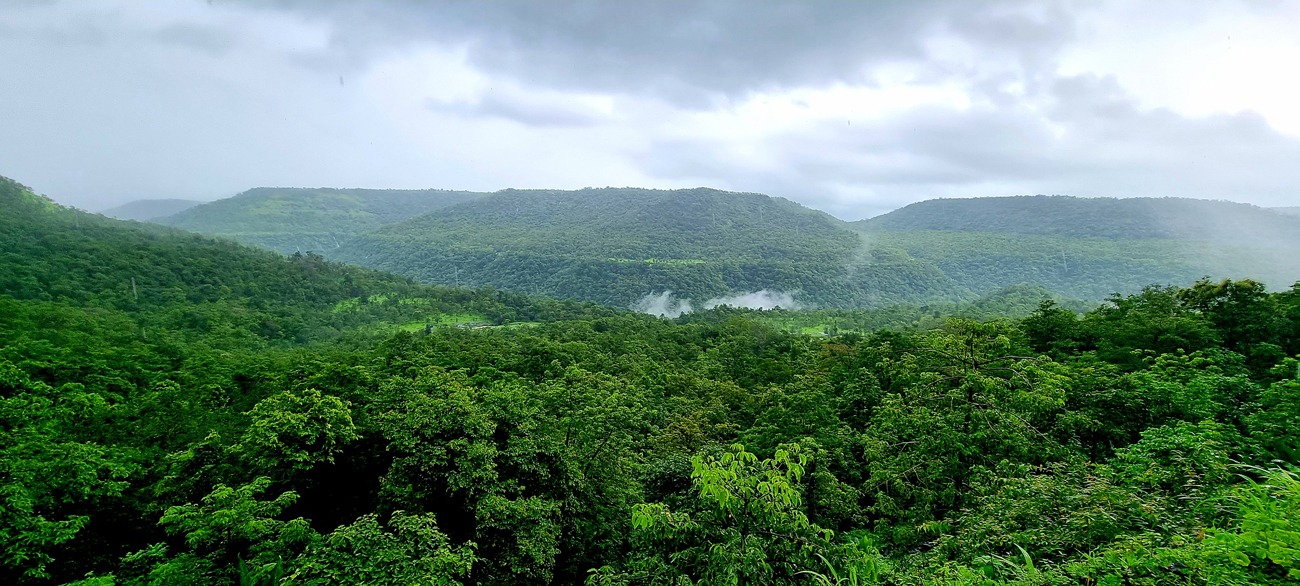
The Government of Maharashtra has approved a large dam on the Gargai river in the Tansa Wildlife Sanctuary, a project that would possibly submerge nearly four lakh trees and a biodiversity-rich forest. Photo: Kedar Gore.
Sacred Roots
Trees are deeply rooted in India’s culture and traditions. From the earliest layers of Indian civilisation, trees have occupied a place of reverence – not merely as physical entities but as living embodiments of life. Ancient Indian wisdom consistently emphasised the ecological, ethical and spiritual significance of trees, long before modern environmental science articulated concepts of sustainability. These beliefs often translate into powerful conservation practices passed down through generations. The Rigveda invokes vana (forests) and vriksha (trees) as divine entities worthy of protection. The Atharvaveda contains hymns dedicated to plants, recognising their role in sustaining health and life. The Indian epics Ramayan and Mahabharat embed environmental ethics within narratives of dharma (duty), where the act of cutting trees was considered akin to committing violence against living beings and was believed to invite societal sufferings. Planting trees, on the other hand, has been praised as an act of punya (merit). The Buddha attained enlightenment under the Bodhi (peepal) tree, making it a universal symbol of wisdom and awakening.
The wisdom in these ancient texts highlights the economical and the ecological benefits of trees (see below), while warning against deforestation and greed. In many tribal and rural societies, certain trees are worshipped as abodes of deities. Protected through religious belief and social norms, these sacred groves – mostly found across the Western Ghats and northeast India – served as reservoirs of biodiversity long before the modern Protected Areas concept. Trees such as peepal, mango, bel, banyan, apta Bauhinia racemosa, shami Prosopis cineraria and ashoka Saraca asoca were associated with deities, rituals and festivals, emphasising coexistence and ensuring their protection across generations. Unfortunately, this ancient wisdom and these eco-logical values have long been lost in the quest for rapid and unsustainable development. Hacking the branches and stripping these once revered trees of its leaves during festivals is a bizarre reality of the eroded ancient value systems of modern times that has forgotten that an entire living tree is worshipped and not its dead body parts.
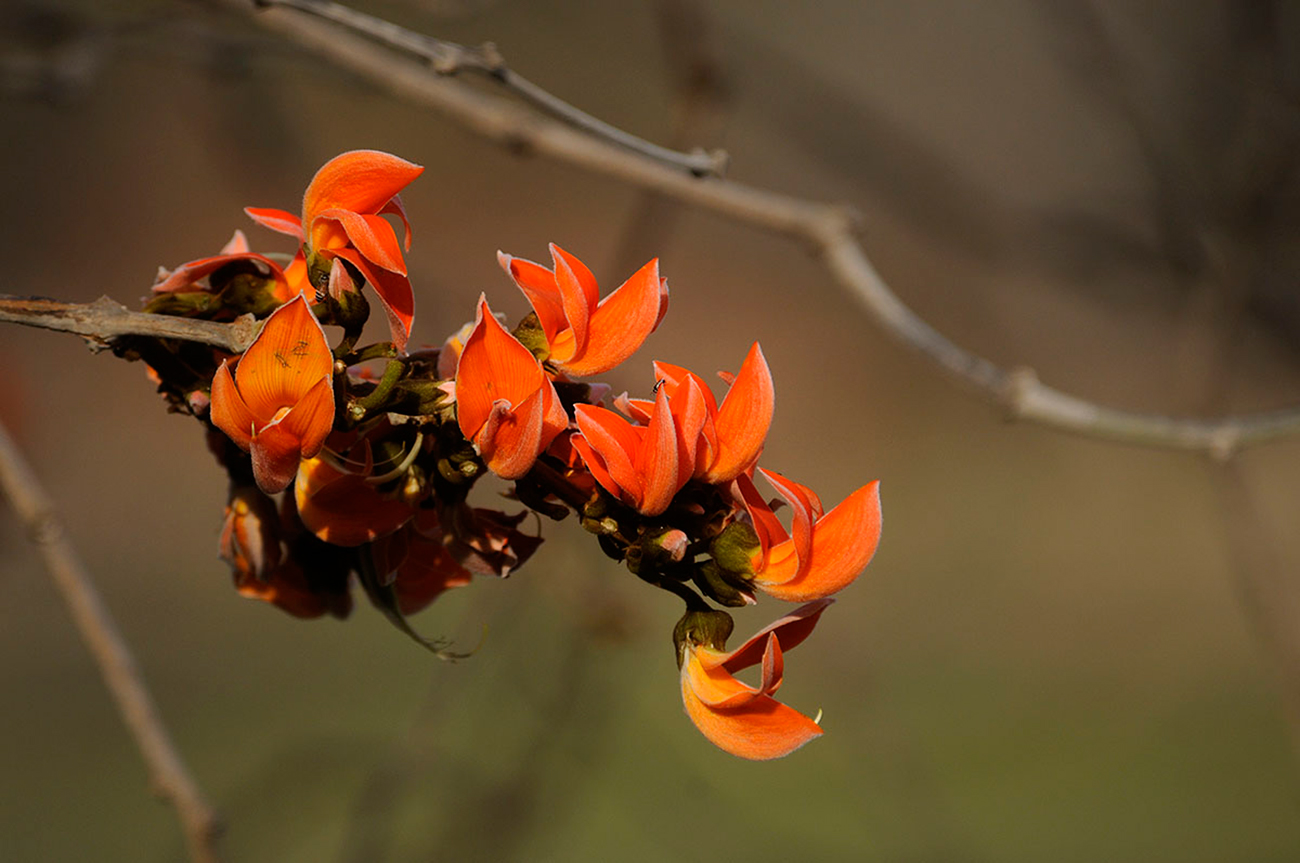
Every tree species stamps its signature on the landscape with its peculiar shape, branching pattern, bark texture, flower, fruit, and seasonal transformations. Photo: Dr. Anish Andheria.
Plantation Follies
Decades ago, fast-growing exotic species such as Neltuma juliflora, Leucaena leucocephala, Acacia auriculiformis, Gliricidia sepium and Senna spectabilis were planted indiscriminately across different regions of India to increase the ‘green cover’ in urban and rural areas. These plantations have destroyed native ecosystems, reduced water availability and displaced indigenous biodiversity. Even today, species such as rubber Hevea brasiliensis, mahogany Swietenia macrophylla and Eucalyptus spp. are promoted for agroforestry purposes and linked with quick ‘greening’ and carbon credits, often ignoring the reality that monoculture plantations can never replace old-growth forests or compete with their ability to store carbon.
The rain tree Samanea saman, gulmohur Delonix regia, copperpod Peltophorum pterocarpum, pink trumpet tree Tabebuia rosea and African baobab Adansonia digitata though exotic are non-invasive, good for avenues, and some even provide roosting places for herons, egrets and colonies of the Indian flying fox Pteropus medius, the largest bat species of India.
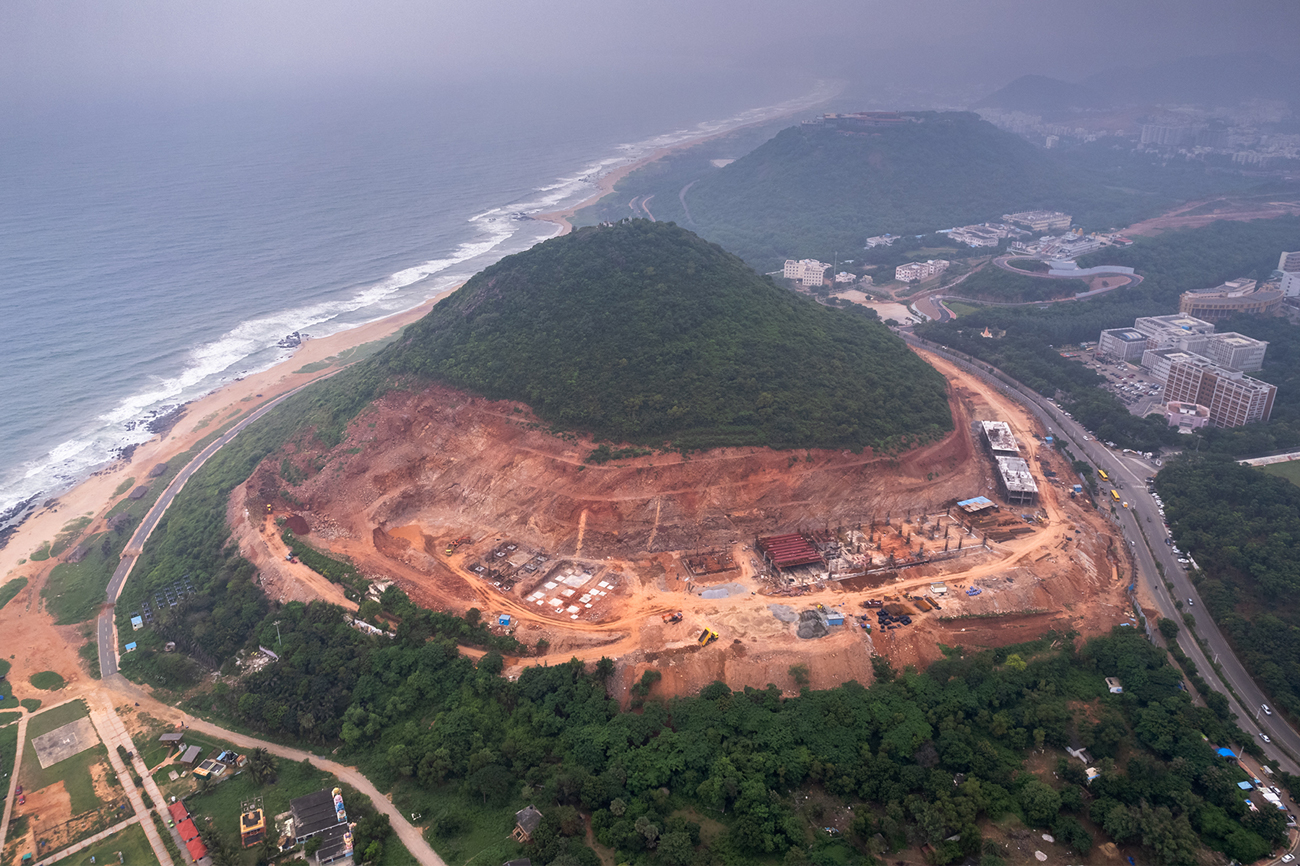
Clearing hillsides in urban areas by cutting trees and blasting rock to build tourism infrastructure, such as beach-view resorts and jungle stays, comes at a heavy cost to local flora and fauna and is deeply unsustainable. Photo: Rukhiya Mohammed/Sanctuary PhotoLibrary.
Myopic Developmental Policies
It is indeed ironic that we take pride in our rich heritage, culture, and traditions, yet have failed to embrace the fundamental values that revere and protect nature. We have adopted a short-sighted vision of development that views trees merely as commodities to be exploited or obstacles to be removed for infrastructure projects rather than integrating them into project design and planning.
Around 31 lakh trees were felled with approval under the Forest (Conservation) Act in 2021-21 alone according to the statement made by India’s Environment Minister in the Lok Sabha. The ambitious Great Nicobar Project consisting of a transhipment port, an airport, a power plant and a township would destroy a patch of rainforest over 130 sq. km. The project proponents estimate around 8.5 to 10 lakh trees to be cut for this project. Ecologists believe that this is a gross underestimate, as a rainforest can have around 1,000 trees per hectare and thus the actual loss of trees is expected to be over a crore! The Government of Maharashtra has approved a large dam on Gargai river in the Tansa Wildlife Sanctuary that would submerge around four lakh trees and a biodiversity-rich forest. The Government of Chhattisgarh has approved the clearing of the Hasdeo Forest by cutting around four lakh trees to allow a mining project. Over four lakh trees were felled for national highway development projects in the northeastern states from 2020-21 to 2023-24. The recent decision to cut over 45,000 mangroves for the Mumbai Coastal Road project by compromising the safety of millions of citizens of Mumbai is just an addition to several other examples of the humongous scale of tree-cutting done so that some of us live more comfortably, travel faster, and get more water to splurge.
The law mandates compensatory afforestation, and thousands of crores are being spent to plant and grow trees elsewhere. Quite often, unfortunately, such plantations have poor survival rates and thus turn into ‘greenwashing’ by the project proponents. The negative impact of such large-scale tree cutting has resulted in severe landslides leading to a loss of human lives and property, depletion of biodiversity, and an increase in the severity of the impacts of climate change.
The fact is, there can be no true progress without forests and their trees. To secure the ecological and economic well-being in India, we must elevate the perception of trees from background greenery to essential natural infrastructure. The Article 51A(g) of the Constitution of India places a fundamental duty on every citizen to protect the natural environment, including forests and trees. If India is to remain green, healthy and climate resilient, we must learn to protect our trees with the reverence and urgency they deserve.
Nature’s Infrastructure
Tree roots stabilise soil and prevent erosion, while their canopies intercept rain, reduce runoff, recharge aquifers, and help sustain rivers and lakes. Their leaves capture sunlight and convert it into energy, releasing oxygen as a byproduct. Trees are powerful climate warriors, storing atmospheric carbon and helping to combat climate change. They provide medicines, food, fuel, timber, fibre for clothing, and essential ecosystem services such as nutrient cycling, protection from storms and tidal waves, shade, and well-being. The benefits trees provide to humanity are truly endless.
Beyond their ecological roles, trees generate enormous ‘free’ economic value. They provide wood for fuel and construction, fibres for textiles, gums and resins for industry, and countless life-saving medicinal compounds. In rural India, it is estimated that around 275 million tribal and other communities dwelling in and around forests, depend on forests for fuelwood, fodder, fruits, seeds and medicinal plants for daily subsistence and income. Timber, sourced sustainably or otherwise, supports industries and livelihoods, while non-timber forest products strengthen cottage industries in many parts of India. Even what trees discard as waste products (gum and resin) have supported livelihoods for centuries.
According to the India State of Forest Report (2024), India’s forests store 7,285.5 million tonnes of carbon, helping to mitigate climate change. According to the FAO's Global Forest Resources Assessment 2025, India ranks 5th globally as a carbon sink, with its forests absorbing approximately 150 million tonnes of CO2 annually during the 2021-2025 period. Urban and roadside trees provide shade that lowers temperatures, mitigating heat island effects, reducing energy costs, providing habitat for biodiversity, and for aesthetic and recreational purposes.
Kedar Gore is a naturalist, writer, and advocate for nature with three decades of experience in wildlife conservation. Currently, he works as the Director of The Corbett Foundation.