The Smallest Carnivores
First published in Sanctuary Asia,
Vol. 45
No. 12,
December 2025
By Soham Kacker
After a long day of fieldwork, I head back to the village pond. Perched on a rock, I lower my feet in, sending swirls and eddies through the still water and scattering the fish. As the water stills I notice feathery, many-branched stems suspended in the water, brushing every now and then against my feet, their filiform leaves looking like the tentacles of a fantastical aquatic creature. Despite their dainty appearance, the plants that drift languidly around my ankles are, in fact, one of the most sophisticated hunters in the plant kingdom. Such is their evolutionary success that they have diversified into a genus of over 200 species, are found on every continent except Antarctica, and thrive in habitats ranging from freshwater pools, clear streams, bogs, rock outcrops and lateritic plateaus, to high in the canopies of rainforest trees. I had found myself in the presence of the smallest carnivores in the plant world – the Utricularias.
At first glance, Utricularias, or bladderworts, don’t look like much. One could be forgiven for mistaking them for algae or moss – but take a closer look (preferably with a magnifying glass), and their incredible architecture becomes apparent. Different species have an astonishing variety of growth patterns: some resemble moss with many-branched translucent stems, others form small rosettes of leaf-like organs, and others yet are nearly imperceptible before they send up long flower spikes topped with brightly coloured blossoms. All species grow in water-saturated habitats, though many terrestrial species have evolved to grow in the moss on tropical rainforest trees, or by the constant runoff on damp rocky ledges. Yet what unites all species of bladderworts are the organ they are named after – their bladder-like traps, poised to catch prey.
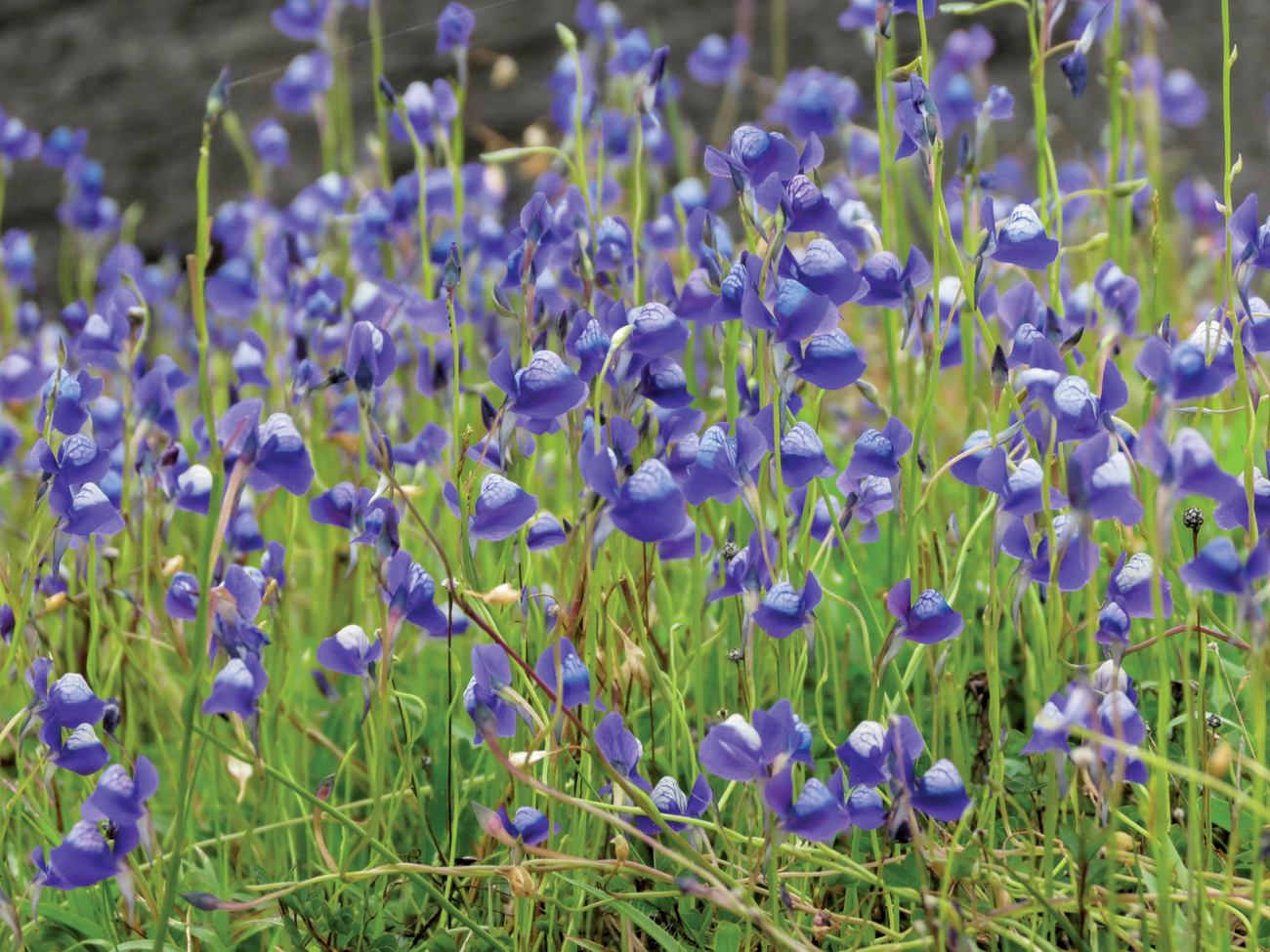
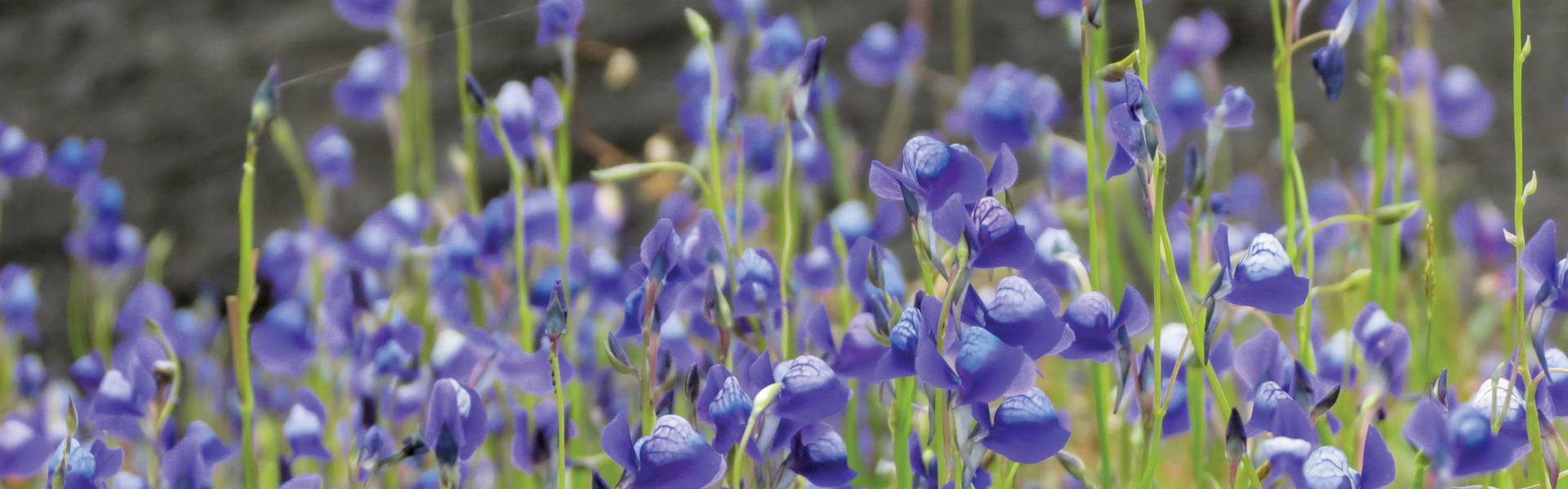
A stand of net veined bladderwort Utricularia reticulata native to India and Sri Lanka. Photo: Public domain/Forest Owlet.
Ranging in size from a truly diminutive one millimetre to around six millimetres at the largest, the traps are hollow pouches shaped like coin-purses, or broad beans, fitted with a small ‘trapdoor’ at one end. They function by a purely mechanical principle, by creating a vacuum inside the traps, which sucks in tiny prey. Specialised cell walls in the traps pump water out of the cavity, driven by a specially evolved respiratory pathway, which powers the constant pumping required to maintain a vacuum. Around the mouth of the trapdoor, a membrane seals the gap (think of the rubber gaskets on air-tight glass jars), and a tiny strip just a few cells wide creates a flexible hinge, allowing the door to swing open. Finally, a ‘beak’ at the door with long, filamentous ‘whiskers’ acts as a trigger. When a prey species approaches the trap, even the slightest touch with the whiskers disrupts the membrane to break the vacuum seal on the trap. The door swings inward in half a millisecond, pulling in water and the bladderwort’s prey. This movement is one of the fastest in the plant world, almost 200 times faster than the traps of a Venus fly trap. Larger species can prey on mosquito larvae, tadpoles, and even fish fry. After digestive enzymes and bacteria in the traps digest the meal, they re-set in under 20 minutes – ready for the next hunt.
Bladderworts are understudied in terms of their distribution and conservation status, and new species have been discovered from India as recently as 2020 such as Utricularia sainthomia from the lateritic plateaus of Kerala. Endangered endemic species of Utricularias such as U. wigthiana from the southern Western Ghats and U. cecilii from western Karnataka tend to have narrow niches, and hyper-specialised habitats – acutely susceptible to the slightest environmental changes.
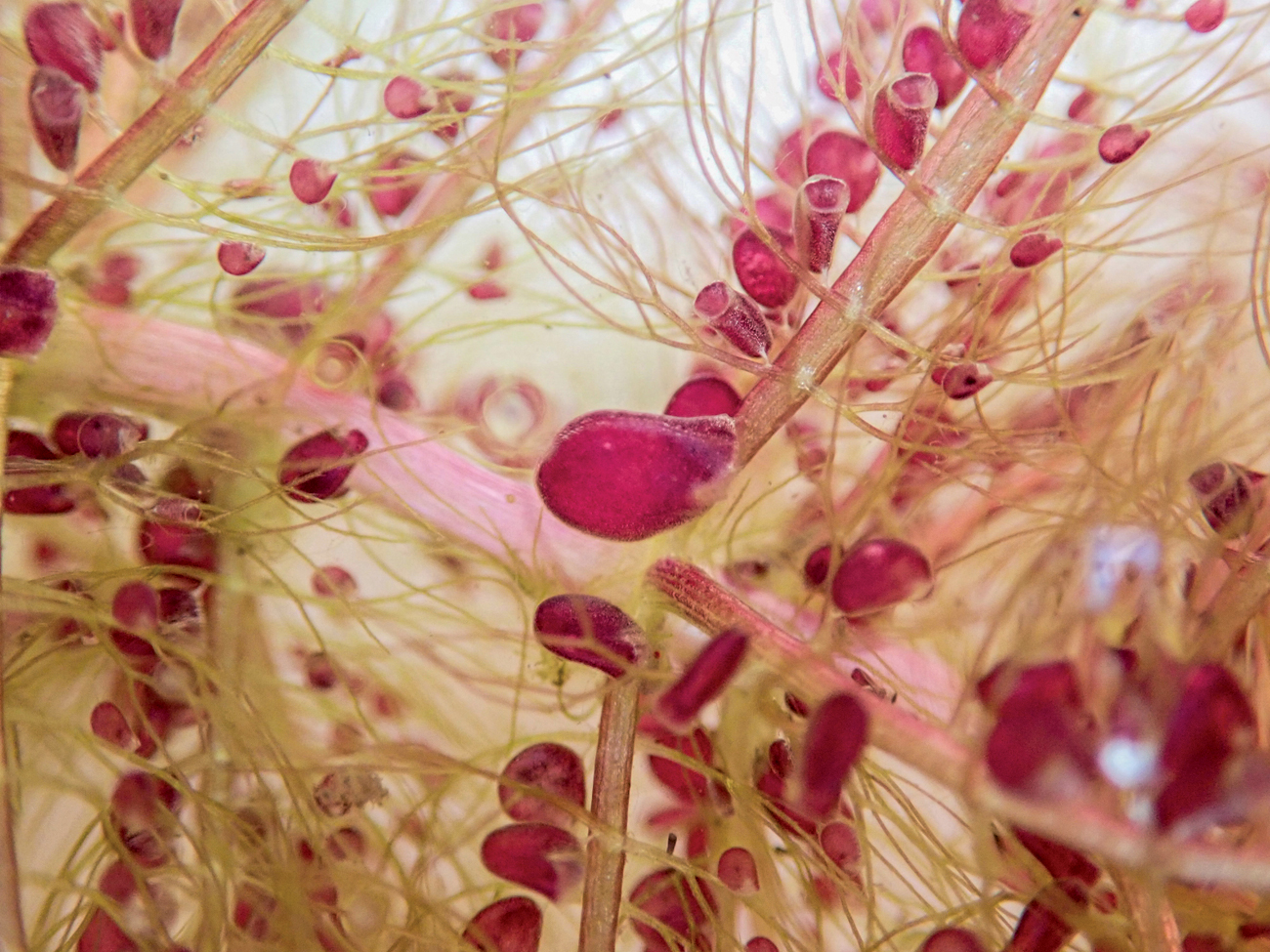
And the bladders of star bladderwort Utricularia stellaris under a microscope. Photo: Wilderness Safaris Botswana - Conservation Team/CC-BY-4.0.
As the cool water of the pond refreshes me, and the bladderworts hunt silently below the surface, I think about the incredible diversity and evolutionary uniqueness, which often goes unnoticed around us. I get up, and tiny yellow flowers bob like fireflies above the dark water – may they always be so.
Soham Kacker is a plant ecologist and horticulturist from New Delhi. His research looks at plant conservation and ethnobotanical landscapes in the Indian Himalaya and beyond.