The Rhythm Of Dhikala
First published in Sanctuary Asia,
Vol. 46
No. 8,
August 2026
Text and Photographs by Nikhil Devasar
The forest announces itself long before the wildlife does. Dry sal leaves crackle beneath the tyres, their russet carpet stretching endlessly through the woods. Above them, towering sal trees arch gracefully over the road, their emerald canopies meeting to form a vaulted ceiling of green. The air is heavy with summer heat. Dust hangs in the stillness, yet the forest is anything but lifeless. Tender shoots push through the dry earth with quiet determination, and everywhere, unseen voices remind you that life here never pauses.
A trip to Dhikala is always special. It also demands patience. Bookings have to be planned months in advance and securing accommodation often feels like winning a lottery, and visitors are allowed only three nights at a time. The restrictions seem frustrating, but perhaps they are what keep Dhikala extraordinary. Limited access means the forest continues to breathe to its own rhythm. Here, people are visitors, not the centre of the story.
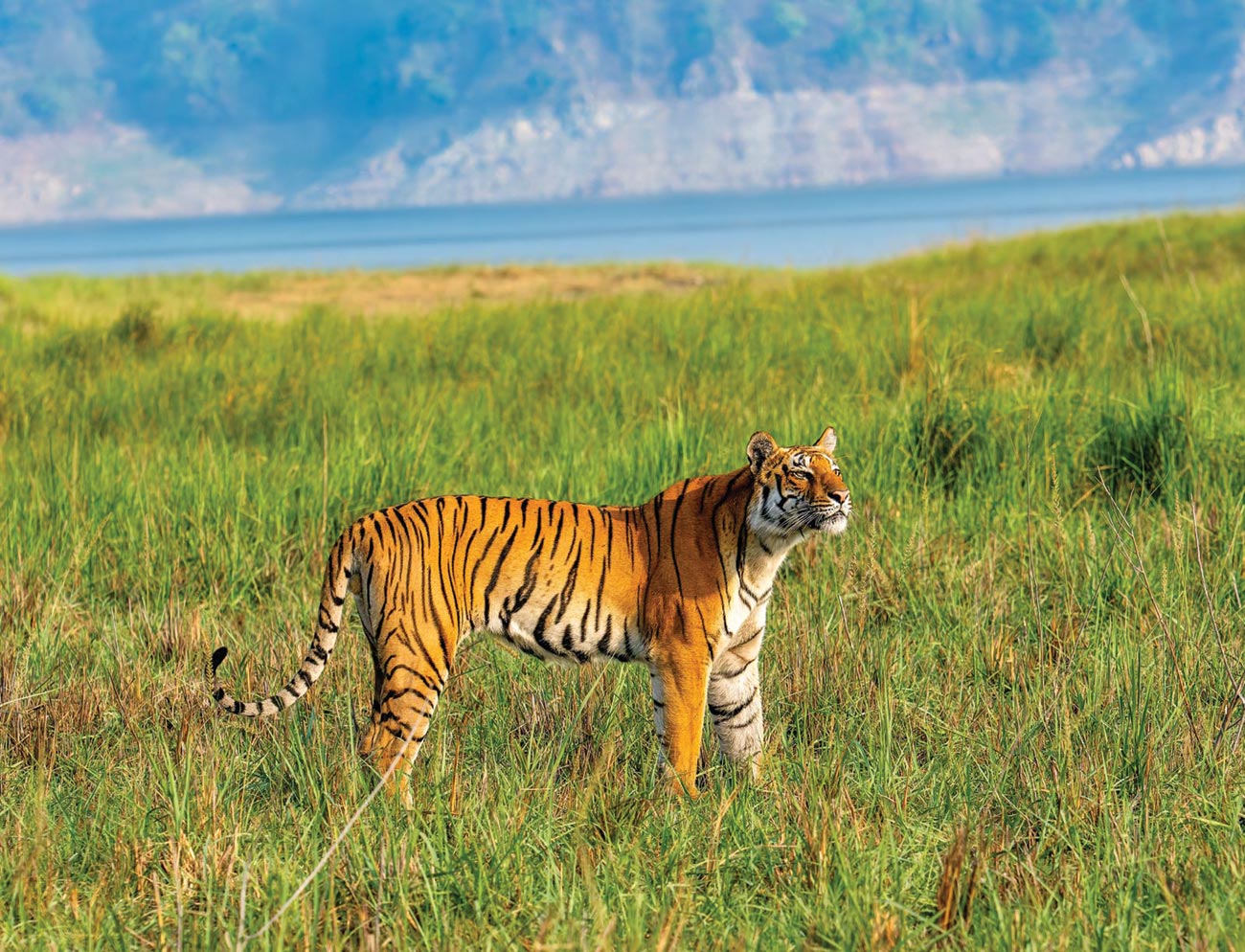
In Dhikala, every safari carries the promise of an unforgettable encounter with a tiger. Sometimes the cat appears for a fleeting moment, sometimes it lingers long enough to leave you speechless.
An Abundance Of Avians
As our jeep rolled through the chaurs, the morning chorus gathered strength. The clear whistle of the Indian Pitta drifted through the grasslands, answered by the Drongo Cuckoo and the Rusty-cheeked Scimitar Babbler hidden in the undergrowth. Paradise Flycatchers floated through shafts of sunlight like white ribbons suspended in the breeze. A Shikra lingered over a forest pool while brilliant Green Magpies descended cautiously to drink. Bee-eaters hawked insects effortlessly across the open skies.
Yet one bird held us spellbound.
Near Dhikala Gate, a pair of Blue-bearded Bee-eaters had excavated their nesting tunnel into a sandy embankment. Their heavier bills and rich blue-green plumage immediately distinguished them from their smaller cousins. We had been told to watch for them, but nothing prepared us for their precision. Within barely five minutes, the pair returned to the nest four times with food.
Each hunt followed the same flawless sequence. From an exposed perch they scanned the air for only a heartbeat before launching into graceful flight. Without ever appearing to slow down, they intercepted a bee or wasp, curved back to the branch and landed with effortless precision. Before offering the prey to their chicks, they repeatedly struck it against the perch, removing the sting with practiced efficiency. Even large cicadas, almost too bulky to swallow, were delivered with astonishing regularity.
The nestlings, meanwhile, seemed impossible to satisfy. Their constant calls echoed from deep within the tunnel, urging the adults to venture once more into the shimmering afternoon heat. Again and again the parents obliged, their rhythm never faltering. Watching them, it struck me that this was every bit as extraordinary as watching a tiger. Here was another family, another struggle for survival, another thread in the intricate web that keeps this forest alive. The bee-eaters depended on healthy insect populations. Those insects depended on flowering trees, grasses and seasonal cycles. Every life supported another. It was a reminder that the forest's greatest stories are often written far from the spotlight.
We heard the resonant call of a Great Hornbill before we saw him. Perched atop a branch that looked too slender to bear his weight, he called repeatedly, occasionally tossing his head back to reveal the magnificent casque that gives the species its unmistakable profile. It was impossible not to admire this ambassador of old forests, a species whose presence speaks of mature trees and healthy habitat.
Birding alone could have filled our days. Corbett, however, had other plans.
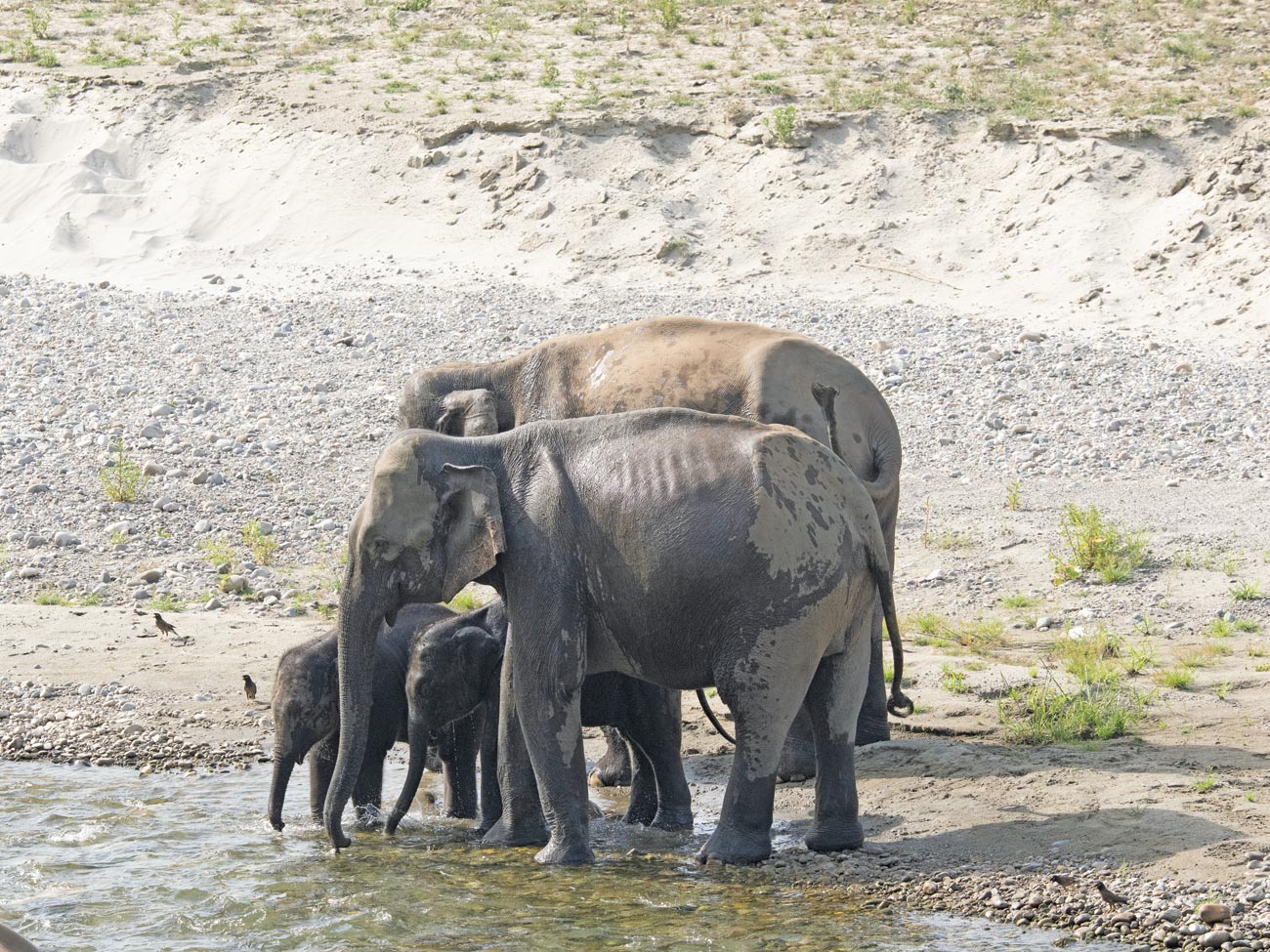
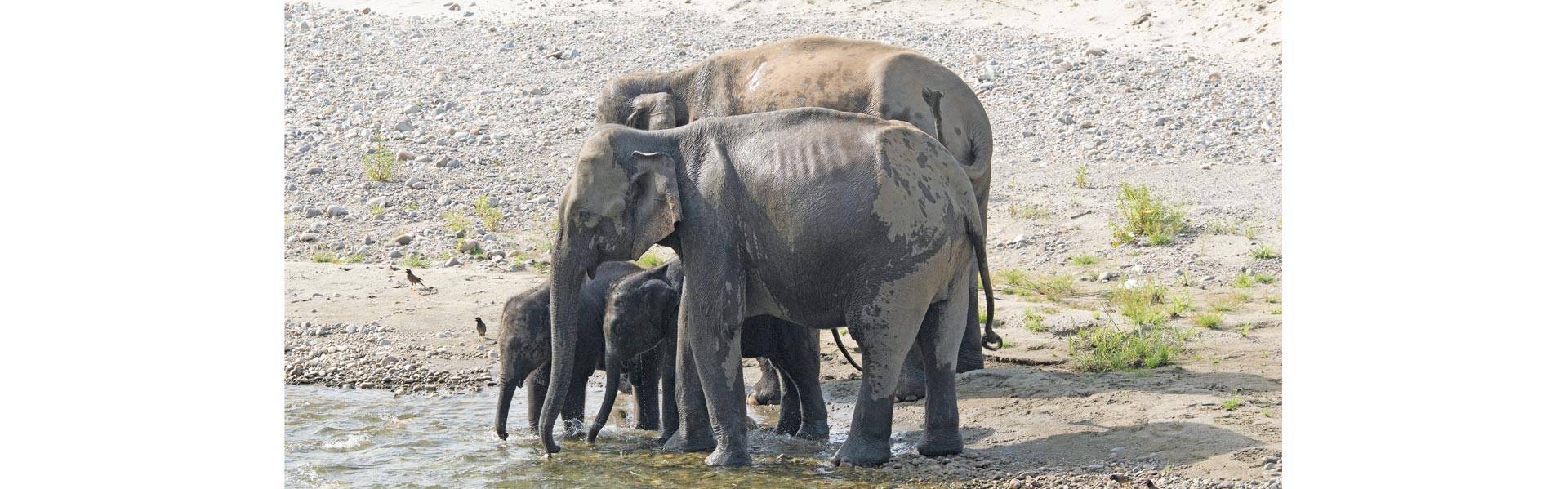
Dhikala is an experience. Grasslands and streams alive with elephants, forests echoing with birdsong, towering sal trees, and the possibility of encountering something extraordinary.
Tigers Galore
My previous visits to Corbett had almost always followed the familiar "Just abhi (now)" script. The tiger had crossed moments before. The tiger had just disappeared into the forest. Someone else had seen it a few minutes earlier. I had almost accepted that this was simply my fate in Corbett.
This time, the forest seemed determined to make amends. Over three safaris we encountered 10 tigers!
A tigress shepherded two tiny cubs across the thandi sadak, the youngsters still entirely dependent on their mother. Another tiger surrendered a cooling waterhole to a herd of elephants approaching with calves. One female rested quietly behind our jeep, lifting her head only briefly before melting into the forest. But one young male remains etched in memory.
For me, the tiger has always been the undisputed royalty of the jungle. Long before he appears, the forest announces his arrival. The langurs seem to proclaim, "Ba adaab, Ba Mulahizah... Hoshiyar!" Have respect. Take notice. Be vigilant. The sambar add their own warning. The barking deer urgently declare that danger is near. Then, the king emerges.
He surveys his kingdom with calm yellow eyes, entirely unconcerned by the convoy of jeeps waiting in anticipation. The iron monsters, packed with hot, dusty pilgrims who have travelled hundreds of kilometres for a fleeting glimpse, quietly reverse to create a clear passage. Cameras erupt in applause as shutters click relentlessly. The tiger walks with complete indifference to his admirers before disappearing once more into the forest, and only then do conversations resume.
A few late-arriving vehicles appear around the bend. "Just abhi..." Yet no king rules alone. The tiger exists because everything beneath him does.
The chital grazing in the chaurs, the hog deer disappearing into tall grass, the elephants shaping the landscape, the langurs acting as vigilant sentinels, and even the bee-eaters tirelessly harvesting insects all play a role in sustaining this remarkable ecosystem. Remove enough of these threads and, eventually, even the king has no kingdom left. That, perhaps, is the greatest lesson Dhikala has to offer.
The grasslands ripple with life. More than a hundred elephants roam across the chaurs. Patient matriarchs lead fuzzy calves that refuse to stray far from their mothers, while young tuskers spar playfully beside them. Somewhere among them walks a magnificent bull whose ivory tusks cross at their tips. Chital graze in great herds, their rutting calls echoing across the plains, while hog deer vanish into the grass with astonishing ease.
Every visitor arrives in Dhikala hoping for a tiger. Some leave with photographs. Others leave with stories. I left with something more enduring: the reminder that a forest is not measured by the number of stripes it reveals, but by the countless lives quietly unfolding within it. Perhaps the real lottery is not seeing a tiger at all.
It is knowing that places like Dhikala still exist, where nature continues to follow its own ancient rhythms, largely undisturbed by our presence. They remind us that we are guests in an ancient home whose future depends on restraint as much as appreciation. As visitors, we are privileged to witness these moments. Our responsibility is to ensure they continue long after we drive away, so that every creature, from the smallest bee-eater to the largest tusker, and the tiger that reigns above them all, can continue to play its part in this remarkable living tapestry.
Camera Details
Body: OM SYSTEM OM-1 Mark II
Lens: M.Zuiko Digital ED 50-200 mm. F2.8 IS PRO
Date taken: May 25-26, 2026
Location: Dhikala,Uttarakhand
Nikhil Devasar is a conservationist, birder, nature photographer, author, and entrepreneur based in Delhi. He founded ‘delhibird’, one of India's largest birdwatching communities.