The Indian Wolf - A Vanishing Heritage
First published in Sanctuary Asia,
Vol. 46
No. 10,
October 2026
By Devvrat Singh
In Bahraich, the evening felt different in October 2024. Mist settled over the fields, the village alleys grew silent, and doors that normally stayed open were shut before darkness fell. Apparently, a man-eating wolf was out on the prowl, as I moved from village to village, listening to frightening accounts and investigating attack sites. I experienced grief up close. I saw how fear can travel faster than any animal. On October 5, 2024, I stopped at a roadside tea stall, a tapree, after an exhausting day, to grab some sips of chai from a kullhad, when a phone call interrupted this peace. The last of the six wolves, identified during the crisis, was killed in retaliation. Relief came, but was short-lived. The state took lethal action when the attacks recurred in 2025. This was far from the reality of the quiet coexistence I had witnessed in Mahuadanr, Jharkhand, where wolves and people shared the same landscape without turning every encounter into a battle.
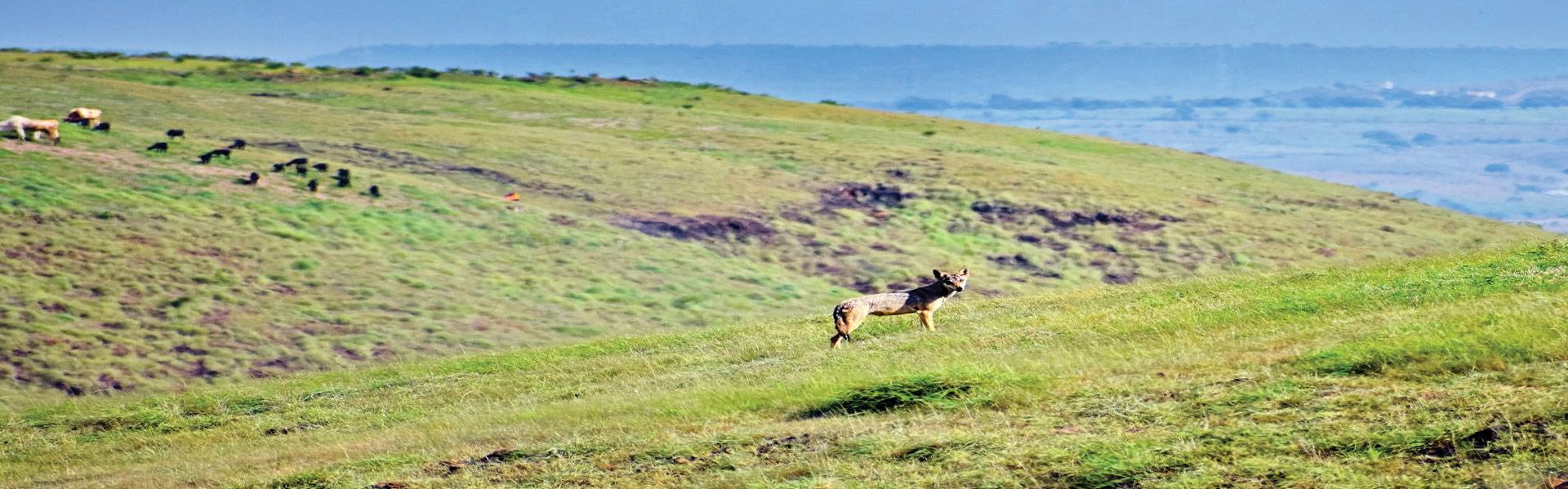
The Indian wolf persists at the uneasy frontier between wild habitat and human-dominated landscapes. In a healthy landscape, a pack may hunt wild ungulates, but elsewhere, it turns to smaller prey and livestock. Photo: Yojna Belani/Sanctuary Photolibrary.
Carnivore Of Open Country
The Indian wolf Canis lupus pallipes (Sykes 1831) is a predator of the open country. It inhabits dry grasslands, scrub, rocky plateaus, and semi-arid plains that stretch beyond the forests. It roams through these landscapes as the apex predator, shaping prey populations and occupying a position that any large carnivore outside a protected forest rarely gets. Its long legs and lean body are suited to heat and open terrain. In a healthy landscape, a pack may hunt wild ungulates, but elsewhere, it turns to smaller prey and livestock. Blackbuck, chinkara, blue bull (nilgai), hare, rodents and other wild prey, where they are still present, form an important part of the Indian wolf’s diet.
Given its habitat preferences, the Indian wolf has chosen, sometimes been forced into, landscapes that are occupied by humans. This dependence is not accidental. Farmers cultivate the plains, pastoralists move livestock through scrublands, and villages sit beside fields, canals and riverbanks. The wolf lives in the same labyrinth. In such places, livestock ultimately replaces its natural diet to a large extent, given its high availability over natural prey. This makes the Indian wolf an inseparable component of the rural ecosystem, blurring its identity associated with wilderness.
Evolutionarily, it carries the highest significance. Genomic research places the Indian lineage as the oldest of living grey wolves, with a recent study estimating divergence from other extant grey wolf lineages at roughly 110,000 years. Their ancient evolutionary history makes them a natural heritage of the Indian subcontinent that needs to be conserved.
The numbers are sobering. The first dedicated IUCN Red List assessment in 2025 estimated 2,877 to 3,310 mature Indian wolves in India and Pakistan and classified the taxon as ‘Vulnerable’. These figures must be read carefully. They are model-based estimates, not the result of counting every wolf. For a species that is difficult to detect and that spends much of its life outside Protected Areas, moving across agricultural mosaics, uncertainty is inevitable. The actual number could differ.
What is less uncertain is the direction of travel. The wolf has disappeared substantially from large parts of its former range. Historically, it occurred widely across most of Pakistan, northern, central, central-eastern and western India, through the Deccan, and into adjoining southern landscapes. Uttar Pradesh has lost much of its former population, as have Bihar and West Bengal. Today, important strongholds remain in Maharashtra, Karnataka, Gujarat, Madhya Pradesh and Rajasthan, with other smaller populations scattered across the peninsula and central India. Landscapes around Velavadar, the Bhal region, parts of the Deccan such as Solapur, the Karnataka scrublands, Nauradehi and Tal Chhapar illustrate the range of settings in which the species can persist.
The Indian wolf was overlooked for decades, even though its decline was visible to people living beside it. Only recently has its ecological importance received global conservation attention. In India it enjoys the highest level of legal protection under Schedule-I of the Wildlife (Protection) Act, 1972. But, law alone cannot save an animal whose home lies largely outside conventional Protected Areas.
-Indian-Wolf-Aurangabad-Anand-Patil_C-1300_1791193649.jpg)
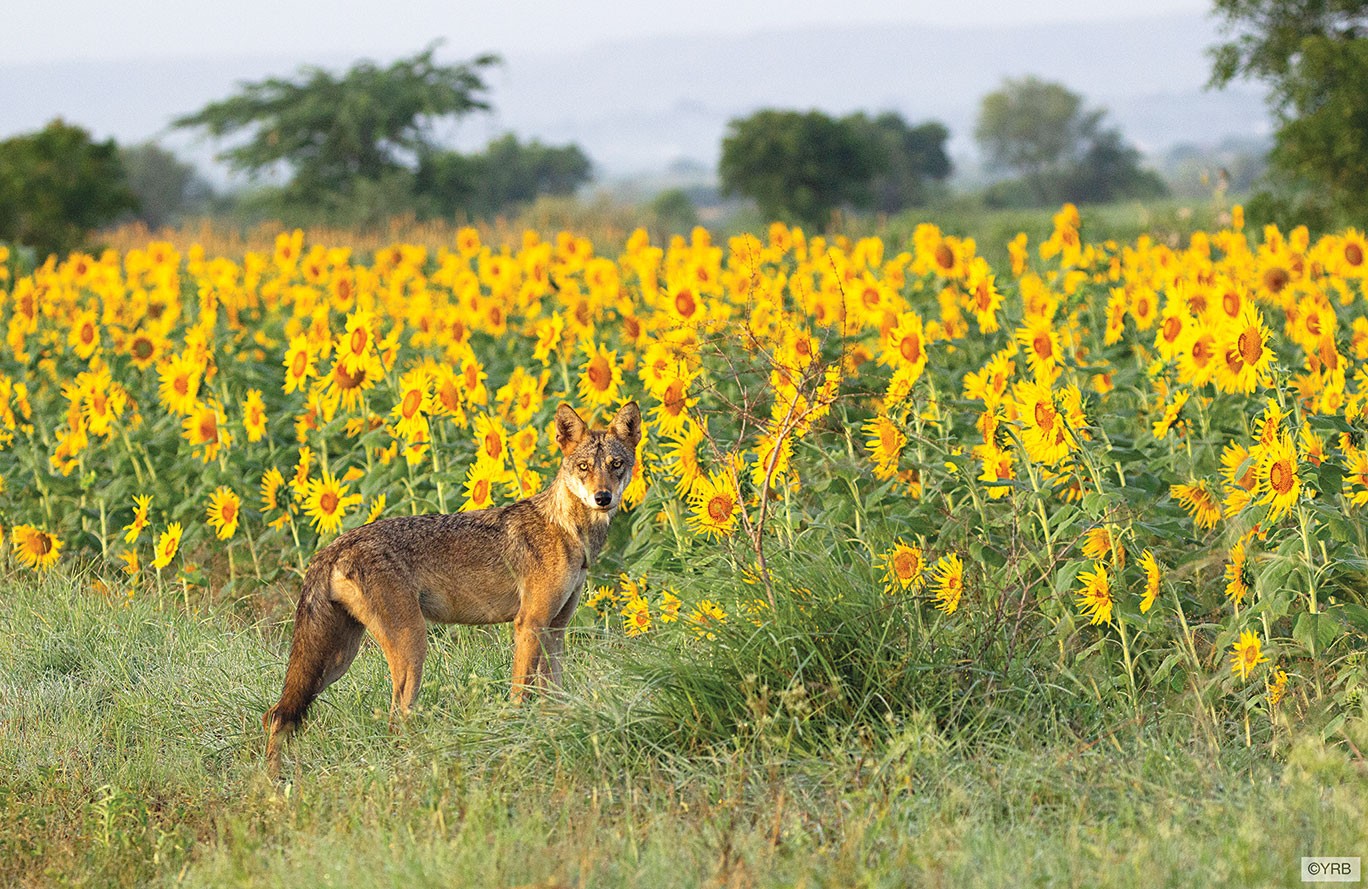
The Indian wolf, the oldest lineage of grey wolf, is now facing unprecedented threats. Photo: Anand Patil/Sanctuary Photolibrary.
Ancient Wolf In A Changing India
The wolf’s first enemy is disappearing habitat. Open habitats are altered, denning sites are disturbed, natural prey is depleted, and power infrastructure creates electrocution risks. Scrublands are often treated as wasteland, yet for wolves they provide cover, prey and rendezvous sites where pups are raised. When scrub is cleared for farms, industry, roads or settlements, rendezvous sites disappear. Disturbance can be equally damaging. A den beside a field may be exposed to tractors, earthmoving or firewood collection.
Conflict remains the most immediate threat. A wolf that repeatedly preys on sheep or goats can become a target for poisoning, trapping or shooting. Free-ranging dogs bring more danger. They compete for resources, transmit disease, and can hybridise with wolves. For a small and increasingly fragmented population, such hybridisation can erode genetic identity.
Some of its last refuges are surprisingly ordinary places. The scrub along irrigation canals, seasonal streams, and natural riverbanks can provide denning cover and movement routes through farmland. However, these strips are being straightened, concretised, mined or cleared for infrastructure. Each small loss may seem insignificant, but across a landscape, these losses can quietly erase the very fabric that ensures its survival.
This paradox is stark. The Indian wolf is legally protected, evolutionarily ancient and ecologically important. Yet its survival largely depends on landscapes where the plough, the grazing herd and its existence find common ground.
The Predator Next Door
For decades, the conservation community has looked past the wolf. Yet, for villagers, the wolf was never an abstraction. It was the animal at the edge of the field, the shadow near the goat pen, and the howl heard after dusk.
Where Indian wolves live alongside people, livestock depredation is almost inevitable. The wolf is an intelligent and opportunistic hunter. It watches, learns, and remembers. A goat tied inside a poorly secured enclosure is easier prey than a fleeting blackbuck. So are sheep or young cattle. Across much of its range, domestic livestock forms a major component of its diet. Studies from north Pakistan, Chhota Nagpur plateau, Gujarat and Maharashtra have repeatedly shown how closely the wolf’s diet is tied to the human economy. Here, the wolf stands as a predator making decisions in unknown territory, a less-than-natural landscape, where wild prey is difficult to come by and livestock abundant.
The remarkable thing is that people largely tolerate this cost. In many wolf-habitat villages, livestock losses are part of generational memory, not an enigma. A shepherd may have lost a goat, his father may have lost sheep, and his grandfather may have had to accept the existence of wolf packs too. To a large extent, this has shaped up as generational tolerance. People have developed ways of guarding animals, reading signs, and avoiding known danger. But there is another inheritance, darker and harder to dismiss. It is the trauma of child-lifting by wolves. Across northern and central India, stories of child-lifting by wolves have travelled through generations.
In Uttar Pradesh, accounts across the 20th century describe children being carried from village edges and homes. Sometimes people noticed the predator, but most often missed it. A wolf, when spotted, would be frequently chased by men, sometimes surrounded by a crowd in dense cropland. Occasionally, it would be isolated and beaten to death by sticks, or burned alive together with the sheltering crop. Such accounts are too easily dismissed today as folklore. And that is a mistake.
The historical record is substantial. Hazaribagh in Bihar has experienced repeated episodes. A study of attacks between 1993 and 1995 documented 80 child casualties across 63 villages, with most incidents occurring after dark. Madhya Pradesh has also witnessed serious episodes, including the Astha attacks of the mid-1980s. Such records do not prove that every story told by every village is true. Nor do they establish that every attacking animal was a healthy, wild wolf. Rabies, unusual individual behaviour, habituation and possible wolf-dog hybrids must always be considered. But nor can the entire history be reduced to myth. During my own case study in Bahraich, I have witnessed human-wolf traumas unfold. The absence of systematic biological evidence from old incidents reflect that seldom were the bodies of victims, collected samples or attacks investigated scientifically.
It goes without saying, however, that a repeated pattern of wolf attacks across regions necessitates investigation, not ridicule. Wolves are evolutionary survivors capable of learning. A young child asleep or unattended near a settlement is at risk. A single successful attempt, even a failed trial or a defensive attack, may be sufficient to teach an individual or pack to alter their behaviour. That makes prevention, rapid investigation, and careful identification vital. It also necessitates a veritable, widespread door-to-door, or village campaign, to stress the danger of children sleeping outdoors, or wandering near dense vegetation.
Such fears have historical roots. Colonial authorities encouraged the mass killing of wolves and other predators through bounty systems. Between 1875 and 1925, an estimated 200,000 wolves were ruthlessly killed in India, particularly in the North-Western Provinces and Awadh. This was over double the number of tigers shot (~80,000) during the same period. The wolf was treated as ‘vermin’ and a threat to cultivation. Such mass killings may also have altered wolf population dynamics at different places, changes in habitat preferences and, importantly, the way they perceive humans. These altered population dynamics and behavioural responses may also have been transmitted across generations within wolf populations.
Even today, conservation actions need to be practical and planned together with villagers, who should be assured of effective warning systems, secure livestock enclosures, and prompt compensation. Communities need support from trained teams capable of distinguishing a problem animal from a transient, innocent wolf.
Having said that, it is vital that conservationists avoid romanticising wolves, as this does villagers who lose livestock, or worse, loved ones, a great disservice. To demonise it is equally unjust. Conservation begins when fear is taken seriously, evidence is gathered quickly, and the animal is understood rather than imagined. The wolf has survived beside us for centuries. Our task is to decide whether the next chapter will be written in coexistence, or blood.
The Wolf In Our Memory
Long before wildlife departments and Protected Areas, the wolf was remembered through art. In the prehistoric rock art of Karnataka’s Malaprabha river basin, R. Mohana identified a depiction of the Indian wolf at Huligemma Kolla.
The wolf has also travelled through India’s literary imagination. In the Rig Veda, the she-wolf of the story of ṚjraÅ›va receives 101 sheep, while in the Mahabharata, Bhima is referred to as ‘Vrikodara’ (the wolf-bellied one), invoking the animal’s appetite. Sanskrit literature such as Hitopadesh and later storytelling often cast the wolf as cunning and opportunistic. The familiar image of the wolf in sheep’s clothing, inherited through Persian and Urdu literary traditions, further cemented its reputation as a creature of deception.
The Mughal court preserved another image. In the qamargah illustration in Akbarnama (c. 1590-1595), Emperor Akbar appears riding towards a pack of five wolves, sword raised, while the nearest animal appears wounded. Another painting in Akbarnama features the game of wolf-running in Tabriz. Centuries later, Jahangir’s artists offered a strikingly different allegory, portraying the wolf peacefully at the emperor’s feet alongside the lion, ox and lamb.
Yet, the wolf was never only a symbol of fear. Among Gond communities of central India, oral traditions remember a mythical wolf as a protector of ancestors during famine. In rural north India, however, another image endured. Here, the myth about child-lifting wolves dominated, where mothers were often heard asking the child to sleep, or else the wolf would come. Such words, passed from one generation to another, reveal how deeply, and negatively, the wolf entered our cultural psyche. The Indian wolf was alternately revered, feared, hunted and mythologised. What has been forgotten is that beneath all these images lived an animal that has shared India with us for millennia.
When The Wolf Comes Home
The first real turning point in Indian wolf conservation came from an individual who looked at the animal differently. The late S.P. Shahi, an Indian Forest Service officer in undivided Bihar (Sanctuary Vol. XXXI No. 1 February 2011), recognised that wolves were disappearing from landscapes where they were once common. In 1976, he helped establish the Mahuadanr Wolf Sanctuary, India’s first Protected Area dedicated to this species.
A decade later, in 1987, Dr. Y.V. Jhala pioneered systematic research on Indian wolf ecology through his doctoral work. His studies, followed by the work of Dr. Satish Kumar in the early 1990s, opened a new window onto a predator that had been largely known through conflict stories. Documentation of their habitat selection, food habits, social behaviour, breeding and the relationship between wolves and agricultural landscapes began to be initiated. Wolf research, unfortunately, could not advance the way it did in case of other large carnivores. Very often, similar questions have been explored in different places, while deeper questions about cognition, decision-making, social learning, dispersal, genetic connectivity and long-term persistence remain less-answered. The wolf is an exceptionally difficult animal to study owing to its elusive nature. It moves across large areas, often at night, leaving virtually no trace of its presence… often for much of its life.
Researchers today need to ask a totally different set of questions. What prompts wolves to make choices in human-dominated landscapes? How do pups learn from adults? How do packs respond to persecution? And what impact do our roads, irrigation projects, vast arrays of renewable energy panels and expanding settlements have on wolf movements?
Clearly, reliable population monitoring, genetic surveillance for wolf-dog hybridisation, disease monitoring and better mapping of dens and rendezvous sites are all vital.
Recent work has gradually begun to throw greater light on how we can learn to live with wolves. Studies by Dr. Bilal Habib and colleagues have expanded knowledge on movement ecology, population genetics, and acoustic communication. Genetic studies have already revealed the extraordinary evolutionary history of Indian wolves, while bioacoustic research has shown that their howls carry behavioural information about this ancient lineage.
The focus of conservation governance is gradually moving beyond forests. The creation of the Bankapur Wolf Sanctuary in Koppal, Karnataka, is one such example. Declared in 2021, it protects scrub, rocky terrain and open habitats used by wolves. Other landscapes such as the Blackbuck National Park in Gujarat, the Nauradehi Wildlife Sanctuary in Madhya Pradesh, and the Great Indian Bustard Sanctuary in Maharashtra all report significant wolf populations. Clearly, however, legal Protected Areas alone will not be nearly enough. The Indian wolf does not recognise a boundary drawn on a map. Its conservation therefore requires a landscape-level approach. This is where Other Effective Area-Based Conservation Measures (OECMs) gain prominence. OECMs can recognise places that are not conventional Protected Areas, yet deliver meaningful, long-term biodiversity outcomes, while securing livelihoods, cultures and heritage. Community-managed grazing lands, village commons, riverine scrub, pastoral landscapes, and other locally conserved spaces could and should become part of a wider network for wolf conservation. It is important to understand which shared landscapes already work over many generations, why they work, and how their social institutions can be strengthened. No solution can possibly succeed without the support of those who live with wolves. Such trust requires to be earned and sustained through fair compensation, safer livestock practices, rapid response to conflict, and palpable respect for local knowledge.
My memory of the Mahuadanr Wolf Sanctuary remains relevant, but the landscape is changing. Recently, a study estimated economic losses caused by livestock deaths by wolves at Rs. 20,00,000 between 2022-2024 alone.
The situation is not hopeless. Nature-based solutions could help restore prey, together with improved livestock protection. This needs to be coupled with secure denning habitats, and safer shared landscapes. The path ahead cannot eliminate the wolves, nor leave communities to deal with unsustainable livestock depredation. We know how, but we must implement action on the ground that creates room for both man and animal to prevent the howl of this ancient predator from turning into a mere memory. India could set a global example of humans looking towards a dawn involving conservation harmony with its only synanthropic large predator.
Devvrat Singh is a conservation biologist working on large-carnivore ecology, human-wildlife co-existence, conservation in shared landscapes, nature-based solutions, and conservation policy. He is the founder of the ‘Indian Wolf Conservation Programme’ and is a member of IUCN SSC Canid Specialist Group.
Enduring The Blaze
With the wolves and the pastoralists
By Shradha Triveni
In August, one can hardly believe that north Karnataka is a dry land. The grass has come back, sunflowers stand in rows, and the hedges surrounding endless boulder-strewn landscapes are green. Jowar and maize have filled the black cotton soil fields, locally known as yeri mannu, and shrubs have grown tall enough to shield a carnivore that has spent a lifetime hiding.
“Thola namga sodarmava idhanga (A wolf is like our maternal uncle),” said Manjunath Poojary, a nomadic shepherd. His family moves with their sheep through the grasslands of Chikkodi, Koppal and Raichur in Karnataka, and parts of Andhra Pradesh. The morning I met Poojary, about 50 lambs were packed into a makeshift shed in a field. His fellow shepherd had taken about 500 sheep out to graze. “If a wolf takes one,” Poojary said, “we believe we will get two more.”
This is an unusually generous attitude towards a predator that occasionally eats your livestock. His wife, Yellavva, offers us tea after milking the sheep, while Poojary continues conversing with me, Durgappa and Gangadhar Gasatti, both locals whose interest in wolves led them to work with the Deccan Conservation Foundation, focused on the grassland ecosystems of Koppal.
This is how many conversations in the grasslands seem to work, especially among nomadic shepherd communities, says Durgappa.
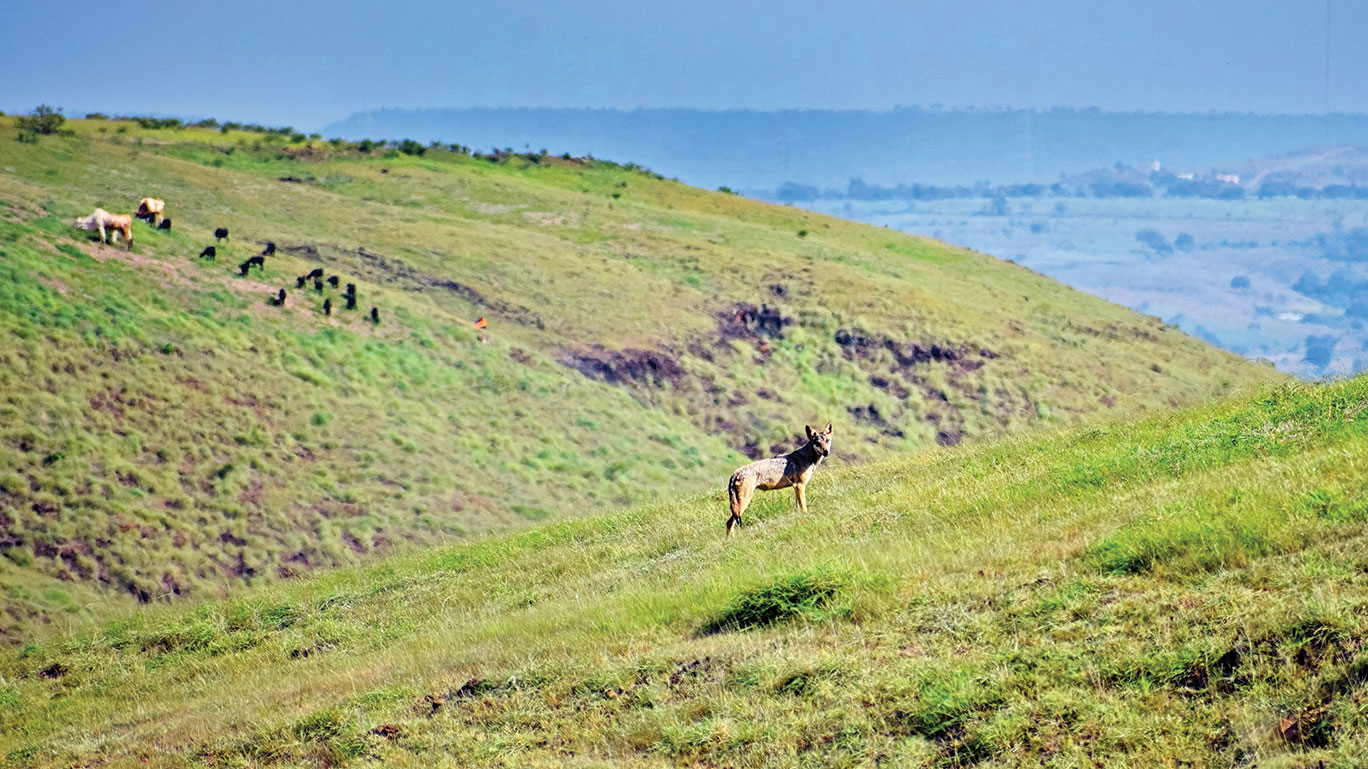
A wolf shares the same rolling grassland habitat as a shepherd with his goats an cattle in Akolner, Maharashtra. Photo: Sudhendra Sonawane.
Science And Lore
“There was a time when shepherds had no problems,” said Poojary, narrating the lore on how wolves came into being. They let their sheep graze. After lunch they lay around the grass. Life was peaceful, almost boringly so.
“One day, a shepherd decided to ask God for a problem,” he said. God took a white sheep, cut a patch of wool, rubbed turmeric on it and tossed it in the air. As the legend goes, that was how the wolves came to be. That was it. The problem was created. Perhaps this is why shepherds like Poojary call the wolf their maternal uncle. Perhaps it is easier to tolerate a relative than a predator. Whatever the reason, the lore has done something decades of conservation efforts struggled to do. It has made room for the wolf inside a shepherd’s world.
The larger problem is that the world itself is now changing.
Wolves are believed to have walked the Earth for around two million years. Evidence reveals that the grey wolf lineage shared the landscape with ancient cavemen as long as 40,000 years ago. Wolves have lived through the rise and fall of kings and empires including the Mauryas, Chalukyas, Vijayanagaras, and Marathas. Adaptable canids, they even managed to survive determined British colonial campaigns that sought to exterminate them. Wolves even lived through two world wars. And yet, modern India has never conducted a nationwide census of its wolves.
Dr. Abi Tamim Vanak, Senior Fellow and Director of Centre of Policy Design at ATREE Bengaluru, believes that the key challenge in estimating wolf population density in India is that most wolves are found outside forests and Protected Areas. Counting a wolf is not as relatively easy as counting a tiger. Wolves live in places that wildlife maps often ignore: agricultural fields, scrub, grazing lands, village edges, and other lands that people have already claimed for themselves. Vanak suggests that scientists cannot entirely depend on camera traps for wolf population estimation, though such methods have thrown some broad strokes and presence-absence population trends.
Based on available data, Vanak estimates that the Indian grey wolf population might be anywhere between 3,000 and 5,000 across India’s fast dwindling grasslands. He adds that habitat loss, human-wolf conflict, poaching, expanding livestock farming, and hybridisation with free-ranging dogs are the primary threats faced by wolves today.
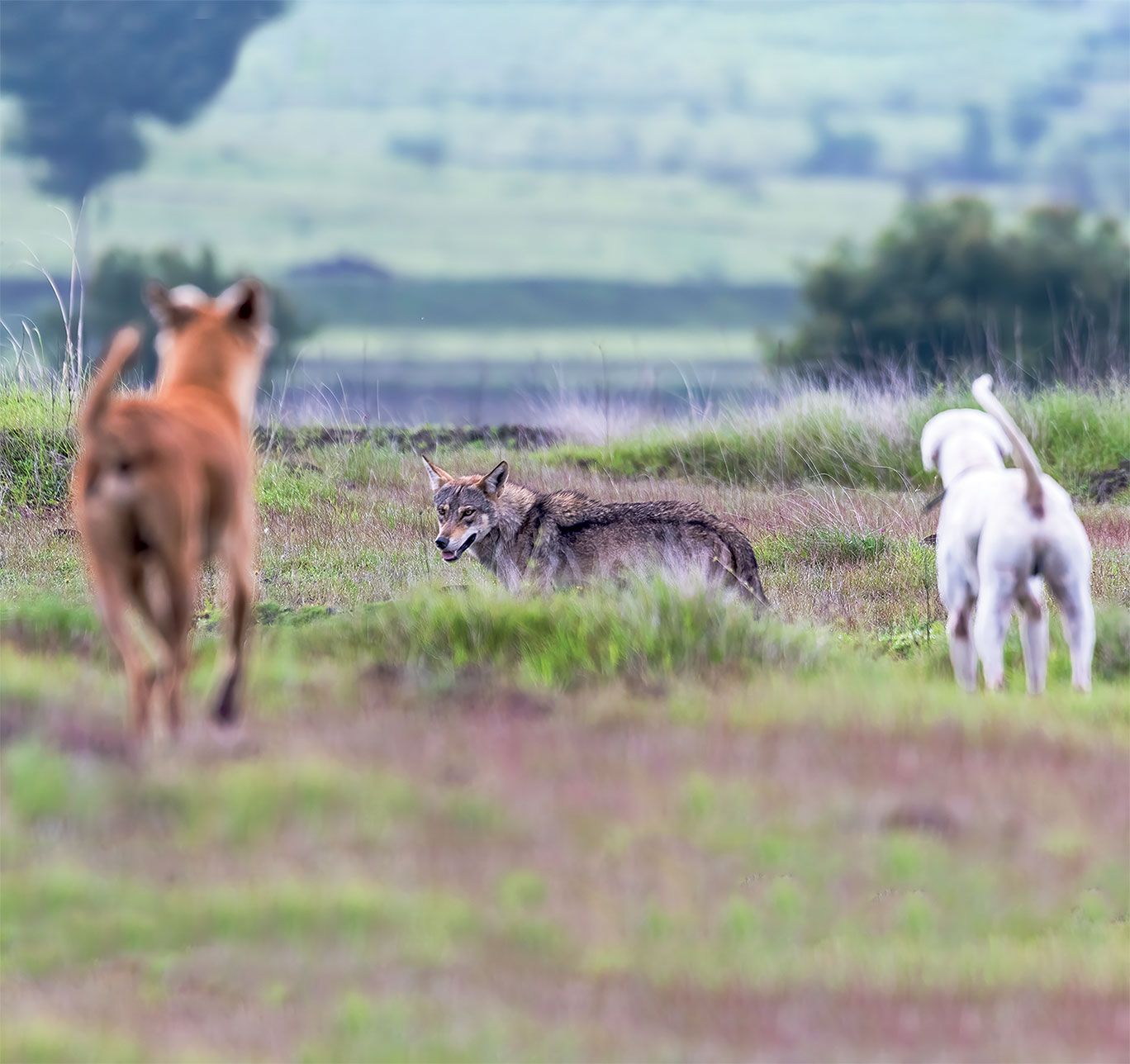
Free-ranging dogs compete for resources, transmit disease, and can hybridise with wolves. For a small and increasingly fragmented population, such hybridisation can erode genetic identity. Photo: Ritesh Dighe/Sanctuary Photolibrary.
Too Little Too Late?
For nearly two days, Durgappa and Gangadhar took me out in search of wolves. Convinced all we would get is their signature pugmarks, scat evidence containing chikoo and watermelon seeds, we made up our minds to head back. And there when we least expected it – two wolves in the grass! One lay on its back, legs pointing towards the sky. Durgappa ran towards it, convinced it was dead. The startled wolf got up, threw us a look, and disappeared into the bush.
We climbed rocky slopes to scan the surroundings with binoculars, but to no avail. As we made ready to leave, a Bengal fox appeared, almost like a consolation prize for all our efforts.
Determined to also spot a wolf on my third day, we left at 6 a.m. Within 30 minutes a wolf emerged silently from the bush. And another larger one soon after. Together they ran and howled across the grassland for 10 minutes, doing precisely what I had hoped they would do, as I sat, mesmerised and watched.
Behind them were windmills, piercing through the grassland skies. There were bunds where the earth had been dug up. In the distance, towers reminded us of several developmental projects. A railway line cut through the landscape a few kilometres from where we had spotted the wolves.
Through all this the howl of wolves persisted. It was a beautiful thing to watch. But made us wonder, sadly, how long this particular view would remain beautiful.
The climate question came to me later. The Indian grey wolf is, after all, an animal accustomed to heat. But climate change is yet an emerging research question in wolf conservation. Temperatures up to 470C occur across parts of its range. It sheds much of its underfur in summer and uses behavioural strategies such as hydrating on watermelons to keep cool.
A 2022 Wildlife Institute of India study found that wolf occurrence is strongly associated with temperature and rainfall, along with habitat, livestock availability, and human modification. Wolves favour warm, semi-arid landscapes with relatively low rainfall.
Indrajit Ghorpade, conservationist and founder of Deccan Conservation Foundation, told me that by summer, most waterholes dry up, forcing the wolves to turn towards whatever optional sources they can find. Sometimes, that means berries and watermelon. As summers become hotter, waterholes dry sooner, and rainfall becomes less predictable. What will happen to the animals that have always survived there for eons, remains an unanswered question for researchers. Will the wolves travel afar, or venture closer to the villages, prey on livestock, thrive on crops and enter into conflicts the species cannot possibly outlast?
Nirmala N.K., IFS, Deputy Conservator of Forests in Koppal, says that for the most part, thus far, wolves have managed to exist in harmony with nature and the locals. She adds that Karnataka is home to the second wolf sanctuary in India in Koppal’s Bankapur. “However, wolves often wander outside the sanctuary and near farmlands or revenue lands, and it does not come under the purview of the Forest Department to step in and set aside those lands for wolves alone,” she said, articulating the administrative challenge behind wolf conservation.
When I asked Ghorpade about the greatest threat to wolves today, he said that for a predator that has survived emperors, colonisers and wars, the greatest threat in the latter half of the 21st century may not be shrinking grasslands, but that the Deccan itself becomes inhabitable.
Shradha Triveni is a Bengaluru-based journalist. Growing up in the stretch between Mangalore and the Western Ghats, observing the wild came naturally to her. Currently, she is a Climate Change Reporting Mentee with Asian College of Journalism, Chennai, funded by Interlink Academy, Germany.