The Economics Of A Living Tiger - Conflict And Coexistence
First published in Sanctuary Asia,
Vol. 46
No. 6,
June 2026
By Dr. Anish Andheria
The debate around vehicle-bound (jeep) safaris in India’s tiger reserves often generates more heat than light. Critics tend to portray vehicle-bound safari tourism as an ecological disturbance that heightens human-tiger conflict. Yet three decades of regulated safari operations across multiple reserves offer no scientific evidence that properly managed vehicle tourism increases conflict. If anything, research and field experience consistently show that habitat degradation, prey depletion, fragmentation, and disrupted wildlife corridors, not tourism vehicles confined to designated tracks, are the primary drivers of conflict.
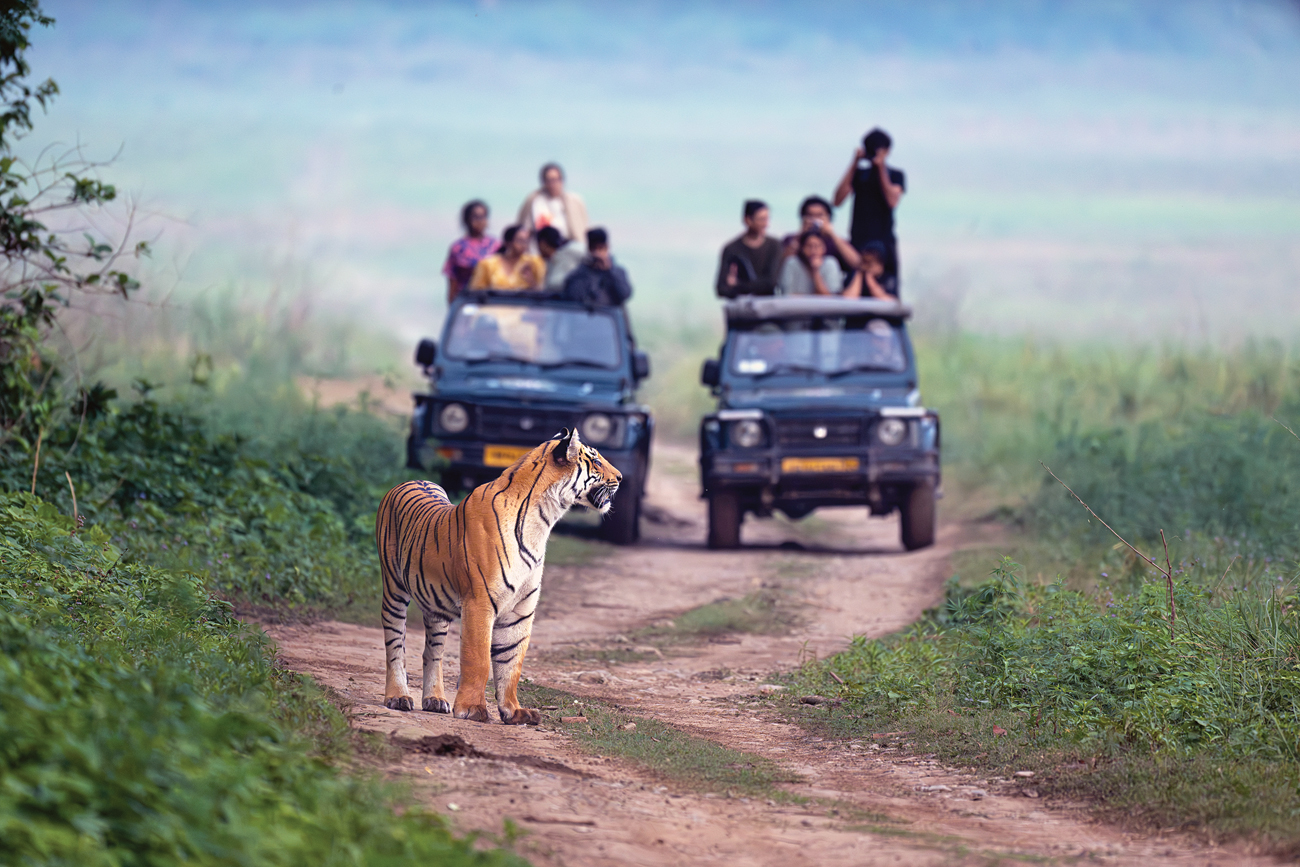
Regulated jeep safaris are not the principal cause of human-tiger conflict. When properly managed, they are instruments that finance conservation infrastructure, sustain rural livelihoods, and incentivise coexistence. Photo: Dr. Anish Andheria.
Conservation Beyond Perception
Jeep safaris in India operate within clearly demarcated tourism zones. Forest Departments regulate the number of vehicles, prescribe routes, and enforce strict entry and exit timings. These are not unregulated intrusions into core habitats; they are structured activities embedded within spatial zoning protocols governed by the National Tiger Conservation Authority (NTCA). Decades of ecological research has shown that conflict mitigation in tiger landscapes depends far more on
• Restoring degraded habitats
• Securing inviolate core areas of tiger reserves
• Maintaining functional wildlife corridors
• Strengthening wild prey populations
• Supporting the livelihoods and welfare of communities residing in the buffer-zones and designated corridors
When these priorities are addressed, tourism can coexist with conservation goals. The narrative that equates jeeps with conflict, oversimplifies a complex ecological reality.
Wildlife And Water Security
The tiger and the elephant are more than charismatic megafauna – they embody the vitality of entire forest ecosystems. Forests, in turn, are far more than wildlife habitats – they function as living water towers. When we connect the dots – from tiger/elephant to forest, from forest to water/soil, and from water/soil to the poorest of the poor living in and around these landscapes – the truth becomes evident: conserving natural ecosystems, symbolised by the tiger and the elephant, is inseparable from safeguarding human survival. What appears to be wildlife protection is, in reality, a landscape-scale life support system.
Madhya Pradesh’s Masterstroke
Wildlife tourism is not merely a leisure industry. In many forested districts, it is a rural economic backbone. The safari economy sustains guides, drivers, vehicle owners, and small hospitality operators. Around them exists a wider ecosystem of home stays, hotel workers, vegetable vendors, artisans, and transport providers.
Consider Madhya Pradesh, home to the largest population of wild tigers in India. In 2024-25, its five leading tiger reserves – Kanha, Bandhavgarh, Pench, Satpura and Panna – generated approximately Rs. 59 crore in park entry fees from vehicle-bound safaris alone. Once the distribution of safari charges is factored in, roughly another `80 crore flowed directly to vehicle owners, drivers, and guides, most of them villagers living within tiger landscapes.
The broader economic ripple effect is even more striking. When accommodation, food services, transport, and related expenditures are included, the annual economic circulation linked to these five reserves is conservatively estimated at Rs. 770 crore. This figure likely understates the total, given the premium tariffs charged by several high-end resorts in these regions. Far from being marginal, wildlife tourism operates as a substantial rural growth engine.
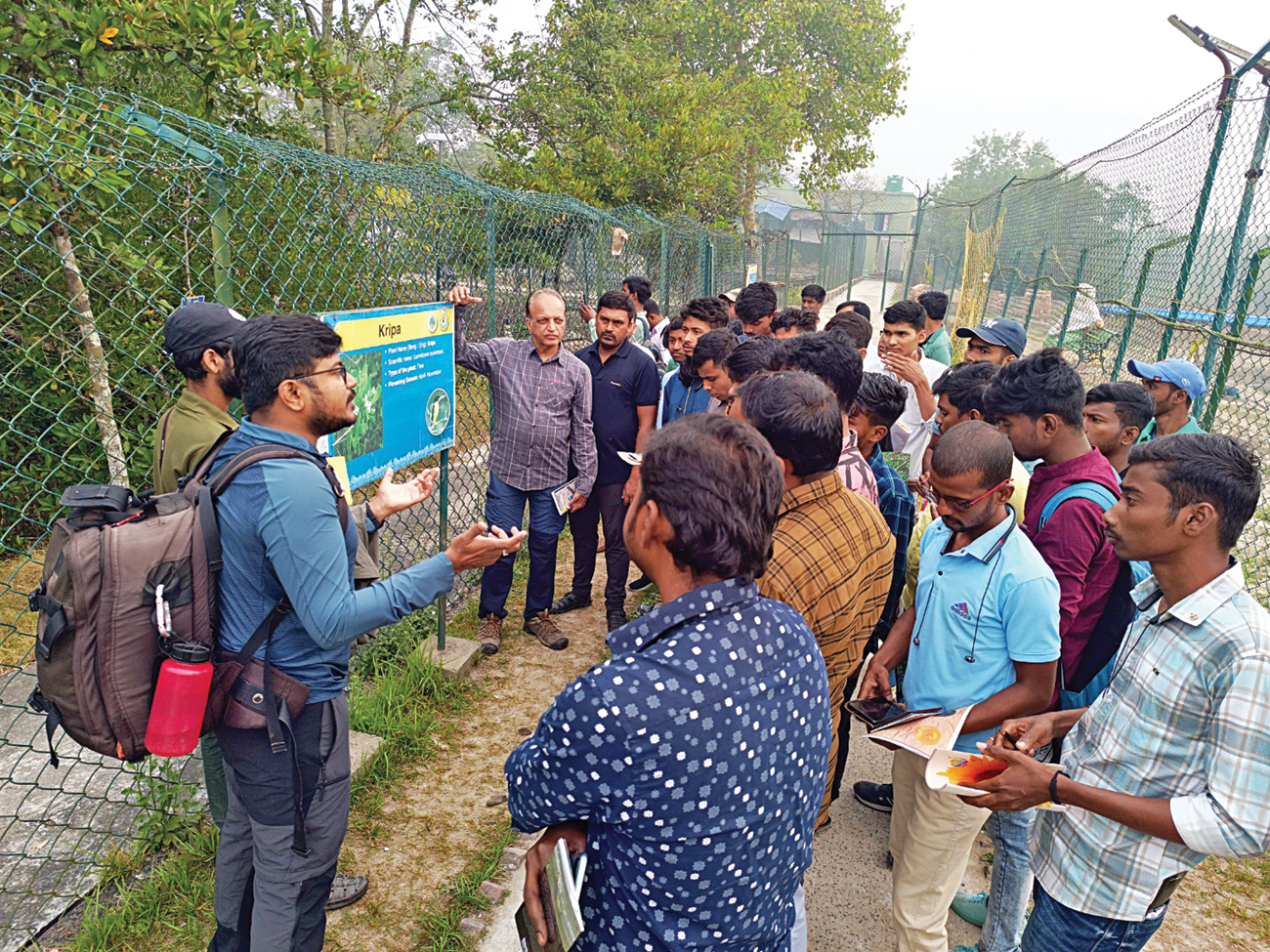
Dr. Parvish Pandya and Saurabh Sawant addressing guides in the Sundarban Biosphere Reserve. Most guides, guards and boatmen belong to local communities. Photo Courtesy: Dr. Parvish Pandya.
Lessons From Tadoba
The Tadoba-Andhari Tiger Reserve in Maharashtra offers another instructive example. With 25 tourism gates – six core, 16 buffer, and three territorial forest gates – it provides steady employment for local communities. In fact, as many as 19 of these gates (those in buffer and territorial forests) are open to tourists all throughout the year.
Annual estimates indicate
• About Rs. 40 crore collected in park entryfees by the forest department
• Approximately Rs. 60 crore earned by vehicle owners, drivers, and guides involved in vehicle-bound safaris
• Nearly Rs. 400 crore circulating through the wider tourism economy
These figures reflect a structured value chain that extends well beyond government collection to localised livelihood generation.
Sharing Gains
An often overlooked dimension is revenue redistribution. Roughly half of the safari entry fee collected by Forest Departments is channelled back to villages through Eco-Development Committees in buffer zones of tiger reserves. These funds support infrastructure projects, livelihood diversification, and community welfare initiatives decided at the village level.
For farmers who experience crop losses because of wild herbivores, tourism income provides a financial cushion. Where wildlife generates tangible economic returns, tolerance tends to increase. This pattern is visible in Madhya Pradesh and Maharashtra, which together support roughly one-third of India’s wild tiger population. Community accommodation of large carnivores in these states is not accidental; it is reinforced by economic participation.
From a conservation-economics perspective, a living tiger is a renewable asset. Over its lifetime, it can generate sustained tourism revenue that far exceeds the short-term incentives associated with poaching or retaliatory killing. When communities perceive wildlife as a source of stable income rather than uncompensated risk, coexistence becomes economically rational.
India’s long-standing cultural reverence for wildlife provides fertile ground for this model. Aligning that reverence with transparent and equitable revenue-sharing systems strengthens both conservation and social stability.
Guard Against Conflict-of-interest
Karnataka must guard against the socio-political ambitions of a small, power-driven few whose actions threaten to dilute the conservation ethos that has long defined this nation. It would do well to draw lessons from Madhya Pradesh and Maharashtra by reducing the state’s monopoly over tourism operations. Such reform would allow income to be redistributed from a narrow band of permanent government employees to communities who share their backyards with tigers and elephants and routinely shoulder the costs of coexistence. The poorest communities are the first to suffer when ecological systems erode – and, fortunately, the first to gain when they are restored. By aligning policy with people through nature-sensitive tourism, we can strengthen local livelihoods while securing the future of these great mammals and the forests that sustain us.
Tool… Not Threat
Regulated jeep safaris are not the principal cause of human-tiger conflict. When properly managed, they are instruments that finance conservation infrastructure, sustain rural livelihoods, and incentivise coexistence. The real conservation battle lies in maintaining habitat integrity, corridor protection, and long-term community engagement. If India’s tiger landscapes are to endure, conservation must work for the people who live alongside wildlife. When ecological safeguards and economic opportunity move together, both tigers and communities stand a better chance of thriving for generations.
Dr. Anish Andheria, President and CEO of the Wildlife Conservation Trust founded by Hemendra Kothari, is a field biologist who works with policy makers to win community support.