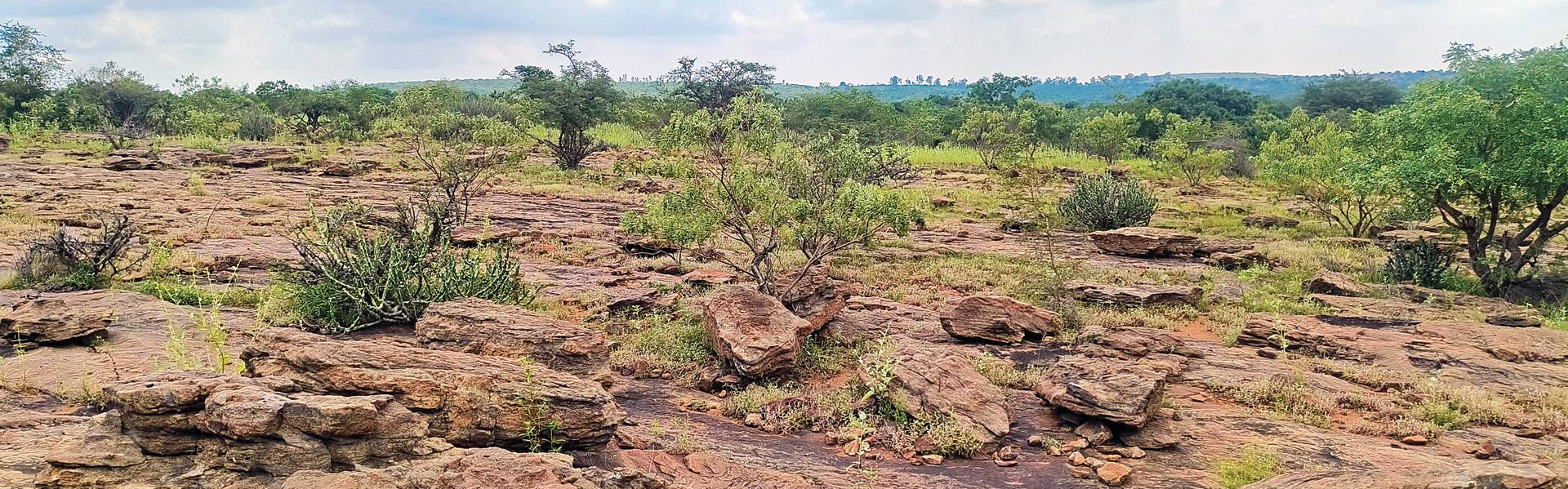
Some Lands Should Stay Brown
First published in Sanctuary Asia,
Vol. 46
No. 6,
June 2026
Sanjay Gubbi takes us into the world of billion-year-old rocks of the Dharwar Craton, a hidden world of hyenas, wolves and foxes that struggle to survive modern pressures.
As we climbed the hillocks under a searing 400C sun, the landscape seemed to shimmer with heat. Trees typical of dry forests – pale trunks of Indian ghost trees, the rugged bedda nut, bursts of flame-of-the-forest, axlewood, east Indian ebony and ivory wood – slipped past us. Thickets of custard apple led me to pause; for a moment, wondering whether I had mistakenly wandered into an orchard! But these were wild, thriving in their natural habitat. Within a couple of hours, drenched in sweat and parched, we reached a plateau. Scattered across the ground were middens of nilgai pellets, an unusual sight in Karnataka. This large antelope has slowly been recolonising the state after disappearing in the 1950s.
I was in the Chincholi Wildlife Sanctuary, a relatively small Protected Area of 134 sq. km., but part of a much larger and ecologically significant landscape rooted in the geological history of the Deccan. Much of this region rests on the ancient bedrock of the Dharwar Craton, formed over 3.5 billion years ago. Among the oldest geological formations in India, it underpins vast stretches of the country. I consider myself fortunate to have been born and raised in this landscape. Yet beyond its geological significance lies a quieter story of wildlife and ecosystems that have long been overlooked.
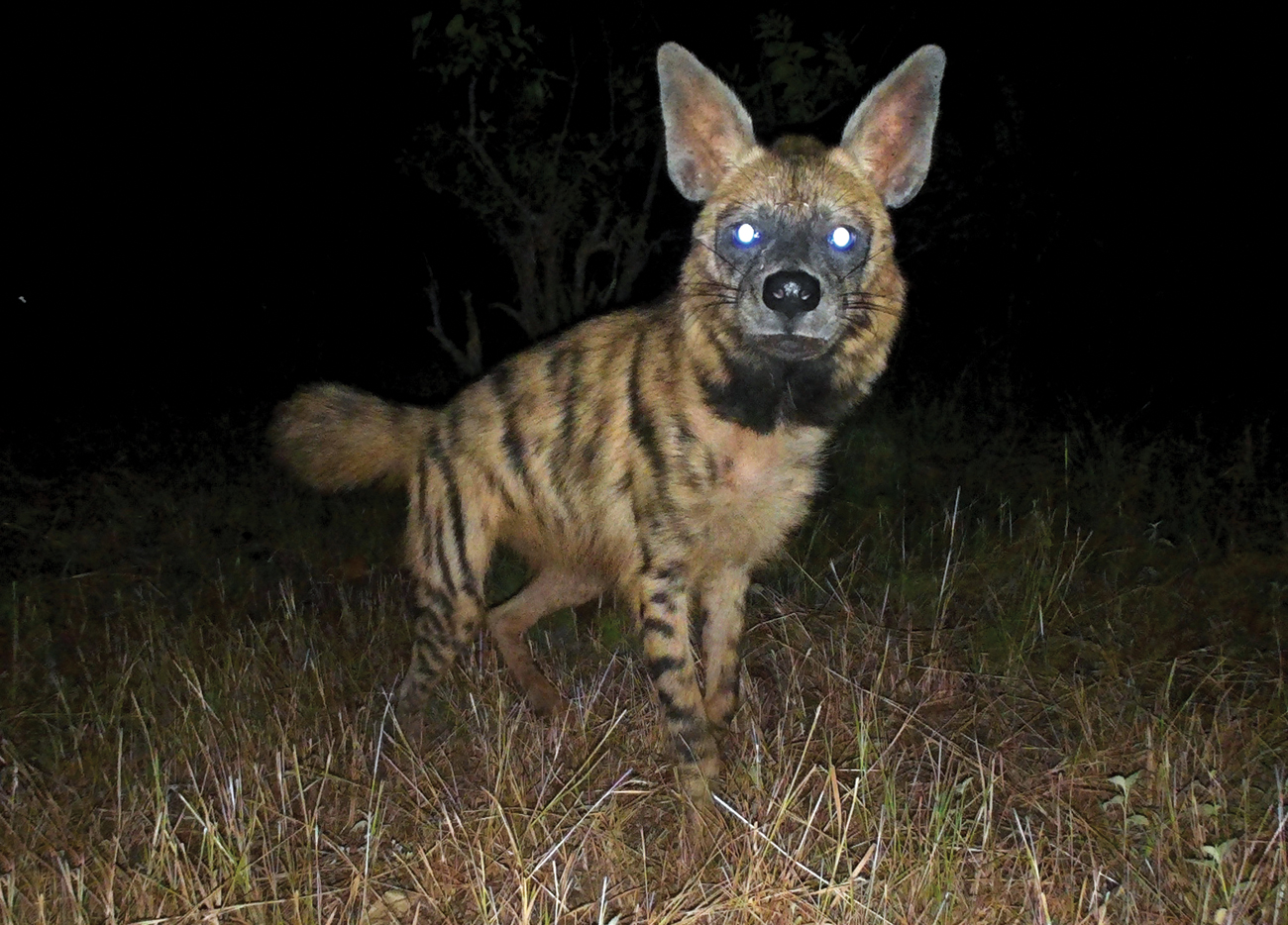
The Kalyana Karnataka region and its adjoining landscapes are home to approximately 150 striped hyenas, one of India’s most misunderstood yet ecologically vital predators. As nature’s clean-up crew, striped hyenas play a crucial role as scavengers, helping keep ecosystems healthy by removing carcasses and limiting the spread of disease. Photo: Holématthi Nature Foundation.
Biodiversity-rich Drylands
One such region is Kalyana-Karnataka, in the northern part of the state, once under the rule of the Hyderabad Nizams. The districts of Bidar, Kalaburagi, Raichur, Yadgir, Ballari, Vijayanagara and Koppala form its core, with adjoining districts such as Gadag, Bagalkote, Belagavi and Davanagere buffering this landscape. Together, they support a remarkable diversity of mammals, birds, reptiles, plants and several other lifeforms, many of which remain poorly studied and urgently need conservation attention.
Understanding and conserving wildlife in this dry, underappreciated landscape had long been a personal goal. When The Habitats Trust announced partnerships to support lesser-known ecosystems, it offered a rare opportunity. Few initiatives venture beyond charismatic forests and well-known reserves. This was a chance to explore a different India – one that exists on the margins of conservation priorities.
Over three years, our team traversed 12 of Karnataka’s 31 districts, covering nearly half its geographical extent. Intensive, methodical surveys were conducted across 2,382 sq. km. (5,88,600 acres), involving 504 days of fieldwork – an area amounting to roughly 70 per cent of Goa, though without any of its laid-back charm. A harsh terrain of rocky outcrops, grasslands, scrub and dry deciduous forests, summer temperatures here routinely exceed 400C. The tyres of our four-wheel drives took a real beating under the sun, and our equipment often failed in the relentless heat. Our estimated costs rose not because of inflation, but because of the landscape itself. Team members too often found themselves drained of energy, but thanks to our persistence the land kept revealing its secrets.
Surprise Discoveries
One of our first surprises came in October-November 2023, when camera traps placed in the Chincholi Wildlife Sanctuary captured images none of us had anticipated – dholes. These elusive, rust-coloured wild dogs appeared nearly 200 km. from their known distribution.The discovery brought both excitement and concern. The dholes were not confined to the sanctuary; they moved through adjoining reserved forests in Bidar district, where wildlife protection remains weak. Recognising this, we proposed expanding the sanctuary by an additional 10,000 acres to secure a safer range for these animals.
Another striking discovery came on a winter afternoon in January 2026. A leopard photographed by our camera traps appeared unusual. On closer examination, the cat displayed a lighter pelage, pale brown rosettes and pinkish pigmentation on its paws – a rare condition known as erythrism, referred to by some as a “strawberry leopard”. Documented only a handful of times globally, this was the second such record from India and the first from Karnataka.
To root it in the cultural identity of the region, I named it the sandalwood leopard. The response was immediate; people connected with it far more easily than with a foreign term.
As surveys expanded, clear patterns emerged. Districts such as Raichur, Yadgir, Koppala, Gadag, Bagalkote and Belagavi proved to be strongholds for striped hyenas. We estimated 149 individuals from our study site, suggesting a state population of 300 to 350 – far fewer than tigers.
One hyena tracked in the Ramdurg-Saundatti landscape revealed extensive movement across human-dominated areas between forest patches. This highlighted their large home ranges and underscored the criticality of reserved forests as denning and survival refuges.
The same landscape also supports Indian grey wolves, though estimating their numbers remains a challenge owing to the absence of unique markings. Their relative abundance (refers to how common or rare a particular species is compared to other species or within a given area, rather than its exact population size) compared to other species struck us as lower than that of hyenas, but higher than that of leopards. Interestingly, in regions such as Lingasugur and Shirhatti, hyenas, wolves and leopards coexist, raising important ecological questions. Might the recent spread of leopards into such areas eventually displace wolves? Particularly concerning since current estimates suggest that Karnataka may support fewer than 400 wolves.
Among the more adaptable carnivores, the golden jackal thrives across this landscape, even as concerns about its decline emerge elsewhere in the state. By contrast, the Bengal fox, dependent on open grasslands, appears far more vulnerable. As grasslands are converted to agriculture, particularly dense crops such as maize and sunflower, this habitat specialist struggles to survive, unlike the more adaptable jackal.
Remarkably, these drylands support four of India’s six antelope species – the four-horned antelope, blackbuck, chinkara and nilgai (the other two, namely the chiru or Tibetan antelope, and the Tibetan gazelle, occur in the Himalaya). While blackbuck and nilgai are found in both forests and agricultural areas, the four-horned antelope and chinkara remain dependent on protected habitats. This contrast underscores the need for species-specific conservation strategies.
Interestingly, nilgai, locally extinct in Karnataka since the 1950s, are now recolonising parts of Bidar, Kalaburagi and Yadgir from Telangana. Their return presents a complex dilemma. While ecologically significant, they are also associated with crop damage, raising difficult questions about coexistence.
Yet, beneath these encouraging findings, lies a more troubling reality.
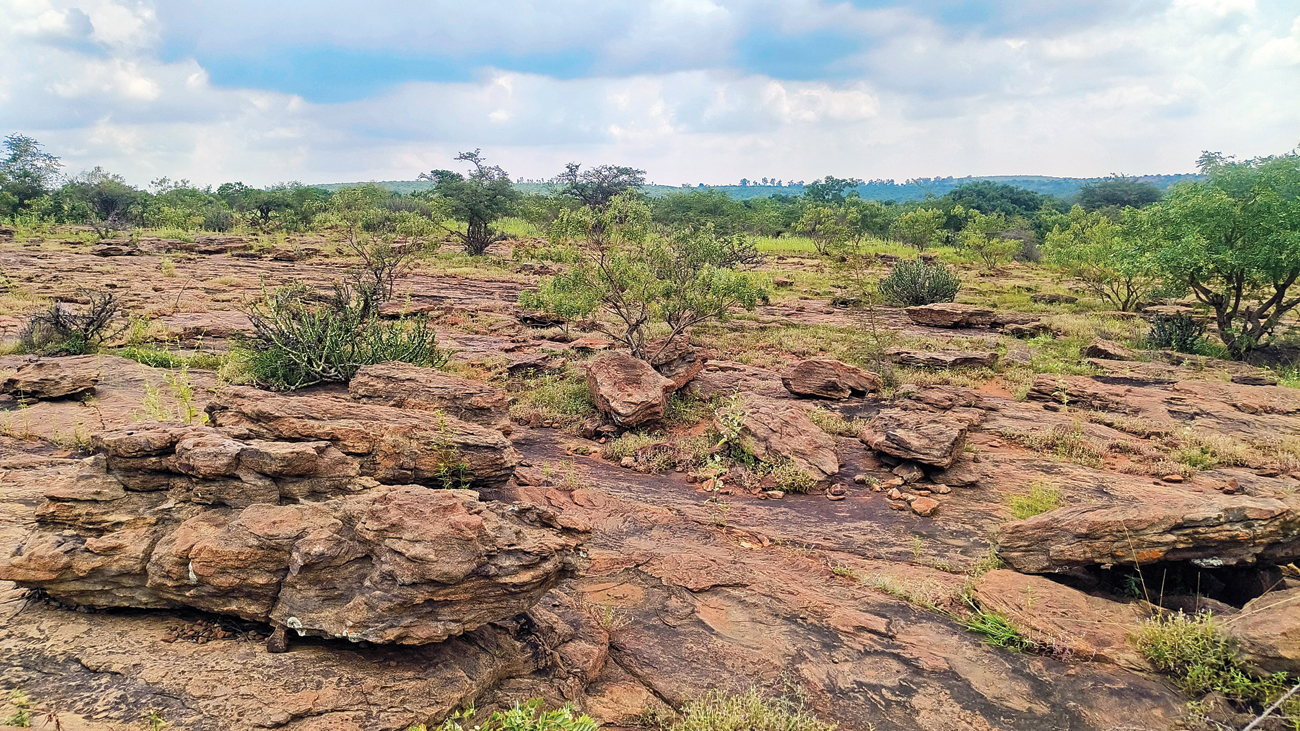
Kalyana Karnataka, in the northern part of the state, is a rugged and overlooked landscape that supports an extraordinary diversity of life. This dry terrain comprising rocky outcrops, scrub, grasslands and dry deciduous forests, supports uncounted mammals, birds, reptiles, and plant species, many still poorly studied and in urgent need of conservation attention. Photo: Shravan Suthar.
Vanishing Lives
A striped hyena photographed with a missing forelimb, and sloth bears scarred by snares, reveal the scale of poaching in this region. In a single night in Yadgir, our camera traps recorded 13 different hunting parties. The scale was staggering.
People carrying guns and snares were hunting monitor lizards, hares and more, and seemed to move about with impunity. Over three years, we documented as many as 49 poaching incidents. Such ungodly pressure inevitably pushes large carnivores towards livestock, intensifying human-wildlife conflict. Our earlier findings confirmed that poaching levels are significantly higher in reserved forests and human-dominated landscapes than in Protected Areas, and this pattern appears to hold true here as well.
Simultaneously, habitat transformation is accelerating. Grasslands and scrub forests are rapidly being converted to agricultural fields. Traditional crops such as pulses once supported wildlife, but intensive cultivation of maize has reduced habitat suitability for species such as hyenas and Bengal foxes. Rocky outcrops and open grasslands, so critical to these species, are rapidly disappearing.
Even lands under the Forest Department are not immune. Increasingly, they are diverted for ‘green energy’ projects. While wind farms may not directly affect large mammals, the infrastructure that accompanies them, particularly roads, fragment habitats, spreads invasive plant species, provides access to poachers, and effectively encourages a veritable snare-setting network. Wind farms also take a heavy toll of birds and bats.
One long-term solution lies in securing land tenure by notifying key habitats as Protected Areas. Based on our work, we have proposed bringing several reserved forests under the Protected Area network. We had some initial success, with the government approving Allur to be notified as a Conservation Reserve, with Sumit Patil – the local Deputy Conservator of Forests – taking a keen interest in the process. However, ecologically sensitive management approaches need to evolve. Dryland species, for instance, do not always require artificial water provisioning. Often, excessive interventions such as waterholes therefore turn out to be counterproductive. Similarly, controlled livestock grazing is often essential to grassland ecosystems; and blanket livestock bans can harm the very species conservation seeks to protect.
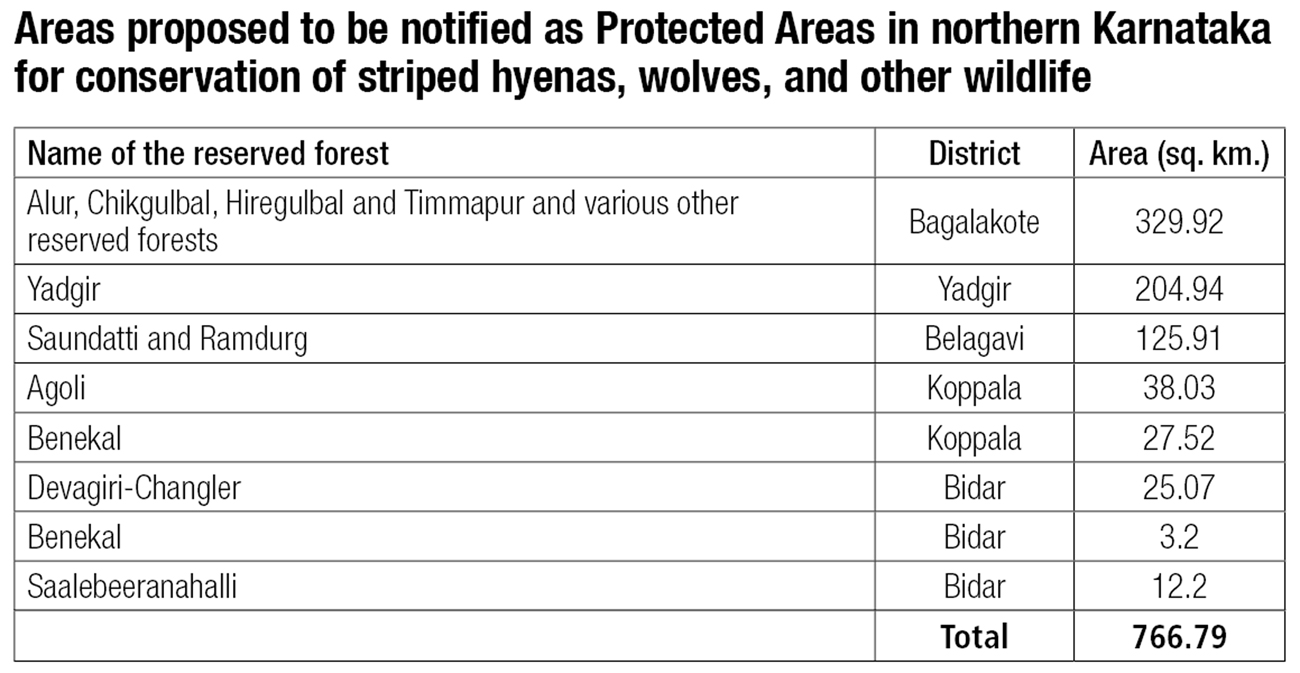
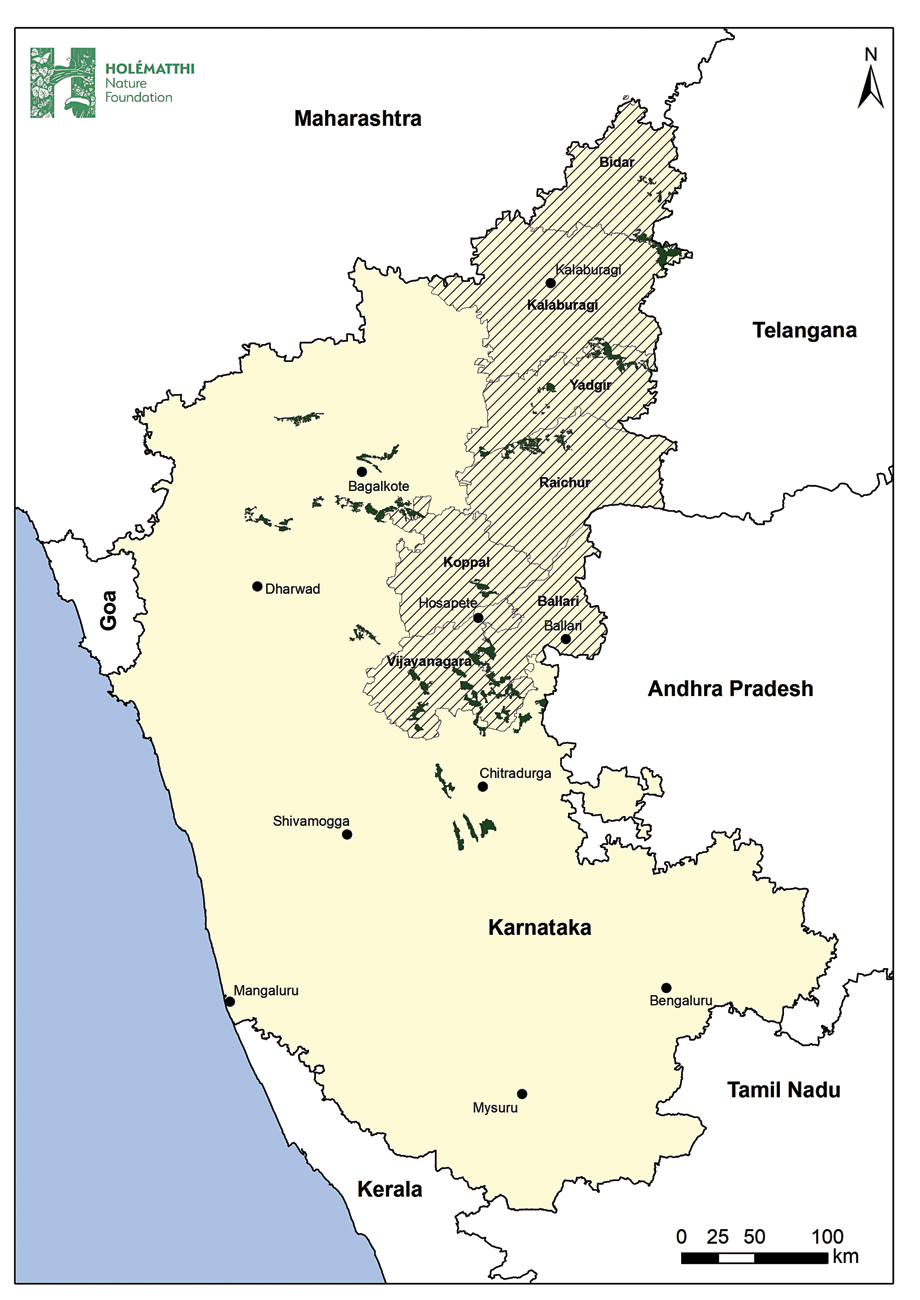
The Holematthi Nature Foundation partnered with The Habitats Trust to study the lesser-known ecosystems of Kalyana Karnataka. Over three years, the team traversed 12 of Karnataka’s 31 districts, covering 2,382 sq. km. (5,88,600 acres) across some of the state’s harshest and most overlooked landscapes.
‘Greening’ The Brown
By our reckoning, perhaps the most paradoxical threat is the push to ‘green’ these brown landscapes. Large tracts of native grasslands and scrub are routinely converted into plantations under afforestation programmes, often made up of non-native species. Plant communities are shaped by complex ecological factors – soil, rainfall, temperature, terrain and long-standing species interactions. Altering these systems without understanding their ecological foundations disrupts entire ecosystems. Yet, there is a persistent belief that all ‘brown’ landscapes must be made green.
The responsibility does not rest solely with government agencies. Environmental organisations too have promoted tree planting as a facile solution to climate change and ecological degradation. Well intentioned as they might be, such interventions often transform native habitats, leading to the regretful decline of species in open ecosystems. We have seen this happen in the Ranebennur Wildlife Sanctuary, where we lost Great Indian Bustards, and the Maidenahalli Conservation Reserve that lost its wolves. Yet the lesson remains unlearned, because grasslands and scrub forests continue mistakenly to be categorised as ‘wastelands’.
The simple truth is that not all healthy ecosystems need be green.
When Wild Meets Domestic
Our camera traps occasionally captured golden jackals that appeared to be hybrids – part jackal, part domestic dog. Similar instances were observed in wolves. In landscapes where wild canids live in close proximity to humans, hybridisation emerges as a serious genetic swamping threat that impacts the genetic integrity and fitness of wild populations.
With the character of habitats being so radically altered, hybrids all too often rapidly end up outcompeting native species by altering ancient ecological dynamics. The presence of domestic dogs also facilitates the spread of diseases such as canine distemper, parvovirus and rabies, posing further risks to already vulnerable populations in this landscape.
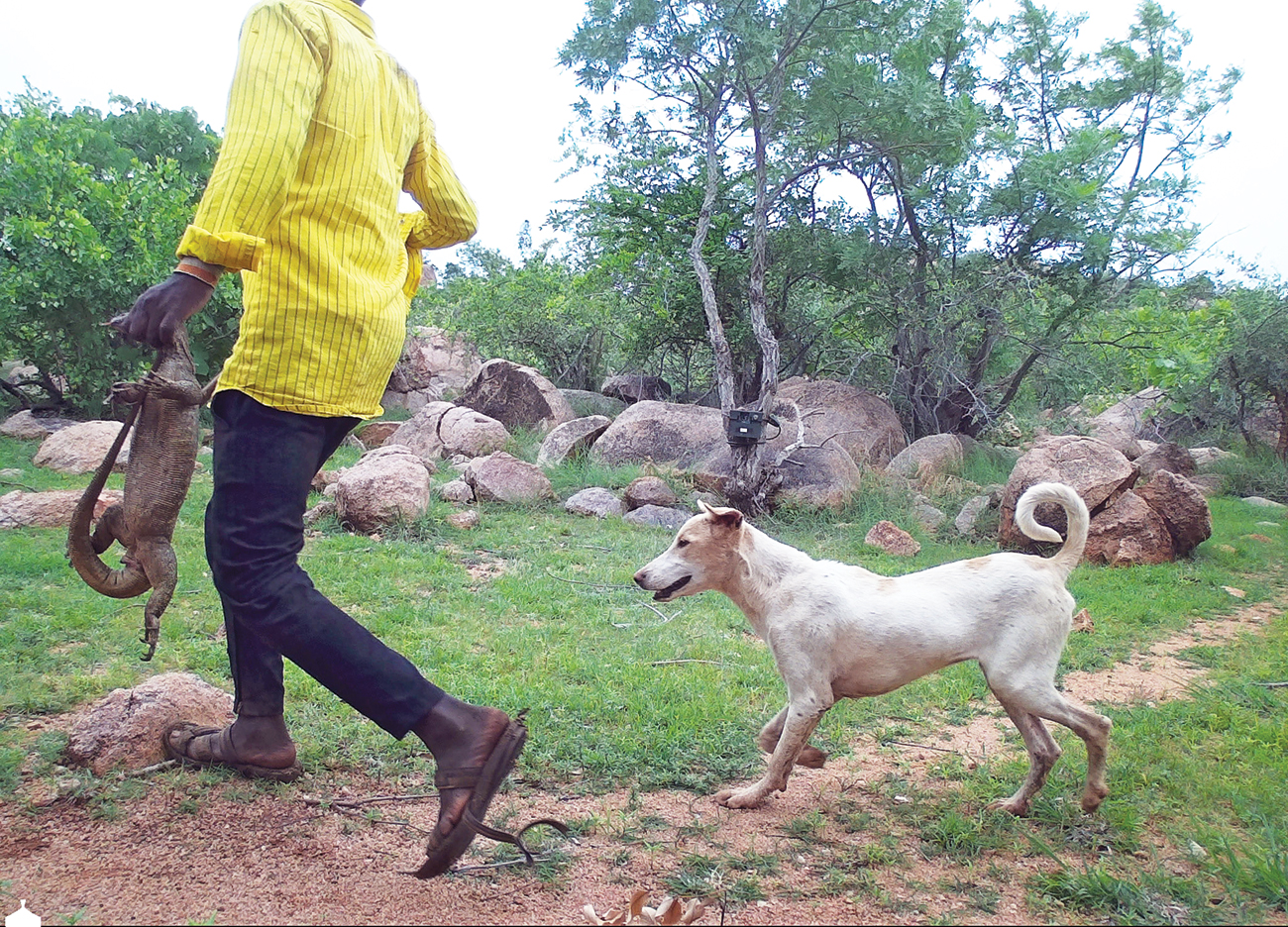
A man carries a poached monitor lizard. Over three years, the author and his team documented 49 poaching incidents. Such relentless pressure drives large carnivores towards livestock, intensifying human-wildlife conflict. This confirms earlier findings of poaching levels being significantly higher in reserved forests and human-dominated landscapes than in Protected Areas. Photo: Holématthi Nature Foundation.
Building Awareness
Compounding such ecological challenges is an alarming lack of awareness. A disturbing video of a striped hyena being stoned to death highlighted deep-rooted fear and misunderstanding, as did the retaliatory killings of wolves, which is also common.
That said, we have many examples of coexistence down the ages. Traditional shepherds such as Seenappa from Dyampura village in Koppala view wolves differently. They believe wolves are akin to maternal uncles, and that livestock prospers when wolves take a few animals. Such beliefs reflect a cultural tolerance that conservationists should recognise and build upon.
To strengthen this foundation, we began building a network of local conservation educators. Among them is Bheemamma, a young woman from Badami, who travels tirelessly from schools to villages, speaking about the importance of wolves, hyenas, jackals and foxes. Whether in classrooms, tea shops or roadside gatherings, she engages people in conversations about coexistence. These efforts are modest, but they are essential. Conservation in such landscapes cannot succeed without local support.
If these landscapes, and the species that define them, are to survive, our approach to conservation must evolve.
It requires a nuanced understanding of habitat needs, a firm response to poaching, and a network of Protected Areas that secure long-term futures. Without this, even these ancient rocks, formed over billions of years, may witness the quiet disappearance of the life they have sustained for millennia.
Sanjay Gubbi A conservation biologist and co-founder of Holématthi Nature Foundation, he is known for his work on wildlife conservation and human-wildlife conflict. He has led landscape-level conservation initiatives across India and contributed to policy, science, and public awareness to protect biodiversity and endangered species.