Saving The Wolves - Catalysing Change
First published in Sanctuary Asia,
Vol. 45
No. 4,
April 2025
By Neha Sinha
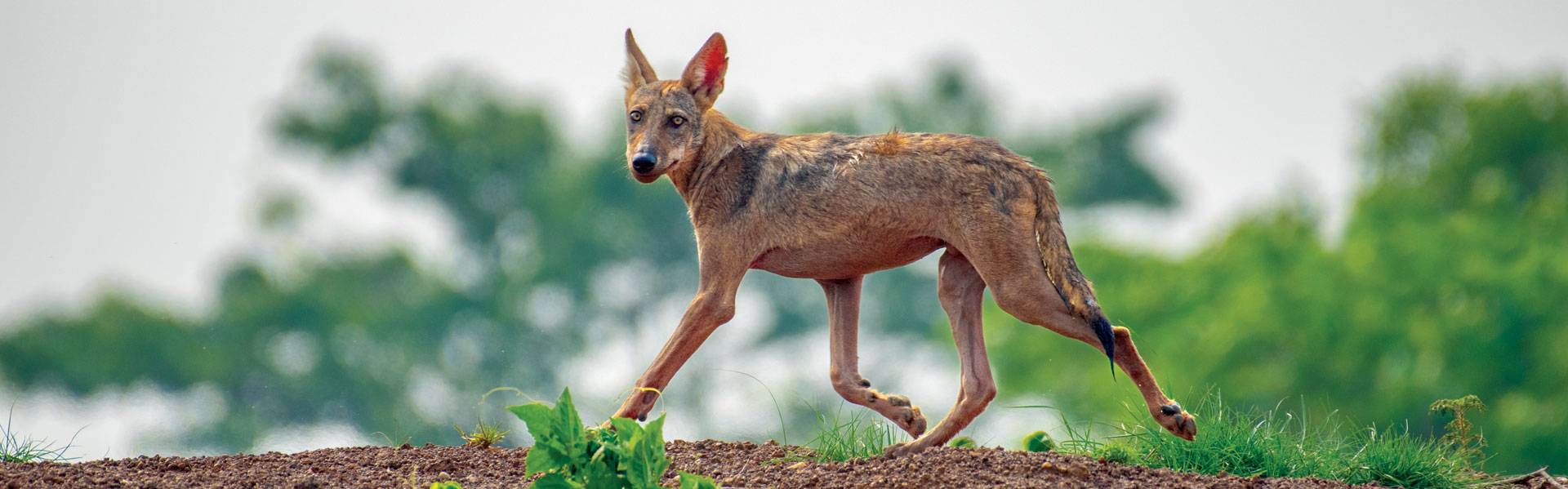
It was a warm January day in 2022. The COVID-19 pandemic was finally receding, and Sagar Adhurya was birdwatching near the town of Durgapur in West Bengal. It was midday, and the winter sun shone softly overhead. He was scanning the landscape through his binoculars, expecting to spot shrikes and babblers. Instead, the view through his lens revealed something unexpected – something secretive. Two mammals, slowly becoming clearer, revealed themselves: a pair of Indian grey wolves Canis lupus pallipes, loping through the abandoned airport of the Durgapur steel plant. It was an incredibly exciting moment. The area, located in Paschim Bardhaman, adjoins mines and steel plants. The fact that wolves could survive there was testament to their adaptability to a surprising variety of habitats. Along with his organisation, Wildlife Information and Nature Society (WINGS), Adhurya decided to keep a watchful eye. Near the Madhaiganj forest, this time at twilight, WINGS’s members Adhurya, Manish Kumar Chattopadhyay, and Arnish Bose spotted the wolves once again. A pack of five was crossing a grassland patch in the Madhaiganj forest.
WINGS received WWF-India’s Conservation Catalyst Programme grant in 2024, a small grant to study wolf presence in Paschim Bardhaman, and to understand the implications of their presence. Under the grant, the team set up camera traps and conducted social surveys in villages. The findings were astounding. Wolves were found in Madhaiganj, Kantaberiya, Bistupur, Rakhistpur, Saraswatiganj, Srikrishnapur and Jambon areas. Yet, alongside their presence, there were also reports of negative interactions. Over 400 people from the surveyed villages said they had suffered direct livestock depredation from wolves, or knew someone who had.
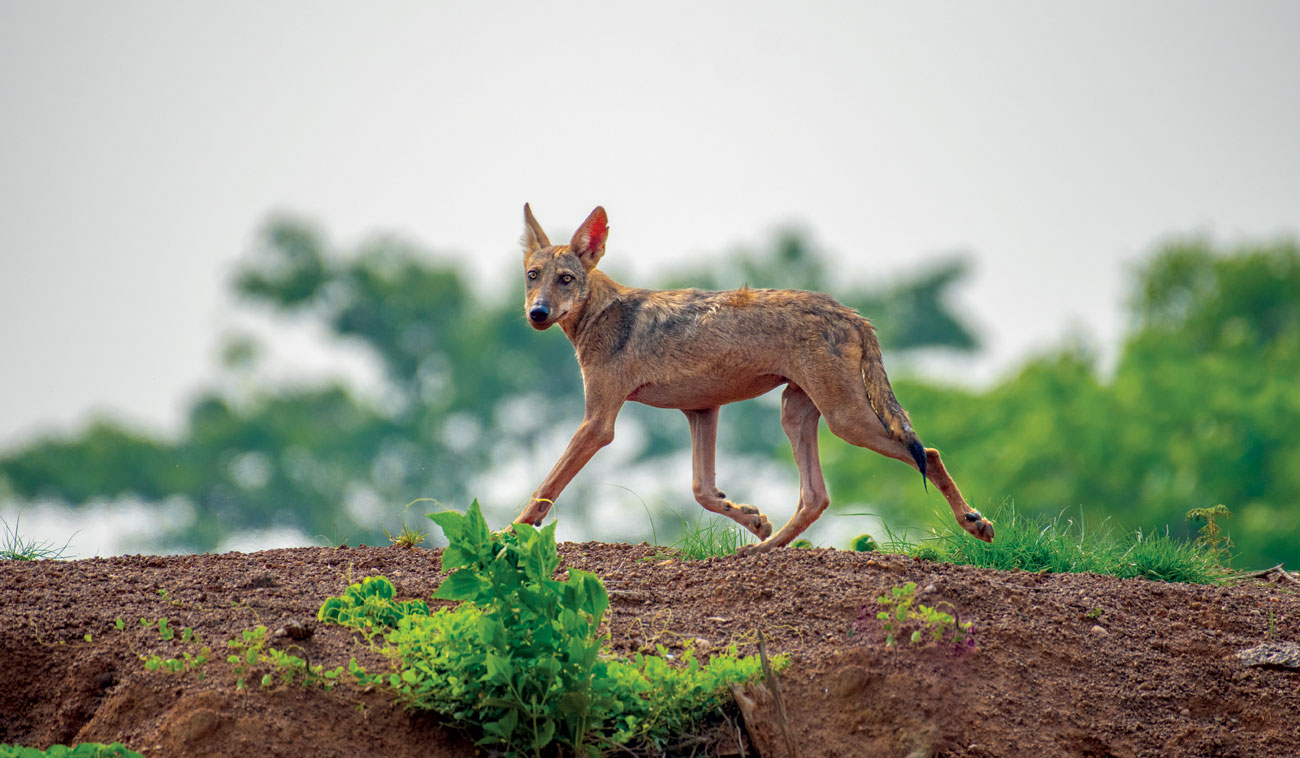
Sagar Adhurya was birdwatching near the town of Durgapur in West Bengal, when he spotted Indian grey wolves Canis lupus pallipes, loping through the abandoned airport of the Durgapur steel plant. Photo: Wings.
Urban Wolves?
For the longest time, large carnivores have been associated with forests. We expect an impenetrable forest tract to hold a tiger; and a hilly, boulder-strewn woodland to yield leopards, with several meso-carnivores hiding in the foliage from the big guys.
Yet ecological studies show that several large carnivores live not just in ‘deep forests’, but also in human-dominated areas. Sometimes, these animals – wolves, hyenas, and leopards – adjust to human presence and resultant subsidies. They forage off garbage dumps, abattoir waste, and livestock. Living with these carnivores will mean addressing the social and economic costs faced by people as well.
In West Bengal’s Paschim Bardhaman, WINGS has documented the presence of both striped hyenas Hyaena hyaena and wolves. It appears that hyenas forage near coal mines, while the wolves move between villages, often preying on livestock. The press has dubbed the Durgapur wolves as ‘urban wolves’, but the animals are there despite urbanisation, not because of it.
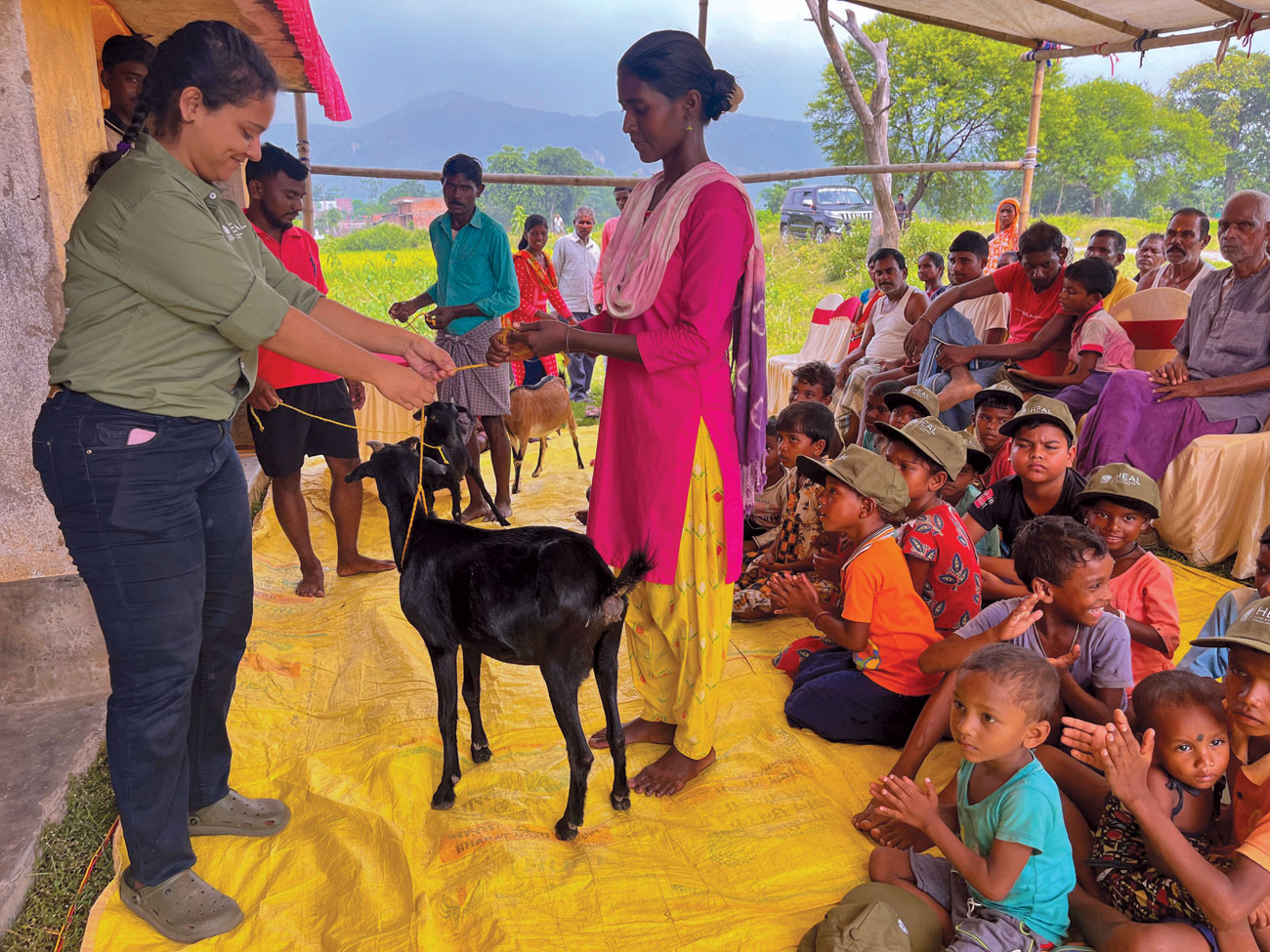
HEAL’s goat bank empowers villages, reducing losses from predators and fostering coexistence with wildlife. Photo: Heal.
“The wolves stay in the forested areas, such as the Madhaiganj forest. On account of urbanisation, their habitats are under threat. If we want to save wolves, we need to prevent the unplanned expansion of urbanisation and indiscriminate mining,” says Adhurya. In surveys done with villagers living around the area, 168 out of 429 villagers reported loss of their livestock to wolf attacks. Out of these 168 people, 74 reported that the wolves had taken livestock from their yard or livestock sheds, meaning wolves were adept at ‘breaking and entering’. The rest of the respondents’ livestock was taken while the animals were grazing. The losses borne by people must be addressed. On an experimental basis, WINGS is testing the use of fladry (coloured flags) on existing fencing to see if it will deter the wolves.
A Goat Bank Stem
In Purulia district, not far from Paschim Bardhaman, an organisation called Human & Environment Alliance League (HEAL) has established an advanced system to deal with livestock depredation. Based on existing bhagi (participatory) systems, HEAL has set up goat banks.
The premise is simple, but empowering.
Along with villagers, by-laws for the goat bank were set up in Simni village, a predominantly Santhali area with a documented presence of leopards, with wolves reported in the larger landscape. Under the agreed by-laws, a 15-member committee, comprising men and women, was formed. Ten committee members were each provided with one female goat, on the condition that they would care for the animals. In return, they would keep a kid from future litters. If a villager suffered livestock depredation by a wild carnivore, they would receive one goat from the goat bank. The seed goats were also vaccinated and given ear tags.
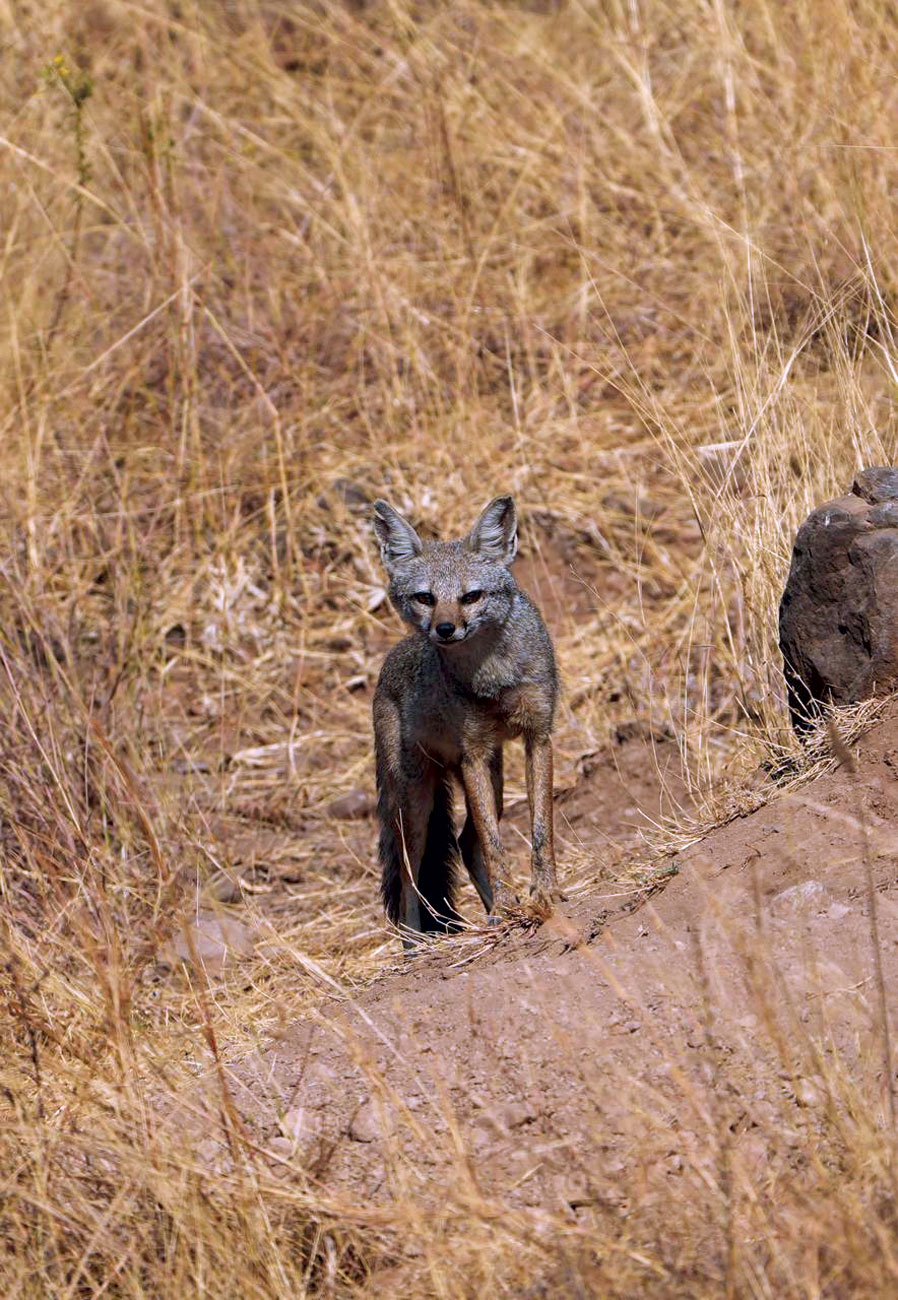
Apart from wolves, the Kiraksal Biodiversity Management Committee has also recorded the Bengal fox, striped hyena, jungle cat, small Indian civet, golden jackal, Indian crested porcupine, and Indian grey mongoose in the surrounding landscape. Photo: Kiraksal BMC.
“The goat bank stems from the idea that people shouldn’t bear large economic losses from wild animal presence. We saw signs of acceptance for the goat bank in a stakeholder meeting when members of the goat bank committee in Simni explained the initiative to villagers in the neighbouring Jabar village. Instead of retaliating or feeling helpless, they now had an option – they could turn to the committee and receive a goat as a replacement. This made us hopeful that, when enabled through community-led initiatives, human-carnivore coexistence in modified landscapes is truly possible,” says Vasudha Mishra from HEAL.
Listen To The Wolves
Meanwhile, in another part of the peninsula, in Maharashtra’s Satara district, the Kiraksal Biodiversity Management Committee (BMC) is trying to understand the presence of wolves in the region.
Surveys with villagers and the Forest Department reported three to four wolf packs (each consisting of three to four individuals) in Kiraksal. Since 2023, the BMC has been monitoring the area for wolves, and have found one pack. The youth group has started awareness drives for the villages and also started liaisoning with the Forest Department to ensure speedy compensation for livestock depredation. Volunteers have been trained specifically on legal documentation related to the compensation schemes.
“This landscape, historically affected by drought and anthropogenic pressures, now faces new challenges because of land-use changes driven by expanding agriculture and irrigation canals. Since May 2023, with intensified monitoring efforts, we have observed frequent wolf sightings – now occurring twice or thrice a month, compared to just once a month previously. We need continuous monitoring to track the wolf packs as they disperse
over larger areas in this landscape,” says Chinmay Sawant from the BMC. “We want to be able to safeguard wolf rendezvous sites, resting sites, and denning sites from November to March each year, as this is the time when wolves have pups. The pups require good habitat, cover, and access to water. This is also a critical time to prevent retaliatory killings.”
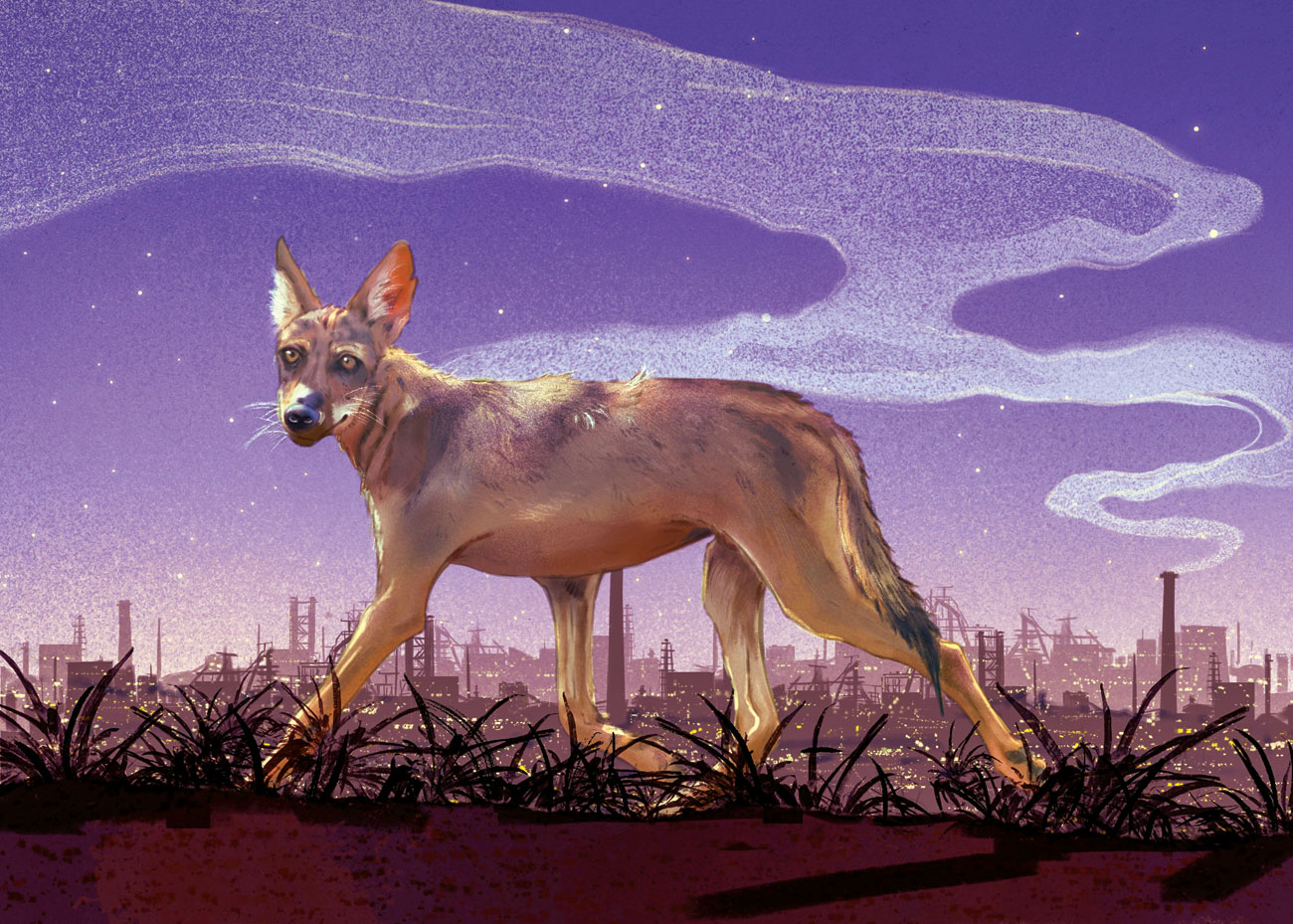
An artist’s expression of a young wolf spotted near steel plants in West Bengal. Photo: Akankshya Subudhi.
The area is significant not only for wolves but also for species such as the Bengal fox, striped hyena, jungle cat, small Indian civet, golden jackal, Indian crested porcupine, and Indian grey mongoose. This corresponds with findings from West Bengal: Tanoy Mukherjee et al, in a 2021 paper, discovered an overlap in the presence of hyenas and wolves in the southern regions of West Bengal.
It’s almost as if the wolves are showing us places that are crucial for other arid-area species. It is up to us to listen, to both the animals, and the people who share lives with them.
WINGS, HEAL and the Kiraksal BMC received WWF-India’s Conservation Catalyst Programme grant for grassroot conservation.
Neha Sinha, a conservation biologist and author, heads Conservation Partnerships at WWF-India.