Reviving Dudhwa's Food-Grass: One Blade At A Time
First published in Sanctuary Asia,
Vol. 46
No. 4,
April 2026
By Somreet Bhattacharya and Mudit Gupta
As dawn breaks, a soft gold seeps across its vast grasslands. The morning air trembles with the chatter of passerines, and on rare, fortunate days, a tiger pads out of tall grasses in search of prey. The tall Terai grasses, locally known as phantas, cradle entire worlds: hog deer carefully picking their way through the undergrowth, swamp deer browsing in small herds, and chital darting in and out of sight. Greater one-horned rhinos graze in these grasslands, leaving wide swathes of flattened vegetation in their wake.
In the Dudhwa Tiger Reserve, almost a fifth of the landscape is grassland, which is essential grazing grounds for ungulates and, by extension, prey for tigers and leopards who move through them like shadows. For the people in the villages surrounding Dudhwa, these grasslands are as much a part of their culture as of the land. They represent the last major expanse of Terai alluvial grasslands in India, and form the beating ecological heart of the reserve. Yet these grasslands, mostly in the buffer areas, are gradually diminishing under the pressures of changing land use, climate impacts and expanding human activity.
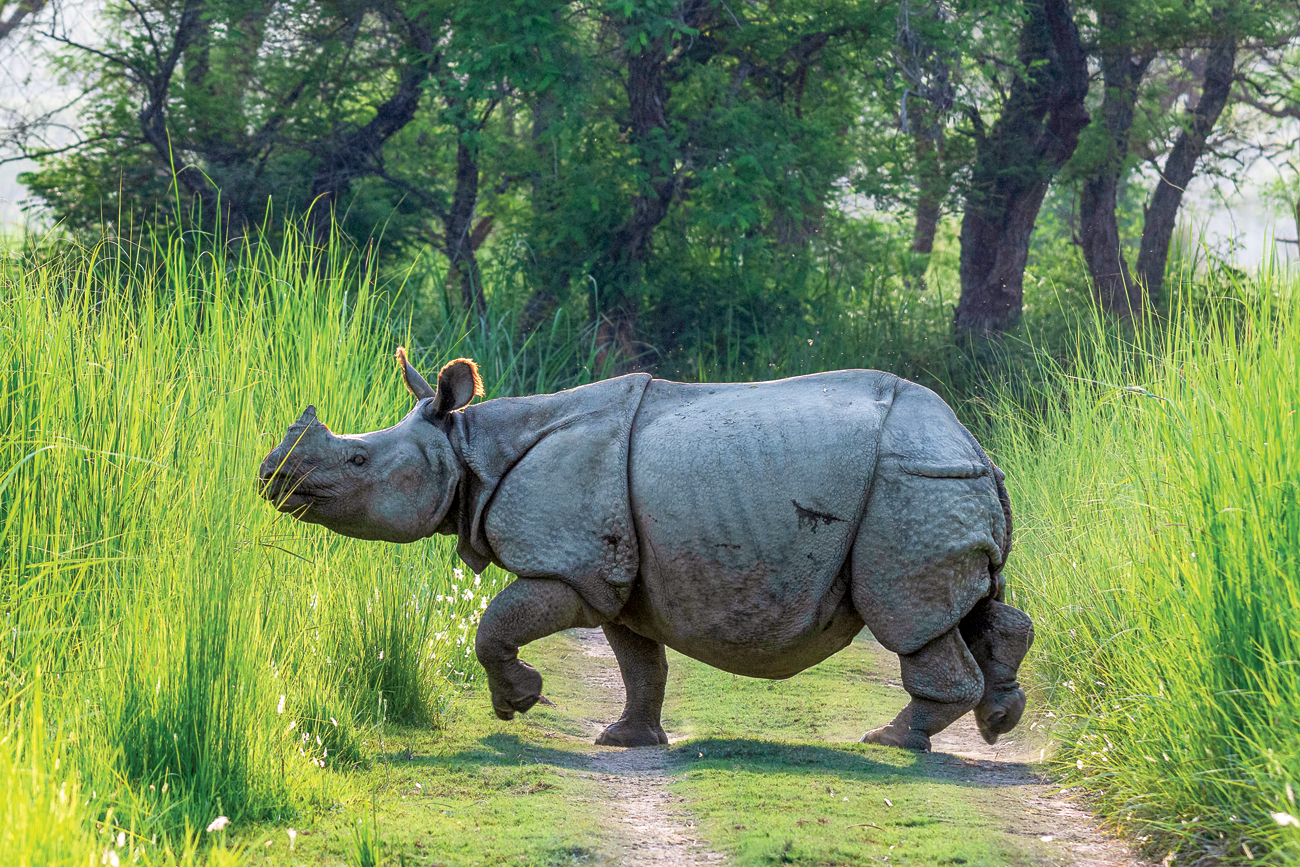
Photo: Neeraj Chandra/Sanctuary Photolibrary.
The Grasslands That Sustain Dudhwa
Over the past five years, WWF-India has supported an ambitious initiative to protect and restore the grasslands of the Dudhwa Tiger Reserve. The project focuses on the meticulous, plot-based restoration of grassland habitats across the Dudhwa National Park, Kishanpur Wildlife Sanctuary, and the Katerniaghat Wildlife Sanctuary. The approach is simple in theory, but complex in execution: restore edible native grasses and monitor their spread.
Seven sites were chosen to plant seedlings into nursery plots, selected for the extent of tall grassland they harbour. Nursery beds were carved into the earth and seeded with native species collected across the forest, including common species such as Cynodon dactylon, Apluda mutica, and Dichanthium annulatum. When the grassland ‘slips’ (areas of shallow erosion) were ready, 12 five hectare plots were planted, fenced, then left untouched to measure ecological change with as much scientific rigour as possible.
-1300_1775040796.jpg)
A controlled slash burning technique is used to remove invasive species. Over the past five years, WWF-India has supported an initiative to protect and restore the grasslands of the Dudhwa Tiger Reserve. The project focuses on plot-based restoration of grassland habitats. Photo: Somreet Bhattacharya.
Restoring The Terai, One Plot At A Time
As the first monsoon washed over the reserve, the fences came down, and the plots were left to their own devices. Throughout the season, forest managers used freely accessible satellite imagery to track the subtle, steady changes spreading across the landscape.
Across all restored plots, 12 species of grass and sedge took hold. Cynodon dactylon – the hardy doob grass – spread vigorously across the planted plots, forming dense mats rich in early-stage protein and well-liked by grazers. Dichanthium annulatum, another nutritious species, performed steadily in multiple ranges, retaining its quality under repeated grazing.
Others offered benefits more selectively. Imperata cylindrica, or kaans, is valuable when young but grows quickly into a fibrous, less digestible clump. Saccharum spontaneum, on the other hand, proved to be a monsoon miracle for large grazers. Rhinos in particular relish these floodplain grasses during the wet months when they flourish in tall, silvery waves.
But some species reveal challenges. Palmarosa Cymbopogon martini, while excellent for soil stability and aromatic oils, is almost entirely unpalatable to herbivores. Its rapid spread threatens to overtake space meant for edible grasses. Vetiver Chrysopogon zizanioides showed similar limitations – useful for erosion control, but virtually useless as food.
Signs of wildlife returning to the plots emerged through quadrat surveys. Barasingha left clear traces in Belrayan, Kishanpur, and Sathiyana. Chital, hog deer, nilgai, porcupine, and wild boar followed, though the latter two appeared only in Sathiyana.
The effort echoes the Dudhwa Tiger Reserve’s Tiger Conservation Plan (2013-2023), which identifies roughly 22 per cent of the reserve’s 1,284.3 sq. km. as essential grassland habitat. Globally, the Terai’s alluvial grasslands have all but vanished. And where they survive, they require constant tending – cycles of growth, seasonal cutting, and controlled burns to keep nutritious grasses at their prime and to prevent unpalatable species from taking over.
-1300_1775040749.jpg)
Across all restored plots, 12 species of grass and sedge took hold. Cynodon dactylon – the hardy doob grass – spread vigorously across the planted plots, forming dense mats rich in early-stage protein and well-liked by grazers. Photo: Somreet Bhattacharya.
A Fragile Future For A Vanishing Landscape
The long-term challenge for grassland managers is monitoring consistency. It is critical that restoration plots remain viable for at least five years. Joint monitoring teams now include forest staff trained in Tranam, a detailed grass-identification manual designed for the project. Understanding how these grasses spread, compete, and respond to grazing will shape future strategies.
Since grassland restoration goes beyond feeding herbivores, the structure of grasslands – short, nutritious patches interspersed with taller, sheltering vegetation – determines the fate of many species. The work ahead remains extensive. Managers continue to fine-tune a mosaic of grass heights and assist the survival of high-nutrition species in strategic ranges, while constraining aggressive varieties that degrade forage quality. Eventually, ongoing monitoring is what will reveal which herbivores prefer restored patches and how the landscape evolves across seasons.
With each new growth cycle, with every hoofprint pressed into fresh earth, these plots whisper a quiet promise: a slow, steady return to health for one of Terai’s most iconic and endangered landscapes.
Dr. Mudit Gupta is the landscape lead for WWF-India's Terai Arc Landscape in Uttar Pradesh. An environmentalist and conservationist for over two decades, he has worked extensively in species and habitat restoration across Uttar Pradesh. Somreet Bhattacharya, Communications Manager at WWF-India, is a journalist turned conservation communicator with a passion for storytelling and narration.

-1920.jpg)