Otters And Jackals: When Lives Intersect
First published in Sanctuary Asia,
Vol. 46
No. 6,
June 2026
By Gopakumar Menon
It is not an easy climb and I can’t shake away the feeling that I must be the clumsiest person ever to study the Asian small-clawed otter and its habitat. My centre of gravity seems to trail a metre behind and I clamber up the rocks, centimetre by agonising centimetre, while the rest of the small team skips ahead with ease. We pause when a large raptor flies out of a tree, taking us by surprise; could it be a Brown Fish-Owl, the iconic denizen of the riparian buffer? We pause again when Dinesh, our team member on site, conveys new information about riparian trees and bushes, and we record and photograph their spring blossoms. By the end of the transect, I am exhausted and in a philosophical mood questioning my life choices, yet by the next morning, I’m looking forward to the day’s survey.
In these hill streams of the Brahmagiris, part of the Western Ghats in the Coorg district of Karnataka, the first quarter of the year is the best time to survey the abundance of small-clawed otters, for the water flow is a trickle and spraint (scat) signs are easily seen on rock assemblages.
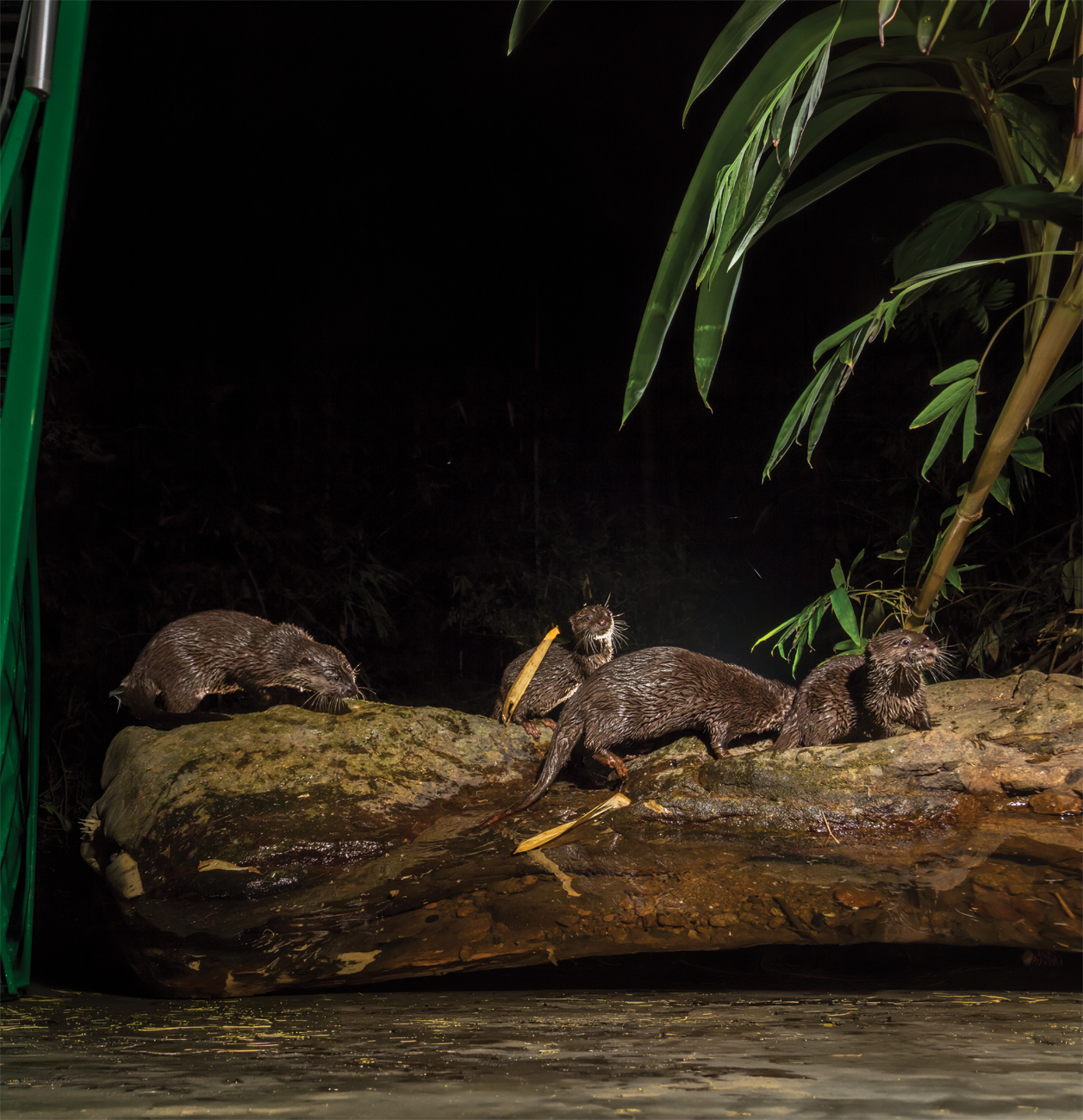
The Asian small-clawed otter Aonyx cinereus, native to South and Southeast Asia, is a key predator in freshwater ecosystems. It helps regulate prey populations and maintain stream health, making its presence a vital indicator of functioning aquatic habitats. Photo: Yashpal Rathore.
More Questions Than Answers
Why do we record spraint? Small-clawed otters are nocturnal or crepuscular and extraordinarily reclusive, so the only sensible method of documenting their abundance, at least for now, is to conduct transects and record fresh spraint (fresh defined as less than a couple of days old).
We select streams carefully, first seeking permission from cooperative coffee planters, as this is coffee picking season and strangers are unwelcome.
The streams must also be accessible and outside the forest boundary, for our work is in plantation landscapes. The presence of elephants (and, on one occasion that my colleague is unlikely to forget, a roaming tiger with a penchant for roaring) is an important consideration. Such selection brings bias to the sampling, for in an ideal world we would choose streams at random, yet field realities define our choices.
On this day in February 2026, the spraint signs in Pathipoley, the stream we have monitored for three years, are few, and when we review the data later, there are more questions than answers. Little work has been done on the abundance or population dynamics of the Asian small-clawed otter, so every question is a step toward understanding. The survey methodology has changed each year based on what we have learnt, and we are far from done. The question, “How can we reliably collect data on otter abundance in a stream system?” remains unanswered.
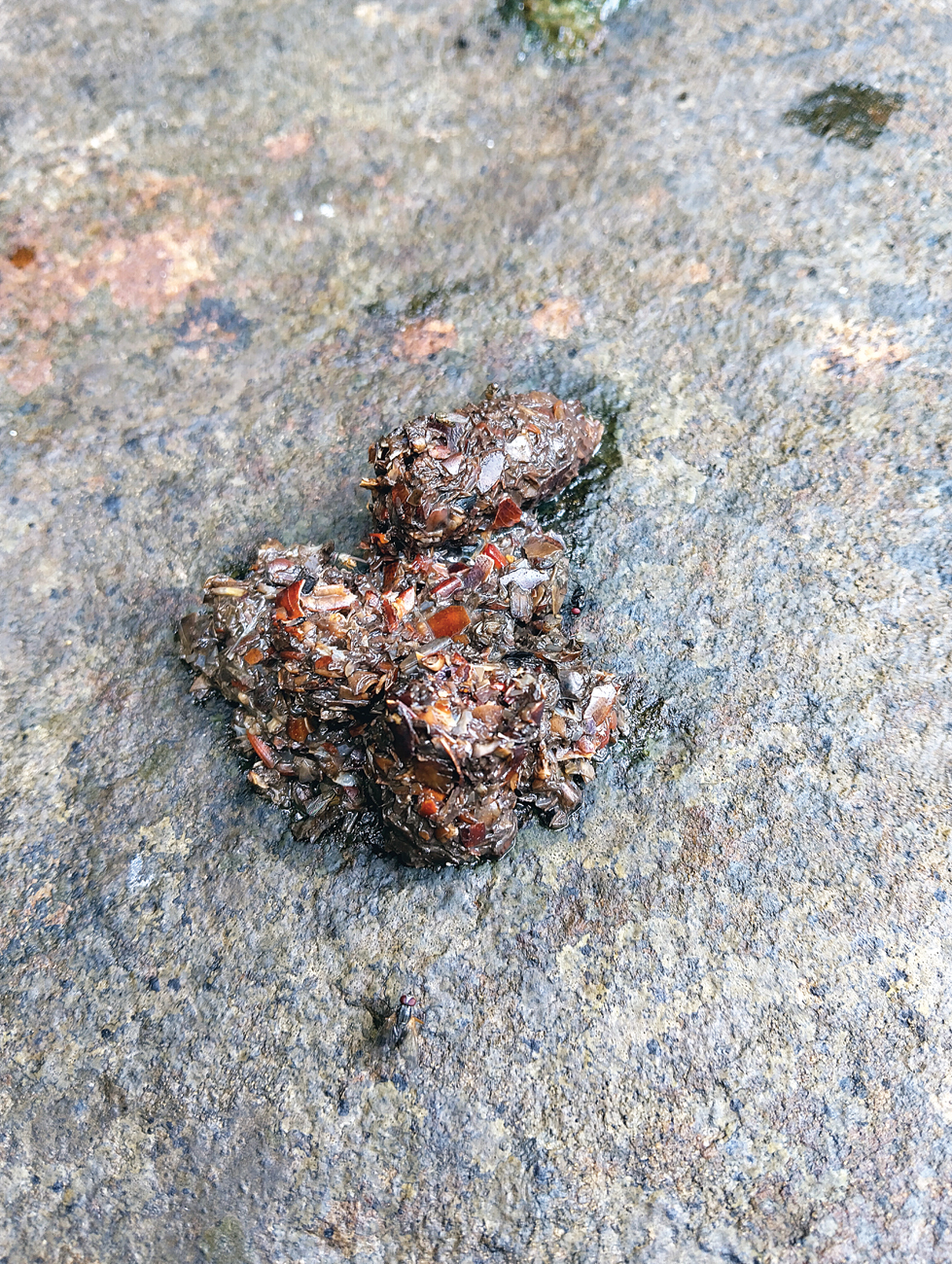
The author and his team found that the first quarter of the year offers the best window to survey Asian small-clawed otters, when streams recede to a trickle and fresh spraint (scat) is visible along rock assemblages. Nocturnal and highly elusive, these otters are tracked by recording recent spraints along transects. Photo: Gopakumar Menon.
Another question however, just as important, has a clear answer: Why collect data and create an index? Because there is nothing to begin with – no information on their status, nothing to guide conservation decisions. Our long-term goal is to develop a species abundance index to estimate how common or rare the Asian small-clawed otter is in these hill stream ecosystems. We can then compare this with data from streams in the plains and prioritise streamscapes for conservation with local communities. We know habitat matters – water quality, canopy cover, and human disturbance all play a role, but the key question is: how important is each factor?
I have chosen not to wait for an answer, because other evidence has spoken: for carnivores, prey abundance matters, and the Asian small-clawed otter is no exception. Sadly, their primary prey of freshwater crabs and tiny fish is in steep decline. This knowledge comes not only from scientists but also, perhaps just as reliably, from local people who harvest them. Their conclusion is unanimous: chemicals used in plantation agriculture – a cocktail of toxic pesticides, fungicides and weedicides – seep into waterways. No threat has been so silent, insidious, and systemic.
And no threat to wildlife has been less discussed. Which brings me to jackals.
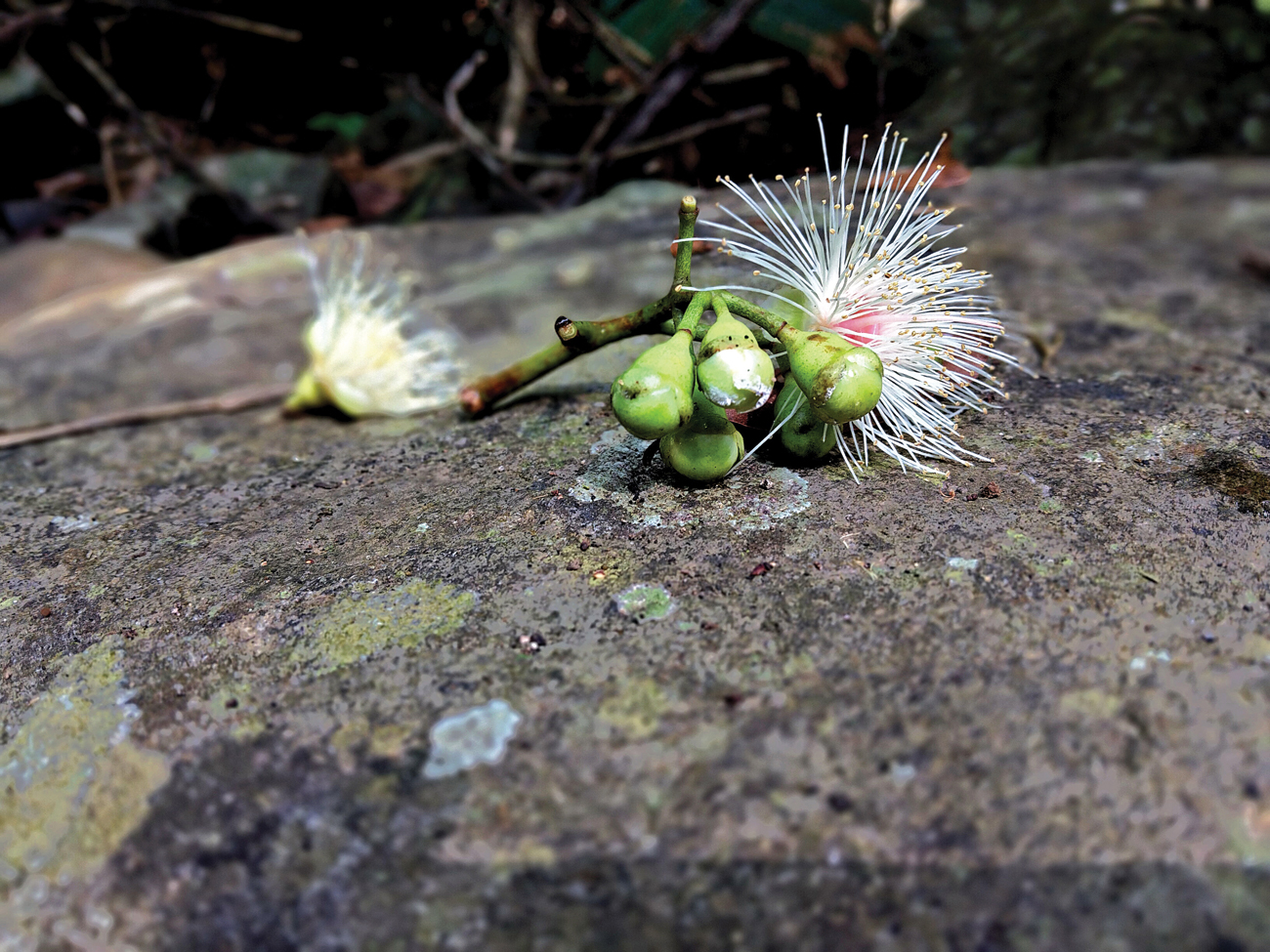
Several species of Syzygium trees thrive in moist streamside habitats of the Western Ghats. Their blossoms rely largely on pollinators such as bees and wasps, to reproduce successfully. Photo: Gopakumar Menon.
D-Day Of The Jackal
Golden jackals are beautiful, lithe, and graceful, moving with a light, rhythmic, almost carefree trot that is a joy to watch. Over the years, in parts of rural India, I have heard their cacophony on quiet warm summer nights, high-pitched yelps and moans overlapping, rising and falling, sometimes reminiscent of the ghostly call of the Rock Eagle-Owl, sending an involuntary shiver down the spine. Golden jackals are largely nocturnal and their calls generally mean, “We are hungry and on the move,” which is bad news for their prey: small mammals such as mice and wild piglets, reptiles, and birds, including the occasional backyard fowl, sometimes resulting in inevitable retaliation from farmers.
That is hardly the only bad news for the animal. When commercial ginger invaded Wayanad, Coorg, and the Kabini landscape in the 90s, farmers sprayed highly toxic pesticides – Thimet, for instance (now banned) – to kill crabs and protect crops. Jackals ate those poisoned crabs and, at first, it suited everyone; dead jackals meant no chicken-lifting. However, it also meant rodents and wild pigs had one less predator. It meant another animal had slipped down the extinction slope to Never Land. And it meant the clear summer nights, once pierced by those unforgettable calls, have lapsed into an uneasy silence.
The toxic ginger, though still grown in Wayanad and the Kabini landscape, has disappeared from most of Coorg, but so have the jackals. With their sudden departure in a fraction of an ecological second, silence has taken over those warm nights, which will never be the same again.
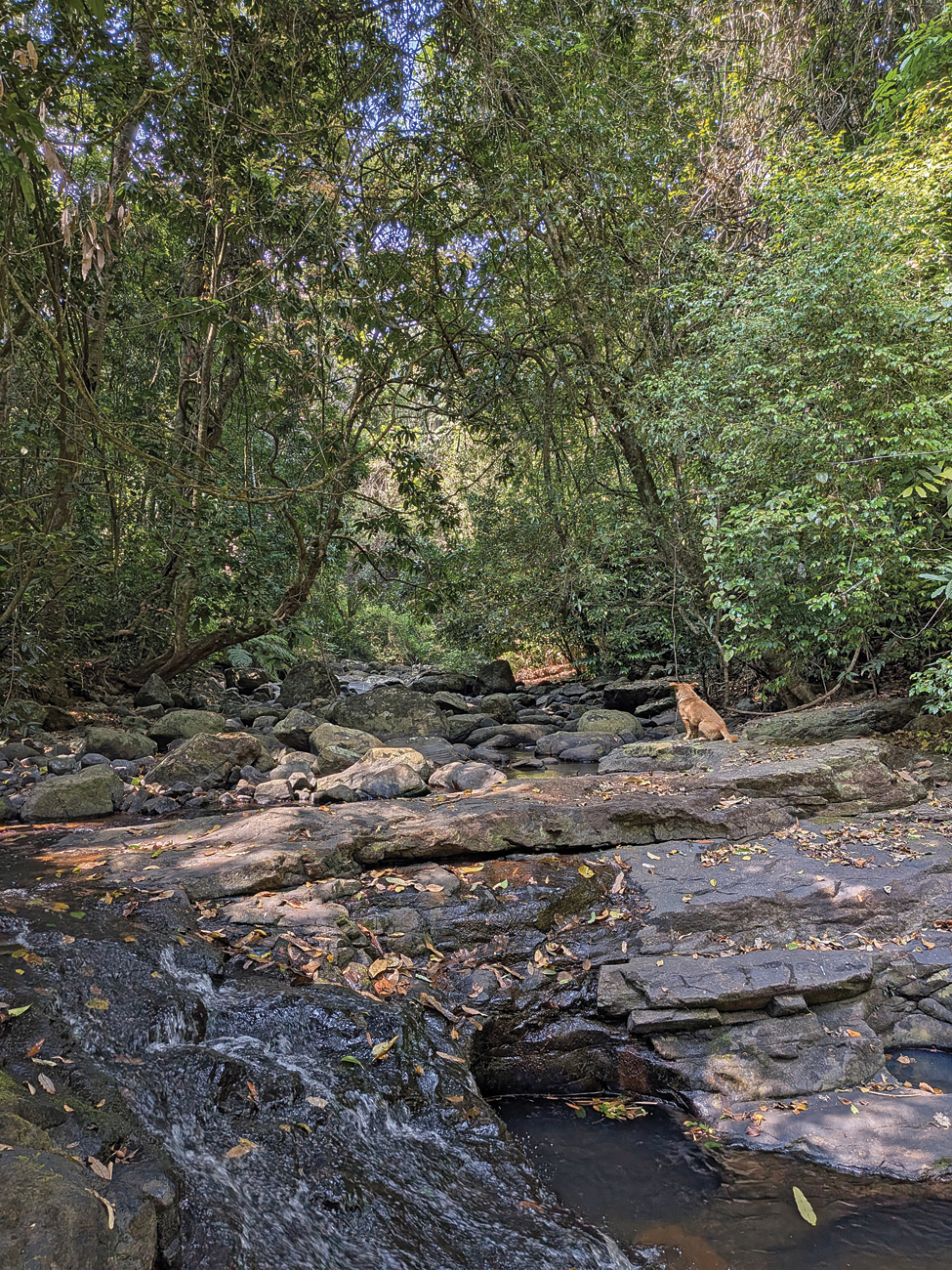
A rare intact riparian buffer area. Such riparian habitats are the mainstay of small-clawed otters as well as raptors such as Brown Fish-Owls. Increasing human presence also brings unwelcome visitors such as feral dogs. Photo: Gopakumar Menon.
To what extent these chemicals have impacted small-clawed otters is unknown, but there is some evidence. In Wayanad, where agri-chemical use in paddy, ginger and banana plantations is widespread and intense, large stretches of streams passing through these landscapes have poor spraint density, often none at all. In contrast, in south Coorg across the state border, where agri-chemical use is minimal, there is widespread occupancy by the species in streams: in 2023, of the 48 transects done by my colleague, each about 500 m. in length in agricultural and plantation landscapes, 47 had spraints. This contrast is telling but hardly conclusive, since there is no past data to determine whether species abundance and population has declined as a consequence of the poisoning of their principal prey. Golden jackals, otters and their prey are hardly the only species affected by the toxic cocktail of chemicals used to control crop pests, with clear evidence seen in the decline of birds, amphibians, reptiles, mammals, and, as extensively documented by entomologists, bees. There is also ample evidence that human health has been affected. Yet, there is little understanding or inclination at the policy level to take corrective measures. So, in essence, it comes down to us: when I make presentations on otters, the inevitable question is, “What can I do to conserve them?” My response is to ask the audience to learn where our food comes from and to choose chemical-free sources. This may seem ineffective compared to field action, yet if enough people made this shift, streams would substantially recover and prey would return. Stories from elsewhere have shown that this is immensely possible. It is definitely not too late for restoration.
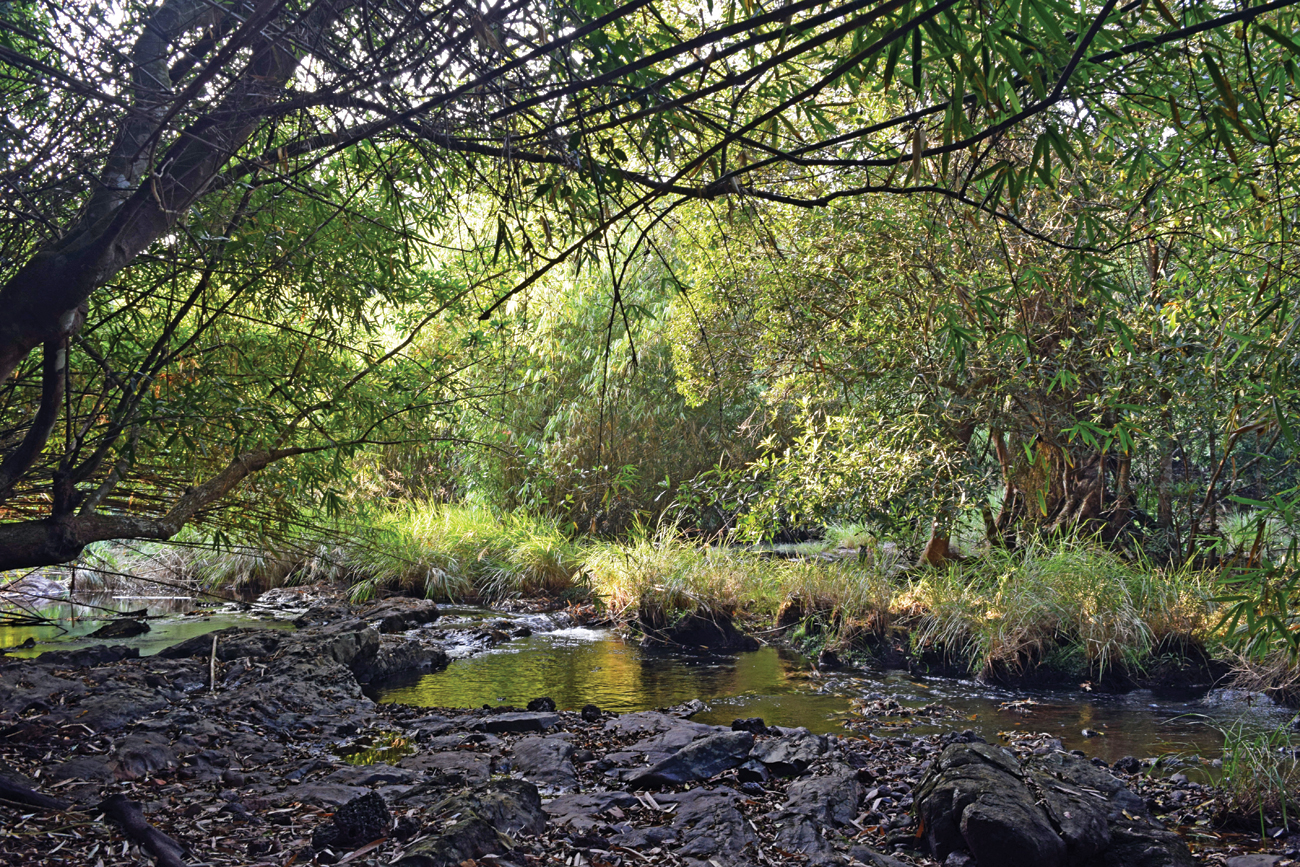
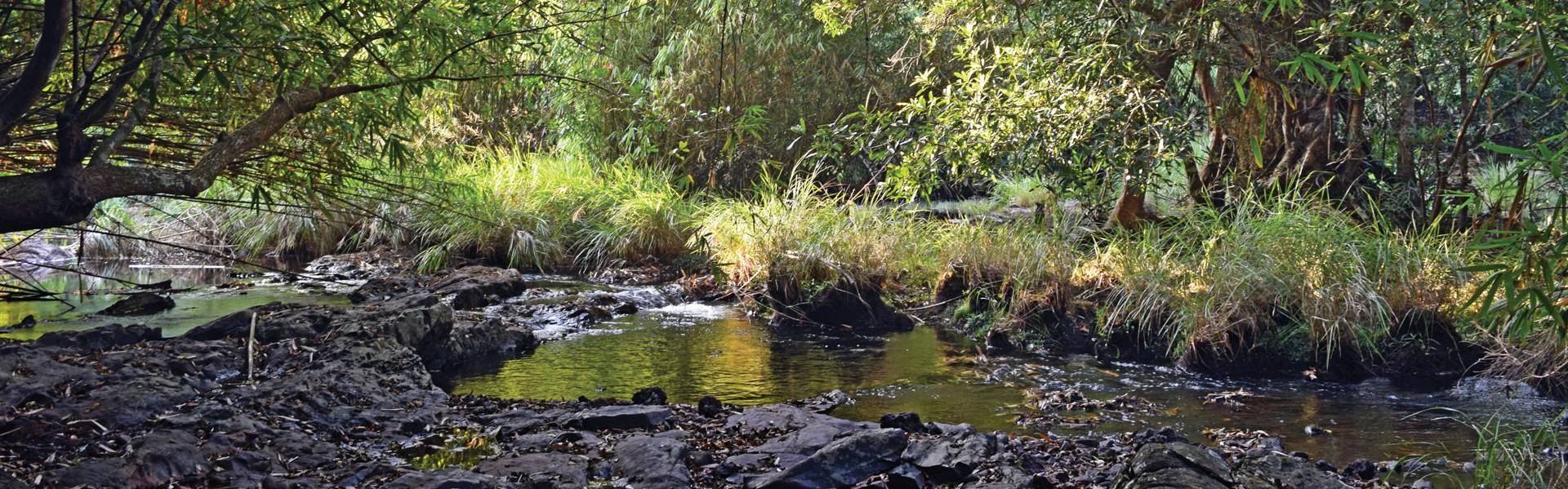
A hill stream glows in soft early sunlight at a private sanctuary in Coorg. Asian small-clawed otters depend on these shallow waterways to forage for crabs and fish, both now in steep decline. Researchers identify a shared cause: agricultural chemicals seeping into and degrading these fragile aquatic ecosystems. Photo: Gopakumar Menon.
Some Steps Forward
Amidst the gloom, there is some good news: the poaching of small-clawed otters is now relatively rare (with the exception of parts of the Northeast), though in the past it was certainly not so.
A wise, elderly coffee planter in south Coorg, Suresh Chengappa, recalls observing small-clawed otters in a stream in the plains near Napoklu during his childhood. He recounts that, in the 1960s, a small group of hunters, locally called the ‘otter people’, would arrive periodically and pitch a decrepit tent near a stream. Over a day or two, they would feed and befriend local feral dogs, then chain and lead them to the stream. These dogs, astonishingly agile on smooth, slippery rocks in hill streams and adept swimmers in the plains, were used to flush otters out and kill them, after which the meat was eaten and the pelt dried and folded. Nobody, he says, would speak with these hunters, but they were allowed to continue with their deadly trade as they posed no harm to people or livestock. His wife independently confirmed these observations, adding that the practice ended in the early 1970s, coinciding broadly with the enactment of the Wildlife Protection Act in 1972.
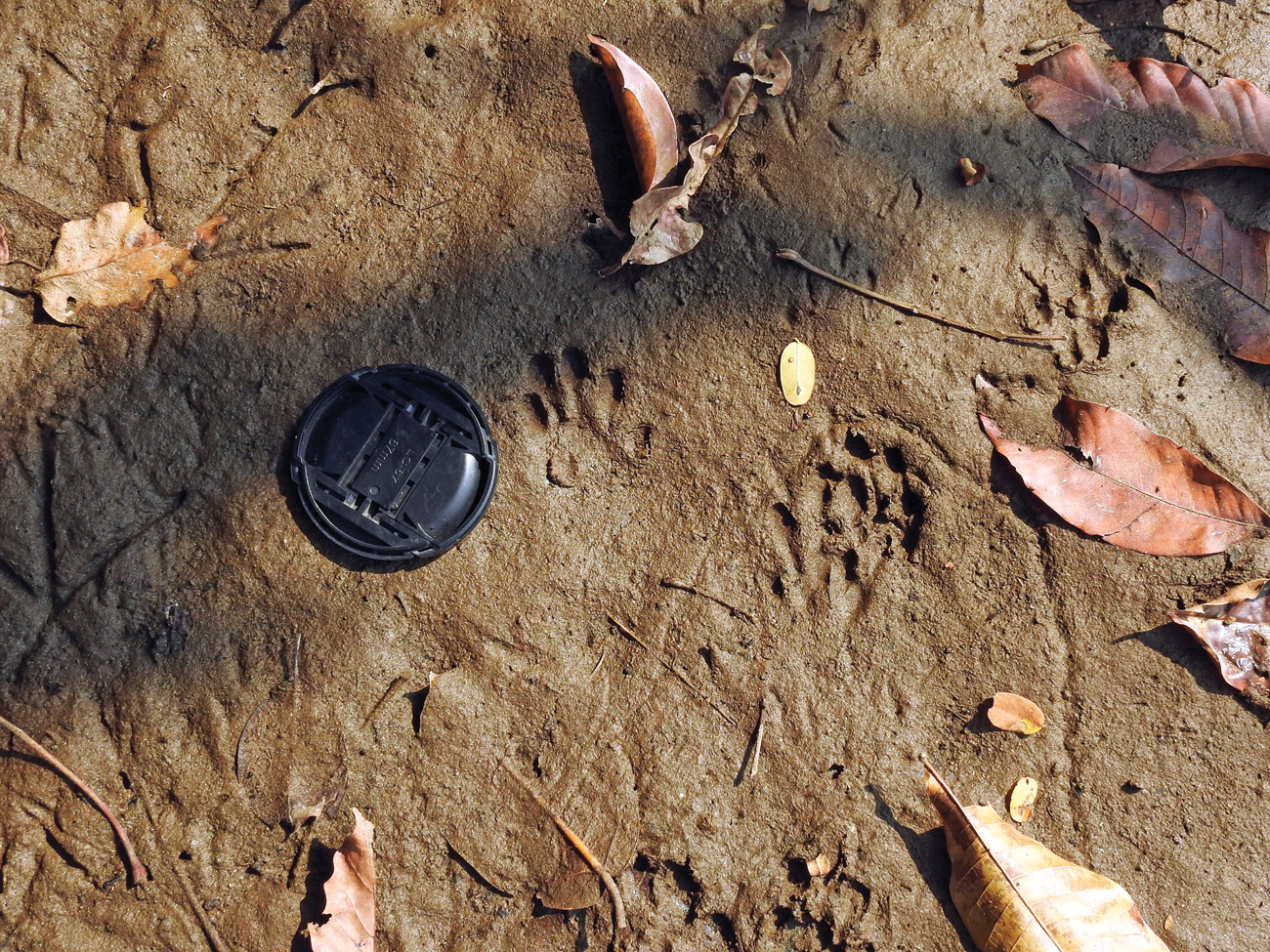
Otter paws leave camera lid-sized imprints in the soft mud around a hill stream in Tillari. With little baseline data on Asian small-clawed otters, each and every track matters – helping us build an understanding of their presence and guiding future conservation in these fragile stream ecosystems. Photo: Gopakumar Menon.
Our surveys to assess abundance must continue. Of this, I have little doubt – as must the brainstorming of ideas, discussion and questioning. Two endearingly charismatic species – the Asian small-clawed otter, a small carnivore in stream ecosystems, and the golden jackal, a larger carnivore in terrestrial landscapes living in close proximity to agricultural fields – are, in every which way, the unintended victims of intensive agriculture, but we are yet to implement state-wide or national protection strategies for them, and their future seems as uncertain as it is worrying. It’s therefore imperative that ecologists broaden their conservation horizon to include agricultural practices and work in close partnership with non-profits and individuals who conserve traditional seeds and practise organic agriculture; we have much to learn from and to teach each other. I believe this partnership is missing but never has the need for it been more urgent, for the primacy and quality of habitat is central to both.
I often think of the outstanding New Zealand ecologist, Don Merton,who brought two species of native birds – the Black Robin and the KÄkÄpÅ, back from extinction. He emphasised action: “There simply isn’t time to test pretty theories,” he said. “Rare species can’t wait… We can’t just go along thinking nature will sort everything out.”
Gopakumar Menon From restoring riparian buffers with local communities in the southern Western Ghats to discouraging agrochemical use around stream ecosystems, he is working across multiple fronts to protect otters and their habitats. As founder of The Otter Conservancy, he advocates for the conservation of otters beyond the boundaries of Protected Areas.