Grasslands Need Protection - Now
First published in Sanctuary Asia,
Vol. 46
No. 4,
April 2026
By Santhosh Pavagada
I watched a lone striped hyena burst onto the wide, roaring Pune-Nashik highway, its gait uncertain, almost bewildered, as it tried to cross back into the other half of its fractured home. Traffic thundered past in relentless waves, tires hissing against asphalt. The animal paused, then lunged forward again, caught between instinct and intrusion. The striped hyena, long burdened with the ominous moniker ‘witch’s steed’, a name born of superstition and its nocturnal, scavenging habits, seemed startlingly out of place in the harsh glare of day. Yet here it was, exposed and vulnerable under the unforgiving sun, daring to navigate a corridor of speeding metal that had cleaved its territory in two.
Its struggle did not end upon reaching the other side. Across the road was a habitat now claimed by a large factory and scattered buildings. How can I, or those who plan such projects, who drive on that highway, or who work faithfully inside that factory, ever truly comprehend the realities of the hyena’s world, or indeed that of any wild creature? While this hyena survived its perilous crossing, January 2023 told a harsher story, when 12 blackbuck bolting across the highway, plunged to their deaths from the hill the road was carved through. In more such instances, wolves, foxes, and other animals are crushed beneath speeding vehicles. However, their deaths pass quietly, rarely stirring headlines. However, my purpose is not to highlight the already well-known fragmentation impacts of linear infrastructure, but the negligent treatment meted out towards certain species and, by extension, their habitats. We hardly ever hear of corridors or mitigation measures for species like these that inhabit open ecosystems.
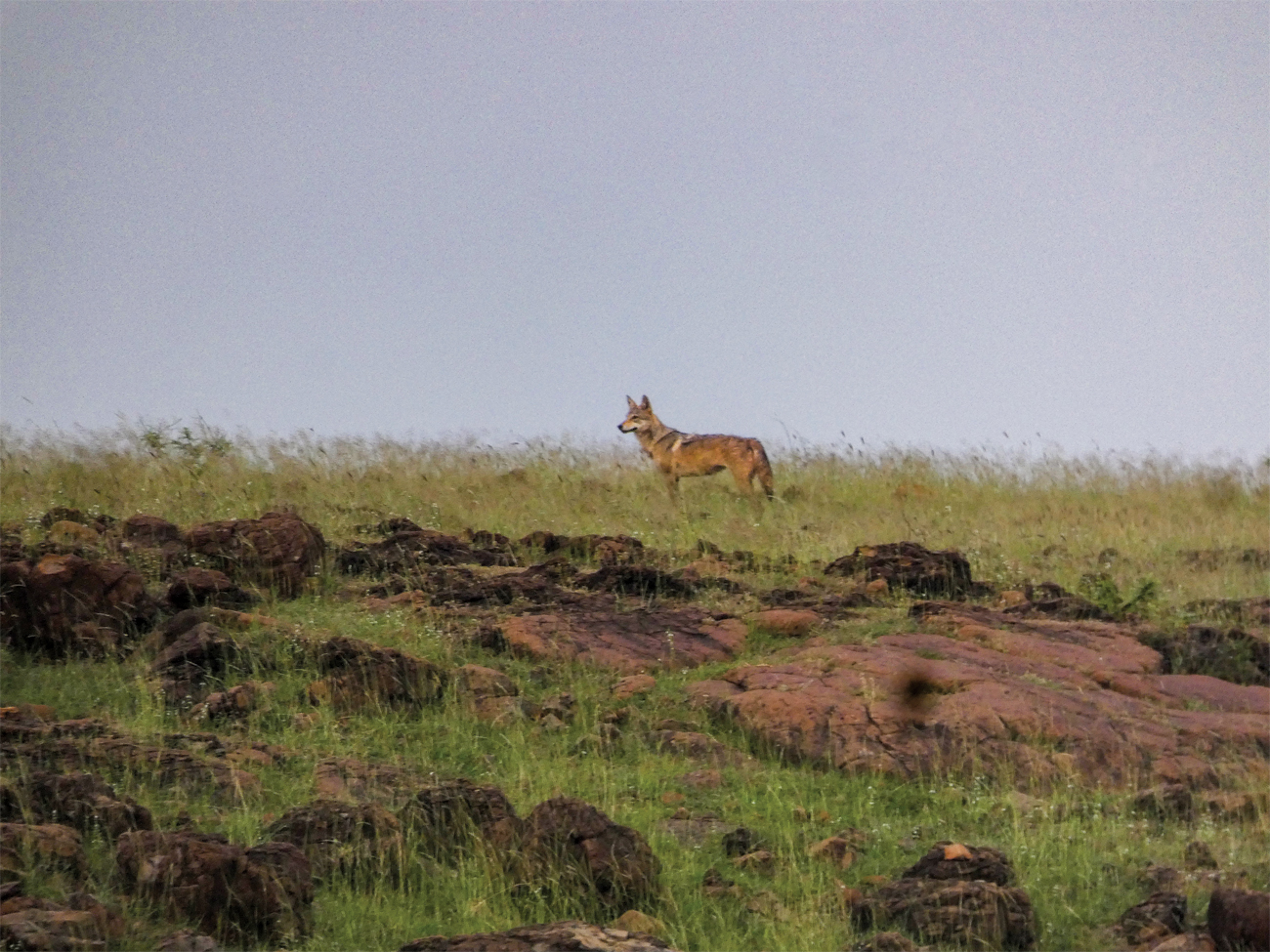
No initiatives have been undertaken to create wildlife corridors or mitigation measures for species like wolves, hyenas, and blackbuck that rely on open ecosystems. They traverse landscapes threatened by fragmentation and degradation. Photo: Santhosh Pavagada.
Open Natural Ecosystems
This is ironic, as hyenas, wolves, blackbuck, bustards, and other species that occupy grasslands or scrublands are all listed under Schedule I of the Wildlife Protection Act (WLP) 2022 and are entitled to the utmost protection, yet their habitats are largely ignored. Grasslands, shrublands, scrublands, deserts, ravines, rocky outcrops, and all other open ecosystems, also known as savannah ecosystems or Open Natural Ecosystems (ONEs), roughly comprise 10-15 per cent of India’s geographic area, according to available literature. However, when we were trying to understand the extent of grasslands, there are no credible sources that confirm the actual area. Unlike the routine exercise to estimate the forest cover extent, there are still no nationwide mapping efforts by government authorities for these open ecosystems. While there are several satellite imagery-based land cover products available that can give us some idea of their extent, the disagreement between these products in classifying such lands and the variance in the estimated areas limit our understanding of their actual extent.
Compared to a forest, an open, plain land, albeit flourishing with lush grass and interspersed with shrubs and bushes, is a visual that fails to attract people’s attention. Forests have always fascinated us; for decades, we have been taught about the services that forests offer, and the need for their conservation might have created the impression that wild animals exist only there, and hence they alone matter. Add to this their celebration in various media, films and even our curriculum, with chapters on the importance of afforestation, green movements to save forests, and the 30 per cent forest cover theory. All this has made us associate conservation with protecting forests. Coming from a semi-arid place myself, I began my conservation journey by planting eucalyptus saplings with the expectation to vegetate the bare-looking ONEs.
There is no denying that forests and their protection are essential, and that our efforts to safeguard them must only grow stronger. Yet alongside this commitment lies an equally urgent need to conserve and manage other habitats that provide critical ecosystem services and sustain numerous endangered species. Recent research has shown that grasslands can sequester carbon at levels comparable to forests, underscoring the need to accord these open landscapes far greater recognition and protection.
Grasslands To Wastelands
We appreciate the African savannah and the sightings of the majestic big five and other species. India’s Open Natural Ecosystems are also home to bustards, floricans, harriers, partridges, larks, fan-throated lizards, scorpions, and a myriad other birds, reptiles and insects, along with large mammals such as wolves and hyenas. Besides this animal diversity, there is a large variety of grasses, herbs, shrubs, and other woody vegetation. But colonial mistreatment and the sentiment in people’s minds that open arid lands are non-productive have led these ecosystems to be considered as wastelands. In fact, the Department of Land Resources commissioned the National Remote Sensing Centre (NRSC) to develop the Wastelands Atlas of India, by designating all those unproductive lands as wastelands. Even the Land Use Land Cover (LULC) map developed by the NRSC, which explains the type of cover for a given patch of land, considers wastelands as one of the categories along with forests, agricultural, and other land cover types. Interestingly, this LULC map has grasslands as a category, but covers a tiny fraction of the actual grasslands. But we can easily understand that most of the land that has been classified as wasteland is either grassland or other open ecosystems by checking the extent of grasslands, rangelands, scrublands, or related classifications depicted by publicly available land cover products such as World Cover, Land Cover, and Dynamic World, among others.
It is even more disturbing to know that the extent of the wastelands, which is indirectly the extent of our grasslands and other open ecosystems, is reducing over the years. As per the NRSC data, between 2005 to 2020, the wasteland class has seen a decline of about 30 per cent by primarily being converted to agricultural lands or built-up areas. This is not surprising, since most of the open ecosystems are extensively modified and adapted for human use. While a forest clearing can easily be identified, open ecosystems that have no distinctive physical boundaries are easy to prey upon for land conversions. Though agriculture expansion has been a primary reason for their decline all these years, built-up areas such as industries, residential layouts, irrigation canals, and renewable energy projects are fast evolving as major threats in recent years.
One can witness the pace at which these landscapes are changing either by driving around any grassland patch or by checking historical satellite imagery. It is unimaginable to comprehend the plight of wild animals that depend on these habitats and the way they are forced to swiftly adapt to the fast-changing structure of their homes. A few decades ago agricultural expansion was seen as a moderate threat to grasslands since it was primarily rain-fed cultivation.
Today, expanding irrigation projects have introduced orchards and other cash crops, which drastically change the habitat structure. New entrants to this threat list are renewable energy projects. With an abundance of wind speed and solar irradiance, grasslands form the preferred areas for setting up mega solar parks and wind farms. These energy plants bring along power lines, roads, and other support structures, leaving behind a far greater land footprint. Large tracts of open ecosystems are getting decimated, fragmented, and degraded by one or many of these threats.
Unlike forests, which have the Forest Conservation Act and other policies that restrict their clearing, open ecosystems have always been losing ground without any legal protection. Though several Protected Areas are carved out to conserve open ecosystems, some of these have already been denotified to facilitate development. Moreover, there are no specific practices or guidelines to manage these ecosystems, because of which forest management practices are being carried out in these ecosystems. For instance, afforestation targets are a default management practice in any forest division, even when dealing with habitats of blackbuck, wolves, grasslands, or others. At times, authorities have constructed waterholes to facilitate species that have evolved to arid conditions. Similarly, whenever an encroachment is removed, irrespective of whether it is a forest or grassland, it will be planted with saplings. Likewise, the prevailing public sentiment of planting saplings or dispersing seed balls in an attempt to green open ecosystems is another major threat. Either for lack of information or interest, many of the Environmental Impact Assessments of the projects in open ecosystems, do not even mention the presence of its wild denizens. It is high time that we understand and appreciate open ecosystems as natural landscapes and prescribe policies to secure them the way they are.
Now that cheetahs have been reintroduced, striped hyenas and foxes are being protected under Schedule I of the WLP, Great Indian Bustards are being successfully reared, and other species recovery programmes are in place, it is extremely important to focus efforts on securing the homes of these species. The first, vital step is to understand their extent, current status, threats, and to map the available open ecosystems. After that, a conservation policy and management practice for these habitats could be established to avoid further damage to these ecosystems. While we have collectively ignored these ecosystems and are responsible for their current state, the government and civil society need to work together to protect or restore them. Unless we begin recognising and conserving such ecosystems with renewed vigour, sprinting blackbuck, scavenging striped hyenas, head-bobbing bustards, or the hauntingly beautiful howls of wolves could disappear from our country forever.
Leading the Technology for Conservation programme at The Habitats Trust, Santhosh Pavagada combines engineering and conservation expertise to explore new ways of safeguarding grasslands, coral reefs, and other ecosystems outside Protected Areas.