Getting More Bang For The Buck
First published in Sanctuary Asia,
Vol. 46
No. 4,
April 2026
Are Conservation Reserves protecting the blackbuck?
By Dr. Seshadri K.S.
The overnight rain had washed everything clean. At daybreak, eight of us, in two cars, drove out of Bengaluru, in search of a mammal that none of us had seen. It was July 2007. We had a hand-drawn map of how to reach the site. All was well until we missed a turn and ended up driving into the neighbouring state of Andhra Pradesh. Asking passersby was of no help. Eventually, we tracked back and the sight of a faded board pointing at the village of Mydnahalli – our intended destination – revived our hope. Little did we know that we would end up running into the animal we were in search of, before we even entered the reserve meant to protect it. One of us had spotted the outline of three blackbuck along the distant horizon.
The landscape was an undulating savanna grassland with a backdrop of rocky hillocks as far as the eye could see. Of the three individuals we had spotted, two were females and it appeared that the third, a male, was trying to woo them. We were outside the Jayamangali Blackbuck Conservation Reserve, which was established in 2007 and is spread over 3.1 sq. km. The reserve gets its name from the Jayamangali river that flows nearby. Having finally seen the animal we had come in search of; we entered the gates of the conservation reserve and went up a large watchtower covered with a pergola. From this vantage point, we could see the savanna-grasslands intermixed with fallow agriculture fields and plantations of Eucalyptus sp. and Acacia auriculiformes. We shared snacks as we settled down, hoping to spot some wildlife.
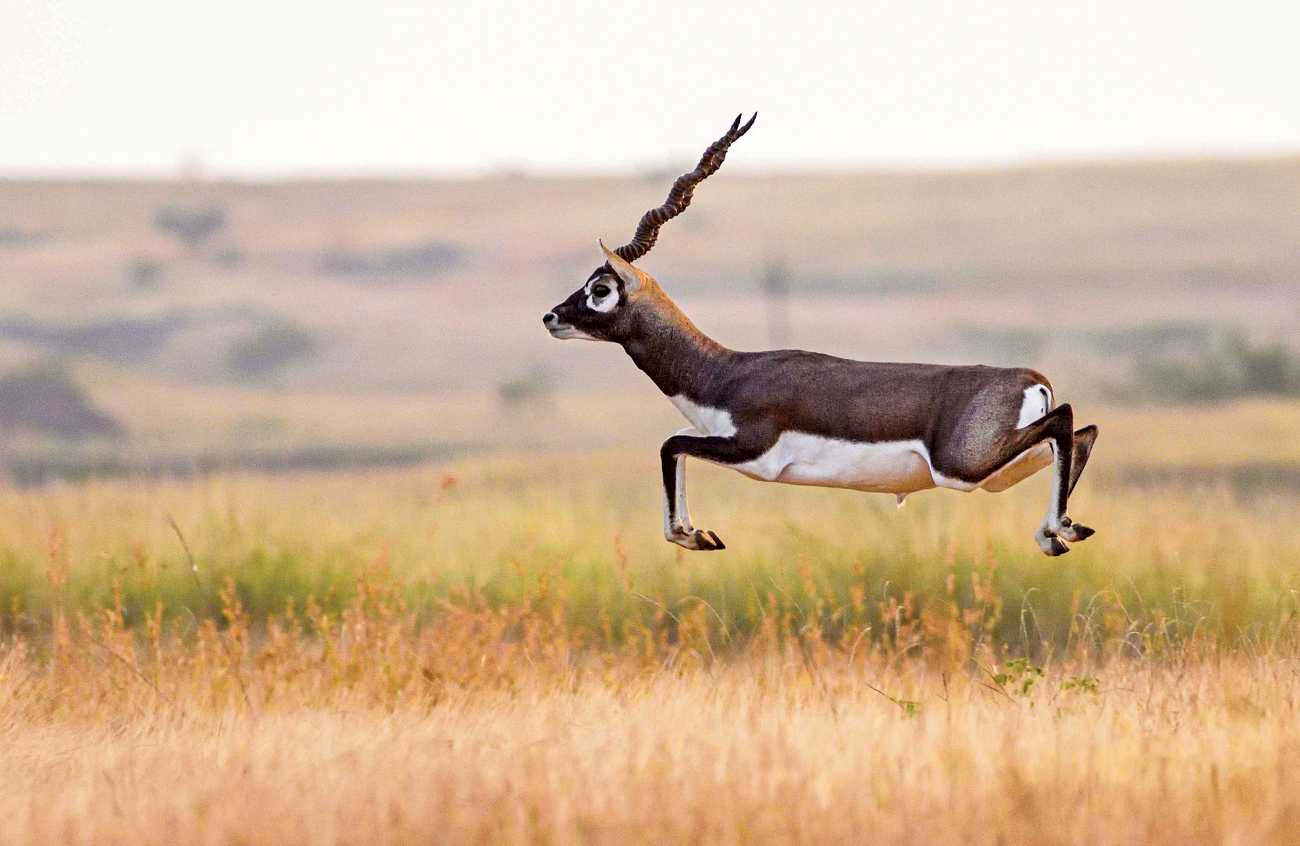
The blackbuck Antilope cervicapra is the only member of the genus Antilope and is largely restricted to savanna-grassland habitats in the Indian sub-continent. Though listed as Least Concern by the IUCN, they face threats from habitat loss, poaching, and agriculture. Photo: Mrunal Kulkarni/Sanctuary Photolibrary.
The Open Habitat Specialist
The blackbuck Antilope cervicapra is the only member of the genus Antilope and is largely restricted to savanna-grassland habitats in the Indian sub-continent. In India, they are found in 13 states and have a fragmented distribution, with varying population sizes, from 10 to over a hundred at some sites. The current distribution range is likely a fraction of the historical distribution. The latest assessment, made a decade ago, pegs the number at around 35,000 individuals. Although listed as Least Concerned in the IUCN Red List, they are protected in India under the Wildlife (Protection) Act of 1972. People often associate the infamous incident of film actors indulging in sport-hunting them, not too long ago.
We did not have to wait too long before spotting a blackbuck herd approaching a waterhole nearby. With eight pairs of binoculars trained on them, we estimated 83 individuals, comprising both adults and juveniles. Blackbuck form social groups of varying sizes including solitary males, females, and offspring, and groups of females and males. The structure of grouping is known to vary between and within populations and this structuring is linked to habitat heterogeneity and availability of food and water resources. The fact that we saw a rather healthy population size despite the overall shrinking distributions and fragmented populations, was a good sign. Today, evidence from multiple locations points to the fact that blackbuck can persist in and around agricultural landscapes interspersed with savanna grasslands. They are also known to damage crops and can be seen competing for resources with livestock as well.
We spent the entire afternoon walking around on the trails in the grasslands. We stopped often to observe pipits and larks. An occasional Bay-backed Shrike would fly off a shrub, and an odd raptor would soar by in the scorching sun. We saw the hoof marks of blackbuck along the trails along with middens. A midden is a pile of droppings; as like other antelopes, blackbuck too defecate in a pile in the same place. While bending down to observe hoofmarks, we were startled by the sudden flutter of a sandgrouse that took to the air. Having heard about how they come to water in the afternoons, we sat down on the bund of the waterbody nearby, but the bird was a no show. We encountered evidence indicating the presence of a sloth bear, black-naped hare, and pugmarks of what we thought was either a wolf or a feral dog. Apart from wildlife, we encountered several herds of grazing livestock from nearby villages. Before long, the evening sun painted the landscape a golden shade of yellow and as the sun disappeared behind the rolling hillocks, we began to make our way back home.
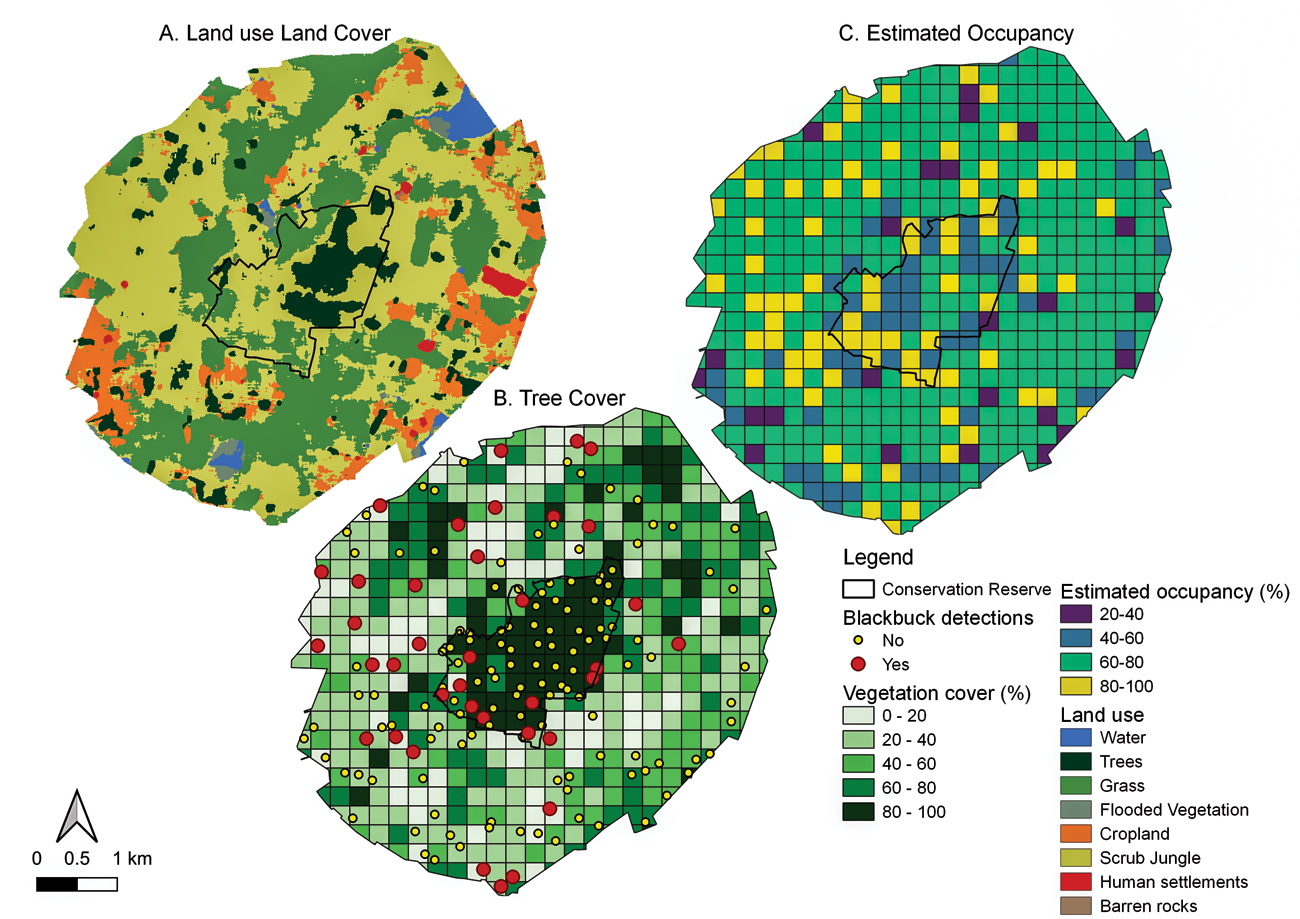
Occupancy modelling revealed that blackbuck presence was similar inside and outside the Jayamangali Blackbuck Conservation Reserve in Tumkur district, Karnataka. Detection probability was influenced by habitat and livestock: it decreased as shrub density increased, increased alongside livestock presence, and remained unaffected by tree cover. Photo Courtesy: Dr. Seshadri K.S.
A Consistent Pattern
Over the next decade, I have made it a point to visit the reserve at least once annually. Each time, I have encountered blackbuck outside the reserve and progressively, fewer are seen inside the reserve. These grasslands were historically a common village land, and people would bring their cattle to graze. The conservation reserve makes room for such traditional grazing practices to continue. But, shrinking habitats from the intensification of agriculture and land-use change, and raising livestock numbers, can push blackbuck to the brink. Protected Areas are the most common tool used for conservation globally. So much so that nearly 18 per cent of the terrestrial ecosystems are protected in some form. Recently, several countries, including India have agreed to increase the area protected to 30 per cent of the landmass, by 2030. India currently stands at 28 per cent. Yet, in all this urge to declare Protected Areas, an important question is neglected. Is the Protected Area effective? Is it helping to conserve the species it is intended to conserve?
Fast forward to January 2023, as I was settling into my new role as a faculty member at ATREE, Manoj Kumar approached me with the intention of studying the blackbuck. My colleague, Dr. Ganesh T., who has been studying grassland ecosystems for over two decades, happily agreed to come on board and co-supervise the student. We had visited Jayamangali in the past and had always wanted to study and contribute to conserving the landscape. Manoj was pursuing his master’s degree in conservation practice and shifted base to a rented house in Madhugiri. He visited the conservation reserve to get a sense of the area and decide on the questions he would be addressing. He came back to report the same pattern that we had been observing since our first visit to the site. Blackbuck appeared to be more frequently encountered outside the reserve than inside! A few rounds of brainstorming were all it took for him to decide on his questions: How are the blackbuck using the space in and around the conservation reserve and, what are the habitat variables that would explain the patterns observed?
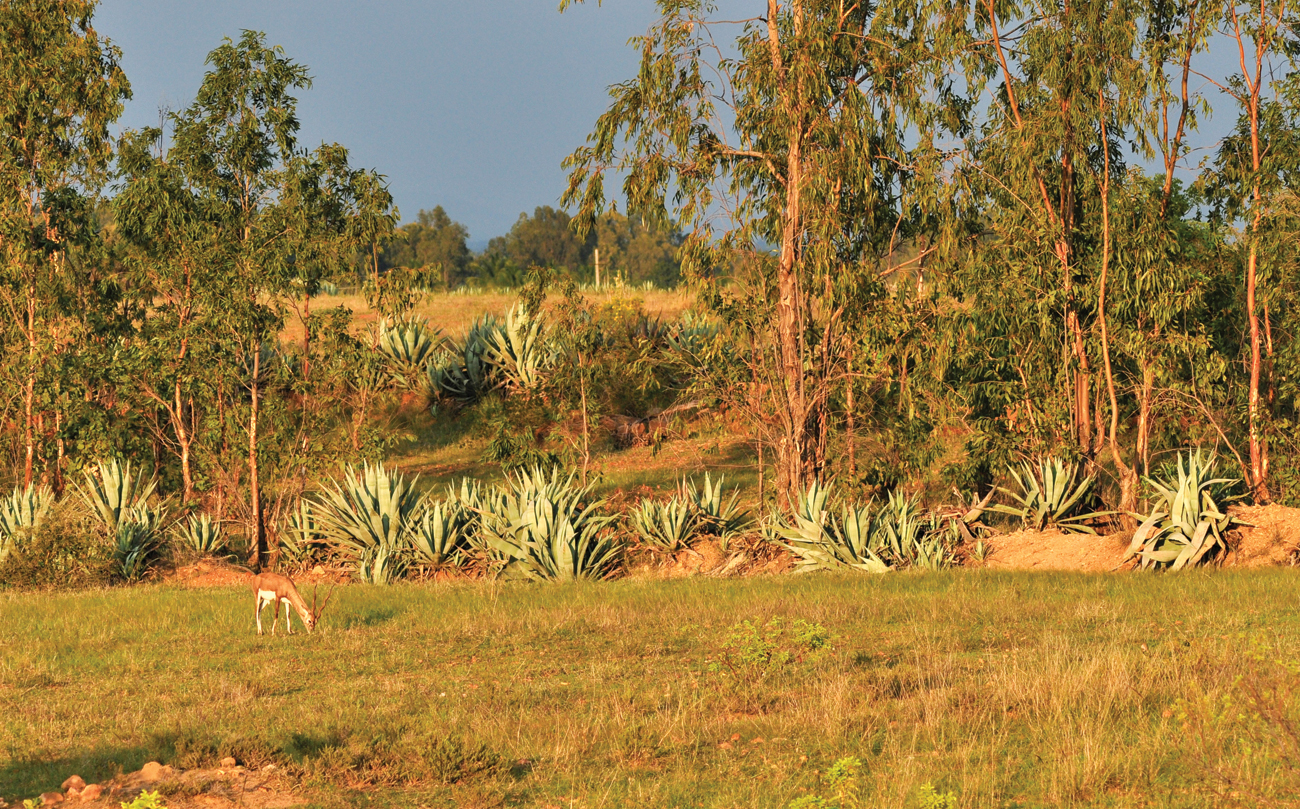
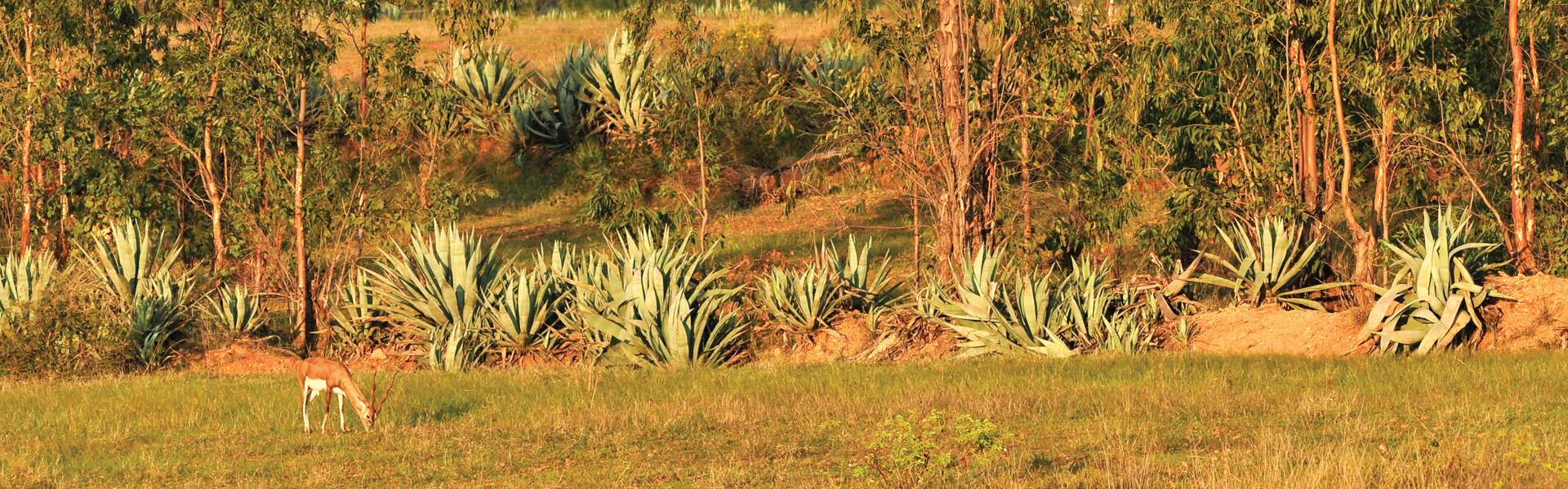
From an elevated perspective from a watchtower in Mydnahalli, the landscape revealed itself to be a mosaic of savanna-grasslands, interspersed with fallow agricultural plots and timber plantations of Eucalyptus sps. and Acacia auriculiformis trees. Photo Courtesy: Dr. Seshadri K.S.
The Blackbuck Attendance Sheet
We began by mapping the land-use and land cover using satellite images to determine how fragmented the landscape was. We then divided the conservation reserve and an area of two kilometres from the boundary into grids of 250 x 250 m. This decision was based on how much the blackbuck would move in the day. Manoj then spent the next two months surveying the grids for the presence or absence of blackbuck. Since the animals move away, we had to rely on detecting droppings or hoofmarks within the grids. In the end, we had sampled a total of 177 grids: 65 inside and 112 outside the reserve. Along with data on presence and absence, we noted habitat variables such as the number of trees, and the presence of shrubs and livestock while sampling. This pattern, however, could be an artefact of the season and we decided to revisit the sampled grids just after the monsoon. When Manoj went to repeat the surveys, many of the grids we had sampled were inaccessible as farmers had fenced off the areas and began to cultivate crops. Despite the limitations, we were able to resample most of the grids to yet again find a similar pattern: blackbuck appeared to be more common outside the reserve than inside it.
When we analysed the data using a robust statistical approach called ‘occupancy modelling’, we found that the likelihood of finding blackbuck was similar inside and outside the reserve. The probability of detecting blackbuck was dependent on the combination of the number of shrubs, trees, and presence of livestock. The probability of detection decreased with increasing shrubs, increased with presence of livestock, and did not vary with the number of trees. These were insightful findings as they showed how blackbuck use the landscape. Being open habitat species, shrubs such as Lantana and trees such as Neltuma juliflora create impenetrable habitats. The positive association with livestock is likely because both livestock and blackbuck are looking for grasses and other feeding resources. Although trees are not ideal in grassland habitats, we have observed blackbuck resting under the shade of trees, especially in the hot afternoons.

The positive association of blackbuck with livestock is likely because both are looking for grasses and other feeding resources. Shrinking habitats from the intensification of agriculture and land-use change, and rising livestock numbers, can push blackbuck to the brink. Photo: Saptarshi Mukherjee/Sanctuary Photolibrary.
Conserving Blackbuck
Protected Areas are created by drawing a line and creating a divide, where something is perceived to be safe on one side and unsafe outside. The preservationist mindset of conservation has also led to what is called the nature-culture divide. In this dichotomy, everything wild belongs to nature and everything human would be culture. One crossing over to the other is not tolerated. In the case of Jayamangali, a conservation reserve had been declared, and plantations of exotic trees were raised. The blackbuck, however, has no notions of constructs such as a conservation reserve, and moves freely to where the resources are, often into human-dominated landscapes.
Nearly all conservation efforts fail when they ignore the fact that ecosystems are complex, and that there is also a societal dimension. In the case of Jayamangali, simple solutions such as expanding the conservation reserve are not going to work because the land around the reserve is privately owned and people are dependent on it for livelihood. A long-term plan to conserve blackbuck would be to conserve the habitat. This includes removal of plantation trees inside the reserve and removing shrubs such as Lantana and trees such as Neltuma juliflora and Eucalyptus. The Karnataka Forest Department has already been cultivating pulses inside the reserve to prevent blackbuck from going outside to forage. Alongside, there is a clear need to understand the grassland plant community and work on rejuvenating some of the fallow lands to promote grasses and forbs.
The land around the reserve is a matrix of grasslands and agricultural fields and this heterogeneity is essential for maintaining a viable population of blackbuck. We must not hesitate to explore innovative pathways to conserve the species. A community-governed model where blackbuck are tolerated, and revenue generated from wildlife tourists viewing them is shared among the farmers may be a viable option to offset the loss from crop damage. At a much broader level, there must be a systemic shift in our thinking too. Grasslands are not wastelands and we should refrain from planting trees and where necessary, actively work towards removing them.
For the blackbuck and other myriad denizens of the grasslands to survive for posterity, it is important that we miss the forest and its trees!
Dr. Seshadri K.S. For the blackbuck and other myriad denizens of the grasslands to survive for posterity, it is important that we miss the forest and its trees!