Camera Trapping Seeing Without Being Seen
First published in Sanctuary Asia,
Vol. 46
No. 6,
June 2026
By Saurabh Sawant
We had climbed onto a small plateau‑like hillock, a quiet patch of forest floor carpeted with damp leaves, moss, and old wood. It simply felt right. We walked slowly in circles, reading the ground for signs – faint trails, old scat, broken movement through undergrowth – trying to understand how an animal might move through this landscape without ever being seen. Eventually, we strapped a camera trap to a tree, tested a few angles, listened to the soft click of the lens and the faint red glow of the sensor, triggered it ourselves a couple of times, and left it there.
I was in a community reserve in Nagaland with my friend Lansothung Lotha from the Nagaland Forest Department, one of the oldest and most respected hunters from the village.
Months later, we finally checked the images. A brush-tailed porcupine, a yellow‑throated marten, and then, suddenly, twice in the same sequence, a clouded leopard, a species that I have rarely seen. Low to the ground, silent, almost brushing past the edge of the frame before disappearing again.
That animal had probably been moving through those forests for years, completely unnoticed by people. The camera trap quietly watched a place where human eyes rarely linger, and for a few brief seconds, something almost mythical became real. That, perhaps, is the greatest gift of camera trapping.
In my years in the field, one of the ideas that has stayed with me is also one of the simplest: what if we could observe animals without entering their world too loudly, too visibly, or too often? Camera trapping made that possible, not by replacing us in the field, but by allowing us to step back and leave a silent observer behind. Instead of constantly following wildlife, we began waiting for wildlife to reveal itself to us.
For conservationists, this has changed more than science. It has changed storytelling itself. A tiger crossing a trail at night. A leopard carrying prey through a narrow corridor. An elephant herd moving silently past a village edge. A pangolin appearing for a few wet, blurry seconds in the middle of heavy rain. These moments have become more than just entries in a field notebook. They have become images that can be revisited, shared, studied, and remembered.
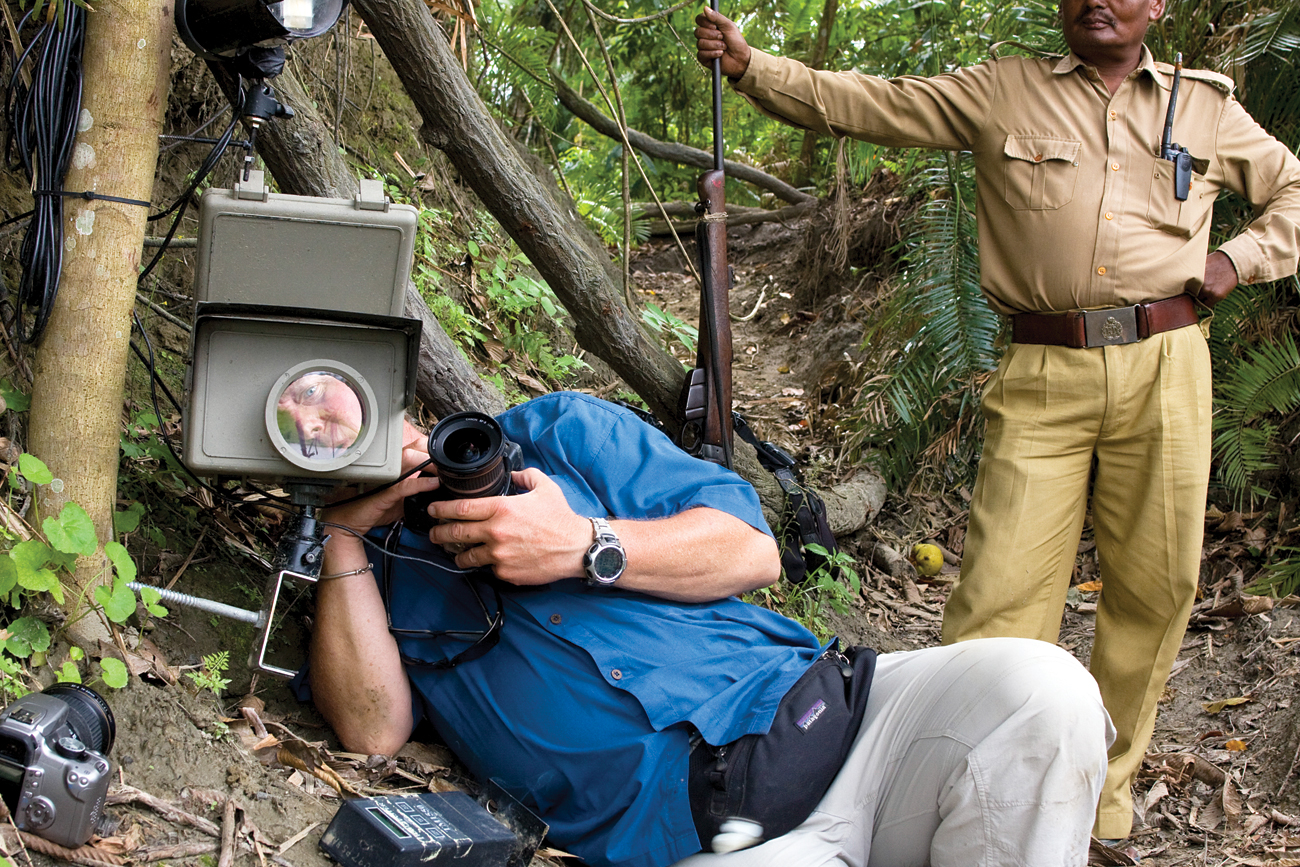
Award-winning wildlife photographer Steve Winter shares a playful self-portrait while preparing a camera trap in Kaziranga National Park, Assam. Over the years, Steve has mastered the craft of camera-trap photography, capturing rarely seen moments of some of the world’s most elusive wildlife. Photo: Steve Winter.
Flash, Film, And Firsts
The roots of camera trapping go back to the late 19th and early 20th centuries, when George Shiras III in North America began experimenting with trip‑wire‑triggered systems and flash powder to photograph animals at night. By modern standards, these early systems were bulky, unreliable, and almost primitive, but they proved something revolutionary for their time: wild animals could photograph themselves.
In India, one of the early pioneers was Frederick Walter Champion, a British forester in the 1920s and 1930s. Using trip‑wire‑triggered flash systems, he produced some of the earliest photographs of wild tigers in their natural habitats. Even today, those images retain a haunting quality… glowing eyes emerging from dark forests, striped forms appearing almost like apparitions in black‑and‑white frames.
The first time I saw some of Champion’s photographs, I remember being awestruck not only by the images, but by the sheer effort required to create them. What must it have taken to carry and set up such equipment in dense forests nearly a century ago? Today, much of that process has become far easier and more accessible. For all the challenges conservation still faces, it is hard not to feel that we are living through an extraordinary period for ecological monitoring and field biology.
But early camera trapping came with serious limitations. Film rolls carried only a handful of exposures. Batteries failed quickly. Moisture fogged lenses and damaged electronics. Cameras had to be revisited too often, sometimes disturbing the very invisibility researchers were trying to study. More than once, I have opened old camera housings to find ants nesting inside, or caught the unmistakable smell of damp metal
and fungus slowly creeping into the precious equipment.
Even moving grass, shifting light, or wind‑driven heat patches could trigger cameras repeatedly through the night, wasting precious film and battery life. Once a bunch of really tiny flies tripped my laser triggers, draining the batteries before a tigress walked in.
More importantly, these systems were still tools of documentation rather than ecology. A photograph could show that a tiger had passed along a forest road, but it could not yet answer deeper questions about how many tigers used the landscape, how they moved through it, or how they interacted with prey, competitors, and people.
Cameras As Scientific Instruments
Camera traps began changing dramatically during the 1990s. In India, one of the most important shifts came through tiger research led by Dr. Ullas Karanth and his colleagues in Nagarahole. By combining camera traps with capture‑recapture methods using the unique stripe patterns of tigers, they showed that camera traps could produce statistically robust estimates of density, not just isolated records or anecdotes. The impact of this work echoed far beyond India and helped shape how carnivore monitoring is done around the world.
Around the same time, camera traps themselves became smaller, more reliable, and far more practical for long‑term field use. Passive infrared sensors improved detection. Motion and heat triggers became more efficient and less prone to false alarms. Metadata such as timestamps, dates, and temperature readings began helping ecologists understand not just which species were present, but when they moved, how often they used certain areas, and how activity changed across seasons and landscapes.
For field biologists, this changed the rhythm of the forest itself. A single camera placed carefully along a ridge, a dry streambed, a forest trail, or a road could continue working quietly for days or weeks while people were elsewhere. The forest no longer disappeared into darkness after sunset. Life simply continued beyond our presence, and the camera became a patient, mechanical witness to it.
Seeing What We Miss
Camera traps began recording things that field teams almost never witnessed directly. Predators scavenging uneasily beside one another at kills. Rare nocturnal carnivores slipping through fragmented forests. Tigers using corridors between villages. Leopards navigating the crowded urban edges of Mumbai through railway lines, scrub patches, and narrow green spaces between houses.
Again and again, camera traps reminded us that wildlife survives in places where people often stop expecting it to exist.
Some of the most memorable images in India have emerged not from pristine wilderness, but from edges: village outskirts, degraded forests, roadsides, plantation mosaics, and thin ecological corridors squeezed between human settlements.
Sometimes even common species can suddenly feel extraordinary. At my village home, I once placed a camera trap along a small trail nearby, hoping to photograph a civet that local residents often spoke about but rarely actually saw. When the images finally appeared, it was genuinely exciting – not because the species was rare, but because it had been living quietly around us all along, completely unnoticed. The reaction from neighbours was equally memorable. People who had grown up hearing stories about these animals were amazed to suddenly see one moving through the landscape almost invisibly, perhaps even crossing trees above our homes at night while we remained entirely unaware of its presence. From that very common civet to the very rare, my only Chinese pangolin on a camera trap was equally exciting.
Yet, the images are not always comforting.
Camera traps have also captured poachers, illegal grazing, snares, armed intrusions, and unauthorised movement through Protected Areas. In several landscapes, such images have become part of anti‑poaching investigations and enforcement efforts. Cameras intended to record wildlife often end up recording threats to wildlife as well.
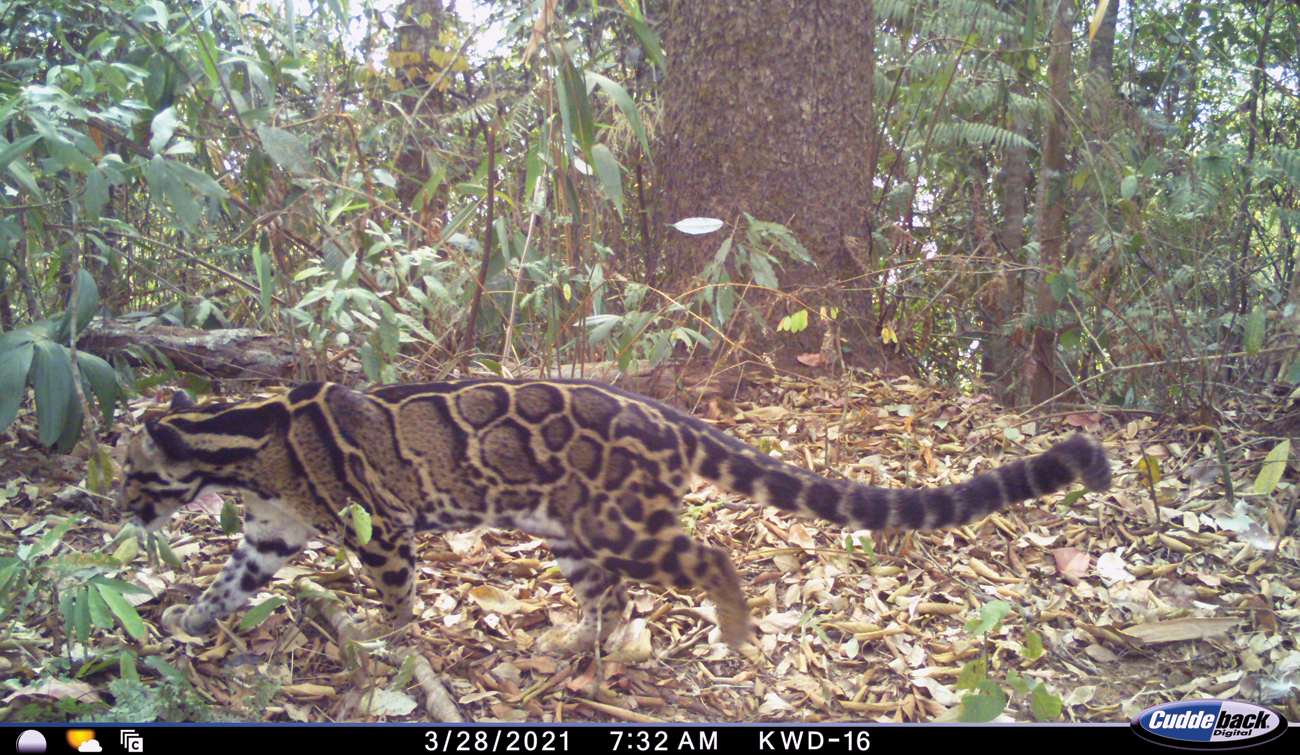
The clouded leopard may have drifted silently through the forests of the community reserve in Nagaland for years, unseen and elusive. In a place where few human eyes ever pause, the camera trap kept its quiet vigil until, for a fleeting moment, the hidden became visible. Perhaps that is the true magic of camera trapping: revealing worlds that exist beyond our notice. Photo: Saurabh Sawant.
The Data Explosion
The transition from film to digital storage during the 2000’s transformed camera trapping once again. Once memory cards replaced film rolls, cameras could remain active for weeks without disturbance, and thousands of images could be stored cheaply and efficiently. Long‑term monitoring across large landscapes suddenly became possible at scales that would have seemed unimaginable only a decade earlier.
This has created a new challenge. The bottleneck has shifted from collecting images to processing them.
A single camera trap survey can now generate tens or even hundreds of thousands of photographs – many empty, repetitive, or triggered by moving vegetation, rain, shifting light, or drifting heat. Anyone who has worked extensively with camera traps knows the strange mix of excitement and exhaustion this creates: days of sorting through blank frames interrupted suddenly by one extraordinary image that makes the entire effort worthwhile.
In India, this explosion of data became central to modern tiger monitoring. The shift away from unreliable pugmark‑based estimates toward image‑based methods did more than improve population estimates. It strengthened the credibility of conservation science itself by creating records that could be revisited, verified, and independently interpreted.
Uncovering Hidden Life
Some of the most important outcomes of camera trapping are not statistical at all.
They reshape the way people imagine wilderness and coexistence.
A marbled cat’s unexpected appearance in a Northeast Indian forest. A melanistic leopard melting into the darkness. A tiger crossing a narrow corridor between villages. A pangolin moving through degraded habitat where few believed it still survived.
These images remind us that wildlife is not confined only to pristine core forests. It persists in fragmented, human‑dominated landscapes as well, often surviving far more quietly and adaptably than we imagine.
At the same time, camera traps are far from perfect. Like every scientific tool, they carry biases and limitations. They tend to favour larger, terrestrial, trail‑using animals while underrepresenting arboreal species, small mammals, reptiles, amphibians, and species moving through dense vegetation, where infrared sensors often struggle. Placement itself shapes outcomes because humans decide where cameras are installed – along roads, trails, riverbeds, ridges, or water sources.
False triggers remain a constant frustration in the field. Wind, rain, moving leaves, shifting shadows, and reflections from wet surfaces can generate thousands of empty frames. Equally important are false negatives: animals that pass through an area without triggering the camera at all.
Even identification is not always straightforward. A blurred image, poor angle, partial body pattern, or obstructed frame can sometimes lead to misidentification or overcounting.
F.W. Champion’s Camera-trapping Legacy
Many naturalists and wildlife enthusiasts are familiar with the concept of camera-trapping, where animals are photographed or filmed using small trail cameras strapped to trees, triggered by sensors that respond to movement. Few, however, are aware that one of the earliest pioneers of such technology, known then as tripwire photography, was active in the jungles of northern India a century ago.
Frederick Walter Champion (1893 – 1970) was a British forester who first came to India in 1913, but it was 10 years later that he finally achieved his ambition to become the first ever person to photograph a wild tiger. His equipment was cumbersome, involving a large quarterplate camera that could only take one shot per night, as well as a magnesium flash, a tripwire, a battery… and endless patience.
Champion would go out during the day and identify a path that was regularly being used by a tiger, identifiable by the pugmarks, and he would set up the camera on a small tripod, camouflage it with leaves and grass, attach the flash and the battery to a tree, stretch the wire across the path, focus the lens on where he thought the tiger’s face might be if it came in the desired direction, and then retreat to a nearby forest rest house.
When he returned in the morning, he would develop the plate, and if luck was with him, the results were remarkable, so much so that Champion’s images are now seen as absolute classics of wildlife photography.
By James Champion
AI and ‘Smart’ Forests
Artificial Intelligence is beginning to transform camera trapping… yet again. Machine‑learning systems can already help identify species, detect humans or vehicles, filter empty images, and process massive datasets far quicker than manual teams work alone. In some landscapes where network infrastructure exists, camera trap systems can even send near‑real‑time alerts when elephants, tigers, leopards, or people are detected near sensitive zones. The implications for anti‑poaching work, conflict mitigation, and rapid‑response systems around villages and farms are considerable.
I have seen Odisha Forest Department teams using some of these systems quite effectively, while also building public awareness around them through outreach and online communication. The cameras are no longer just silent recorders; they are becoming part of a broader network of tools such as acoustic sensors, drones, satellite data, cloud‑based dashboards, and AI‑assisted analysis, which together begin to create what some describe as ‘smart forests’: landscapes that can be monitored almost continuously in near real time.
But conservation rarely improves simply because technology becomes more sophisticated. More cameras do not automatically mean deeper ecological understanding.
The real challenge ahead lies not just in deploying more sensors, but in building systems that are both scientifically sound and ethically thoughtful, and that actually mean something for the animals on the ground. AI may help process enormous quantities of data, but interpretation still depends heavily on field experience, local knowledge, and ecological judgment.
Perhaps one of the most important future challenges will be training these systems using the knowledge of experienced naturalists, local communities, forest staff, and field biologists who spend years understanding landscapes in ways that algorithms alone cannot. That is a task that cannot be outsourced to machines.
The Quiet Witness
Camera trapping began as an attempt to see wildlife without disturbing it. Over time, it evolved into one of conservation’s most powerful tools for monitoring populations, understanding behaviour, documenting threats, and revealing animals that often exist beyond ordinary human observation.
But perhaps its greatest contribution is more subtle.
Camera traps remind us that forests are full of lives unfolding continuously, even when we are absent. They show animals behaving more naturally once human presence disappears. And in doing so, they return a certain humility to conservation, the understanding that sometimes the best way to observe nature is not to follow it constantly, but to step back, remain patient, and allow the forest to speak for itself – just the way a seasoned wildlife photographer would do.
Consultant, Projects and Natural History at the Sanctuary Nature Foundation, Saurabh Sawant is a wildlife researcher, naturalist, wildlife photographer and filmmaker, and his work has been widely published.Consultant, Projects and Natural History at the Sanctuary Nature Foundation, Saurabh Sawant is a wildlife researcher, naturalist, wildlife photographer and filmmaker, and his work has been widely published.
The Hidden Worlds of Big Cats
By Steve Winter
I was failing. I’d set up camera traps in the jungle in Belize, working on my third story for National Geographic, this one on jaguars, and I’d only gotten two photos. I began to understand why no one had done a jaguar story for the magazine in its entire history: These cats are elusive and rainforests are dark.
It was June 1998, I was using slide film at the time, and it was slow ISO 50 and ISO 200. My best image had motion blur, and I only had 36 frames on a roll. Then I learned I could actually see this cat in Brazil, so I gave up on camera trapping and was able to photograph them along rivers in the stunning Pantanal wetlands.
By the time I did my next big cat story – on snow leopards – for National Geographic in 2006-2007, my cameras were digital, which entirely changed the game. They had dramatically better light sensitivity and what felt like limitless images on a card. It also allowed me to compose my image and have my assistant crawl through so I could check the lighting. And when an animal came, I could actually see what I was getting in real time and adjust lighting and composition.
On that assignment, I camped out with a team of seven in the Hemis National Park in Ladakh for three months in the dead of winter. I always work with scientists and local people, and for this story, I collaborated with Snow Leopard Conservancy India, which was doing a snow leopard census. Scientists had identified places along high mountain trails where the cats walked and marked territory. That’s where I set up my 13 camera traps.
Our camp was at an altitude of 4,700 m., but the cameras were often up higher, which made it pretty tough to check them a few times a week. Temperatures dropped as low as -50℃ at night, and the batteries usually died overnight. Once the sunlight breached the mountaintops, the cameras warmed up and resumed working.
This is where I really learned to camera trap, and I incorporated lighting techniques I’d learned years before, essentially creating a ‘movie set’ with multiple flashes, just waiting for my animal actors to step onstage. Some of those ‘actors’ include lions in Africa and Gujarat; tigers in India, Sumatra and Thailand; leopards in Mumbai and Africa; the famous cougar, P-22, in California, as well as everything from bobcats, bears and deer to elephants.
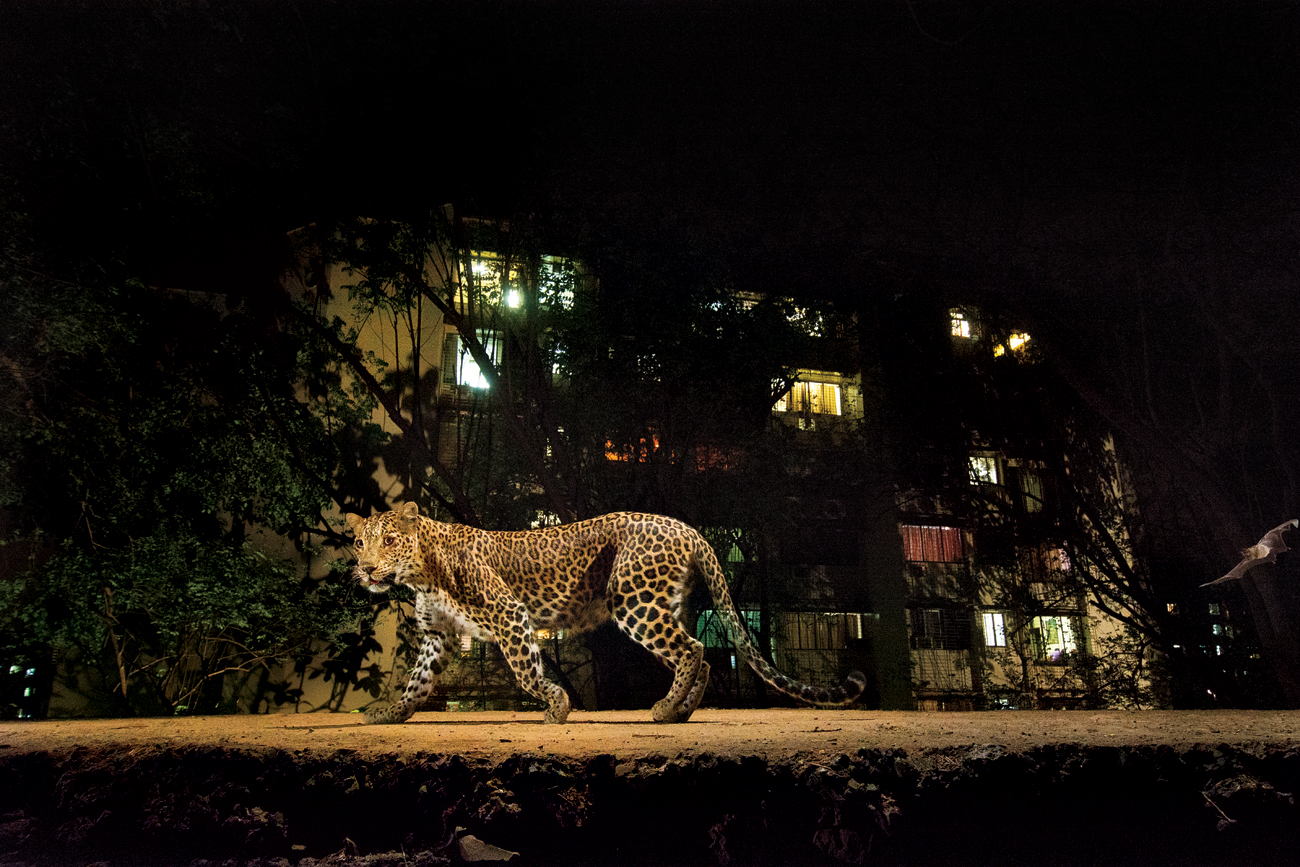
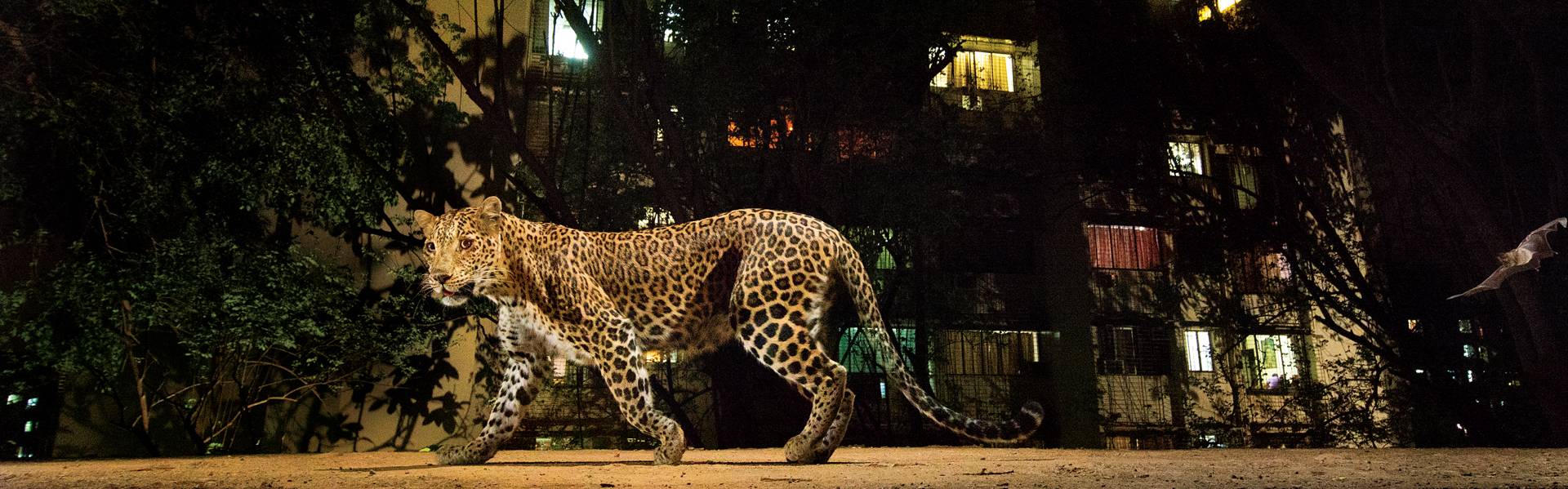
Remote cameras allowed Steve Winter to tell stories in unique ways – for instance, photographing leopards in the Sanjay Gandhi National Park at night, with lit-up apartment blocks in the distance, highlighting that these were urban cats. Photo: Steve Winter.
Peering Into Secret Lives
Back then, in 2007, we called snow leopards ‘ghost cats’ because people almost never saw them; with strong conservation efforts, that’s changed. Camera traps are the only way to peek into the lives of rare or elusive animals and capture images of secret behaviours. I caught a snow leopard spraying a rock to mark territory and another standing on its hind legs, rubbing its chin on a boulder, exactly like my housecat, Punkin, does.
Remote cameras allow me to tell stories in unique ways – for instance, photographing leopards in the Sanjay Gandhi National Park at night, with lit-up apartment blocks in the distance, highlighting that these were urban cats.
But it’s hard. The reasons that a camera trap fails, or fails to get pictures, are infinite. You’d spend hours (or days) setting up a remote camera; it worked when you left and didn’t work when you returned. Sometimes the reason was obvious; other times, I never managed to get it working again.
Initially, traps were corded and connections didn’t work (often for no obvious reason) or cords were chewed by animals. Ants somehow crawled into my camera boxes, and into the cameras. A blade of grass or falling leaves have taken thousands of pictures of themselves, filling a card and/or killing the camera and flash batteries. In Kaziranga National Park, elephants and rhinos sometimes went after traps: a few times elephants grabbed them with their trunk and snapped them off the tripod heads. Rhinos stomped on them.
In some cases, it’s dangerous. In tiger parks, or out in African savannahs, we’re in safari jeeps, but you have to be on the ground to set up camera traps. Sometimes you have a guard with you, if not, you’re with a scientist. But I’ve spent much of my career covering big cats: apex predators. For these stories, I start by consulting experts. For example, on a tiger story in Bandhavgarh, I asked the guards and mahouts, “Where’s the best place to set up a camera?” They were unanimous: the Patparanala watering hole. It produced a gold mine of photos, starting on the first day.
But it can take months to get a single picture, which takes monumental patience. When I’ve run out of field time, I’ve left camera traps up, hiring people to keep them running. When I was working in Sumatra on my tiger story, I never saw the cat. I was back at home for four months when I received an email with a photo: a Sumatran tiger at night that became the story opener.
When camera traps work, the images can be extraordinary.
The Shot that Changed LA
The most powerful example of that, for me, is my photograph of P-22. I was working on a cougar story in the U.S., and I wanted to include cats that lived in Southern California. These were urban cats that lived in a heavily populated area, cut by some of the nation’s busiest freeways.
In a meeting with Jeff Sikich, the biologist who studied these cougars, I’d asked how to get camera trap images of these cats, and then I described my dream shot. “You know what could really show this?” I asked. “A picture of a cougar under the Hollywood sign.” He later told me he thought I was crazy, but sometime later, a young male (which he named P-22), safely navigated two 10-lane freeways and settled in Griffith Park in Los Angeles, which had 10 million visitors a year.
It took 15 months, but I miraculously captured that image. The editors stopped the presses to include the photo. It made P-22 a celebrity in the land of celebrities: L.A. fell in love with their cougar. Urban wildlife is now part of the L.A. school curriculum. The L.A. County Natural History Museum installed a permanent P-22 exhibit. Every year in October, L.A. celebrates P-22 Day with a festival. And P-22’s plight, trapped in a small, fractured habitat, sparked construction of what will be the world’s largest wildlife overpass.
The Wallis Annenberg Wildlife Crossing will open on December 2, 2026. I have been given permission to set up camera traps on and near the crossing to document what animals use this new pathway, which reconnects the best habitat in the region.
Camera traps have been a critical tool. My goal throughout my career has been to produce images that people have never seen before, and hopefully, make people care about these animals, and want to protect them.
Steve Winter specialises in wildlife photography, particularly big cats photography, though he began his career as a photojournalist at Black Star Photo Agency. He’s been named BBC Wildlife Photographer of the Year and BBC Wildlife Photojournalist of the Year.
Into Their World My Journey With Camera Traps
By Yashpal Rathore
At the beginning of my journey as a nature photographer, I found myself surrounded by thousands of striking wildlife images – crisp portraits, dramatic action, and intimate behavioural moments captured from safari vehicles across India and Africa. These photographs were powerful, no doubt. Yet, over time, I began to feel that something was missing.
Most images isolated the animal from its world.
They celebrated the subject, but often overlooked its story – its connection with the landscape, the subtle interplay between animal and habitat, the quiet emotion of belonging. I realised I didn’t just want to photograph wildlife; I wanted to place it back into its environment, to tell a more complete story.
That led me to explore a different approach – one that required me to step back, quite literally, and let the wild take over.
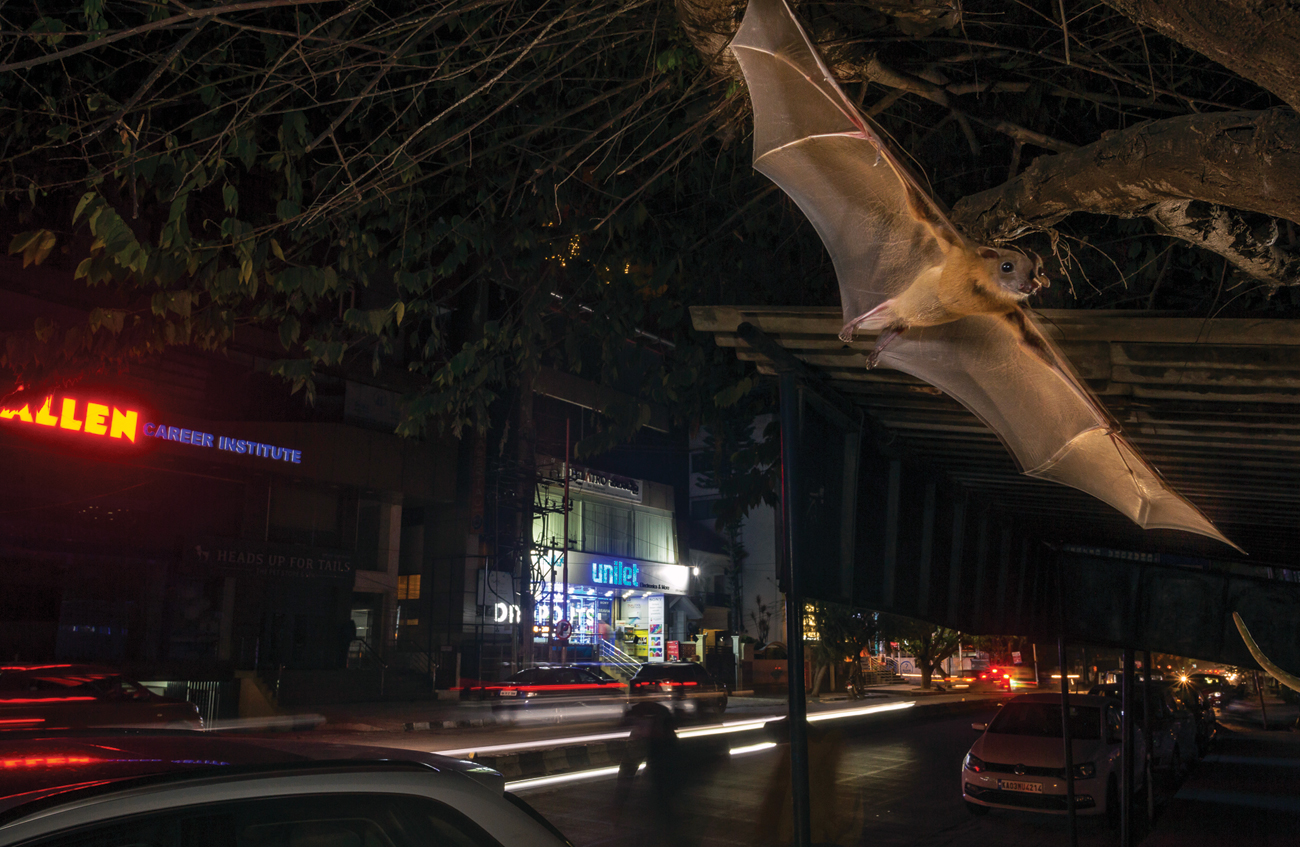
Yashpal Rathore’s work with camera traps is guided by two core objectives: one is to create environmental portraits, and the second is to document lesser-known mammals – species that are shy, nocturnal, or extremely rare. For many of them, camera traps are the only way to capture high-quality images. Photo: Yashpal Rathore.
A Camera For Where We Cannot Go
The question was simple, but the answer was not: How do we create images from within an animal’s world, without disturbing it?
We cannot approach most wildlife closely without altering their behaviour. But what if, instead of going to them, we could send our cameras? This idea drew me into the world of remote triggers and, eventually, DSLR camera traps.
To create a wider-angle image using remote triggers, we have to really plan well in advance. For example, we knew hornbill behaviour, or that of the Demoiselle Crane, and so we planned accordingly, but for others such as an African elephant, I had to think differently. Such moments shaped my confidence. I was on a game drive in Amboseli when we spotted a group of elephant bulls approaching a track. The marsh lay on the other side, and it was almost certain they would cross. Though the terrain seemed open, animals often follow invisible pathways – patterns you begin to recognise with time. Within seconds, I placed my camera low on a rock along that path. The settings were already visualised – focal length, focus distance, exposure. There was no time to think; only to act on instinct built through practice.
Weeks of preparation often culminate in a few fleeting seconds like these.
As I continued photographing wildlife, another realisation struck me. We were repeatedly documenting the same set of species – the charismatic megafauna that dominate our safaris and social media feeds.
But India alone is home to over 400 species of mammals. Even if we exclude bats and rodents, we are left with around 200 species – many of them nocturnal, elusive, and rarely seen. How many of these have we truly documented in a way that inspires people to care? This question became a turning point. Camera traps offered a way to explore this hidden world, to photograph species that are otherwise nearly impossible to encounter, let alone capture well.
From Trail Cameras To DSLR Traps
Camera traps are not new. For decades, field biologists and conservationists have used trail cameras to study wildlife. These compact, weatherproof units, often no larger than a lunchbox, combine a camera, sensor, and flash into a single system. They have been instrumental in discoveries, population monitoring, and even national-level censuses, including tiger estimation in India.
However, while trail cameras are incredibly useful, they come with limitations – image quality, harsh lighting, red-eye, and limited creative control.
As a photographer, my goal extends beyond documentation. I want to create images that resonate emotionally, that draw viewers in, and that inspire conservation.
That’s where DSLR camera traps come in.
They operate on the same principle, but offer complete control over composition, lighting, and image quality. With the addition of off-camera flashes, they open up an entirely new creative dimension.
What Drives My Work
My work with camera traps is guided by two core objectives.
The first is to create environmental portraits – images where the animal and its habitat share equal importance. These photographs tell a larger story, one that highlights the need to protect not just species, but the ecosystems they depend on.
The second is to document lesser-known mammals – species that are shy, nocturnal, or extremely rare. For many of them, camera traps are the only way to capture high-quality images.
There is a vast, unseen world around our Protected Areas. Many of its inhabitants remain uncelebrated, simply because we do not see them often enough. Photography can change that.
Lessons From The Field
Working with camera traps has transformed me – not just as a photographer, but as a naturalist.
You cannot rely on luck. Every placement demands an understanding of the animal, its behaviour, movement patterns, habitat preferences. It forces you to slow down, observe deeply, and think like the subject.
Unlike traditional wildlife photography, which is often fast-paced and reactive, camera trapping is deliberate. You plan the frame, visualise the outcome, and then leave, sometimes for weeks, trusting your preparation.
There is also a unique thrill to it. Retrieving a camera after weeks in the field feels like opening a mystery box. Often, the results are disappointing – false triggers, empty frames, unexpected disturbances. But sometimes, nature rewards you with something extraordinary – an image you never imagined. Those moments make everything worthwhile.
How It Works
At its core, a DSLR camera trap system consists of three components: the camera, flashes, and a trigger mechanism. The trigger replaces the photographer. When an animal passes a certain point, it activates the camera and flashes.
There are two primary types of triggers: Passive Infrared (PIR) sensors detect motion and temperature differences. They are affordable and easy to deploy but prone to false triggers – from heat shifts, moving vegetation, or weather changes.
Active Infrared (AIR) systems use a beam between a transmitter and receiver. When the beam is broken, the camera fires. These systems are more precise and reliable, though slightly more complex.
When I started, nothing was readily available. I built my first trigger using a basic home security system. Today, more advanced systems offer greater reliability, but the essence remains the same – anticipation and precision.
More Than Just A Photograph
There is a common misconception that camera trapping is simply a matter of luck, or worse, that it is somehow ‘cheating’, because the photographer is not physically pressing the shutter.
In reality, it often demands more preparation than traditional photography.
You must study the terrain, predict movement, plan for changing light conditions, and ensure your settings work whether the subject appears at noon or midnight. Then you walk away, placing your trust in the process.
For me, camera trapping is perhaps the most challenging, but also the most rewarding way to photograph wildlife, because in the end, it is not just about
the image.
It is about surrendering control, respecting distance, and allowing the wild to tell its own story on its own terms.
Yashpal Rathore is an Indian wildlife photographer, filmmaker, and expedition leader known for documenting some of the planet’s most remote and fragile ecosystems, with a strong focus on conservation storytelling and lesser-known species. Through his company WildSpirit, he mentors photographers and curates immersive nature experiences for wildlife enthusiasts and conservation-minded travelers.
A Vital Tool in the Armory
By Dr. Anish Andheria
What began in the early 1990s as a tool to estimate tiger densities has today become indispensable for answering critical ecological and conservation questions concerning wildlife. Camera traps are now used to study species ranging from small cats, clouded leopards, red pandas, and musk deer to critically endangered birds such as the Jerdon’s Courser and Bengal Florican, as well as poorly understood species such as pangolins and ratels. They are equally valuable in monitoring large mammals, such as gaur and elephants, which increasingly come into conflict with people owing to rapid land-use change.
At the Wildlife Conservation Trust (WCT), camera traps are central to nearly every research project, helping illuminate urgent conservation challenges. They led to the remarkable discovery of the Eurasian otter in the Satpura Tiger Reserve and its subsequent documentation across several central Indian river systems. Our long-standing Indian pangolin project would have been impossible to envisage without them. Being nocturnal, shy, and burrowing, pangolins remain among the least understood mammals. Camera traps have enabled unprecedented insights into their distribution, behaviour, diet, and densities, generating knowledge vital for both conservation and rehabilitation.
Camera traps have also become indispensable in addressing the impacts of linear infrastructure such as roads, railways, and canals that fragment habitats and cause wildlife mortality. For over a decade, WCT teams have used them to identify critical wildlife crossing points and recommend mitigation measures such as underpasses and overpasses to maintain genetic connectivity. Post-construction monitoring further helps evaluate the effectiveness of these structures, supporting a more balanced approach to development and conservation.
In the northern Western Ghats, camera traps are helping WCT understand the growing conflict between farmers and gaur, the world’s largest wild cattle. Erratic weather conditions and declining crop yields have accentuated intolerance toward gaur near farmlands.
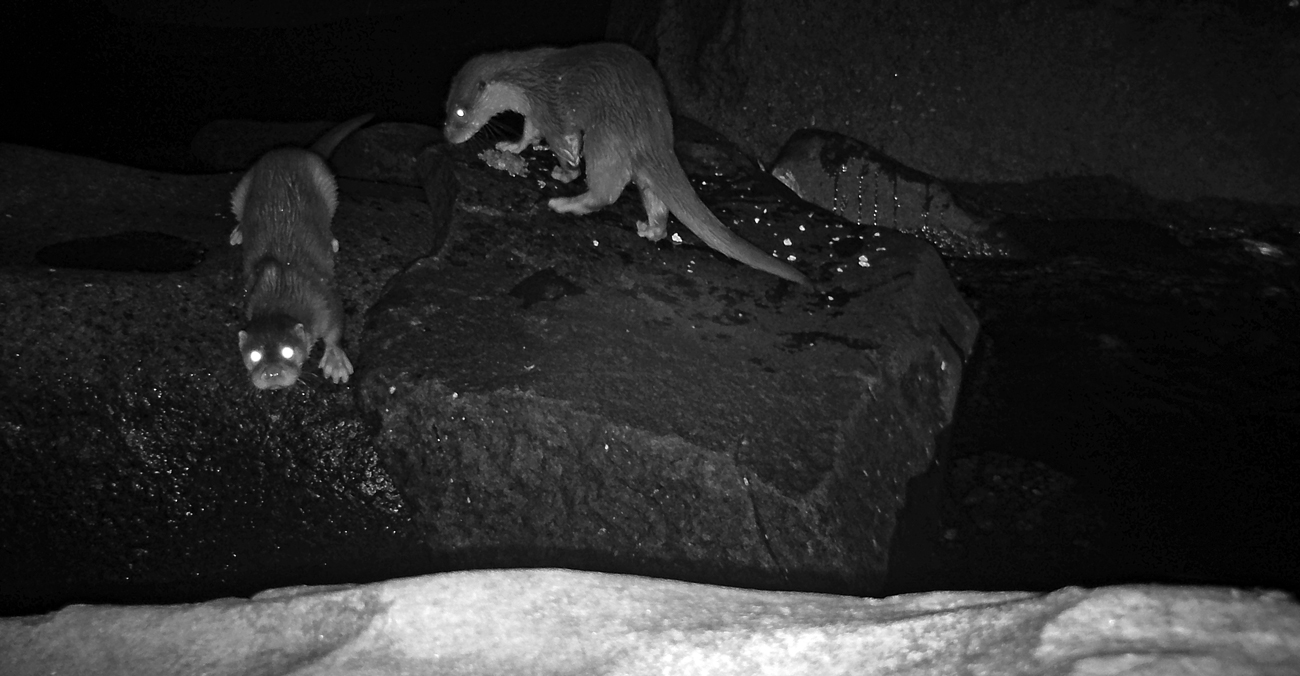
The remarkable discovery of the Eurasian otter in the Satpura Tiger Reserve was made possible through extensive camera-trap surveys conducted by the Wildlife Conservation Trust. Photo: WCT.
Camera traps are helping estimate gaur densities and study the correlation between the intensity of crop depredation and the type of crop, aiding the design of practical coexistence strategies before persecution escalates.They also play a crucial role in identifying tigers and leopards involved in negative interactions with people. Working closely with Forest Departments, WCT field teams use camera traps to unambiguously identify the individual responsible for attacks on humans or livestock. This not only builds confidence among local communities about the response system, but also prevents wrongful removal of other innocuous individuals occupying the same landscape.
Long-term carnivore monitoring and population estimation programmes in Maharashtra and Madhya Pradesh have revealed the transformative value of camera trapping. Years of systematic surveys across 20,000 sq. km. of tiger corridors and Protected Areas in central India and the northern Western Ghats have generated fine-scale insights into how land-use change and management practices affect tigers, leopards, sloth bears, and other carnivores such as dhole, jackals, wolves, small cats, and hyenas. These findings have enabled WCT to create landscape-scale connectivity maps, especially for tigers, which are now being used by Forest Departments, project proponents, and conservation organisations to guide strategic interventions. The maps also serve as critical tools for identifying relatively undisturbed, low human-density landscapes that merit stronger protection through inclusion in the Protected Area network, thereby securing vital river catchments for eternity.
Dr. Anish Andheria, President and CEO of the Wildlife Conservation Trust, specialises in scientific conservation research, securing wildlife corridors, and human-carnivore interactions.
Observation, Surveillance and the Camera’s Trap
By Pranav Capila
The camera trap can be more than a wildlife monitoring tool, but then studying its impacts on the inhabitants of our shared conservation spaces becomes important.
At its core, camera-trapping is about wanting to see an animal. We are profoundly visual creatures after all, and a photograph, even one taken in absentia, is second only to a direct sighting. All your tracks and signs – claw marks on tree bark, a call nearby, pawprints, scat – can’t match its ability to evoke the animal. You may be able to touch, hear, see, sniff and even derive genetic data from the former, but the latter, far more intangible, somehow feels more irrefutable.
Personally, I have also found that the inherent uncertainty of camera-trapping makes it exciting. The technology may be unrecognisable since F.W. Champion jury-rigged his pioneering system of cameras, magnesium powder flashes and tripwires in the Kumaon forests a century ago, but that frisson he would have felt while checking his equipment, not knowing what (if anything) had been captured?
You feel it too, never mind your infrared flash and your motion sensitivity settings and trigger interval configurations. The anxiety of the wait, the disappointment of false-trigger captures... and then the pay-off: a secret glimpse into a secret life.
Champion’s nocturnal captures inspired a generation, including close friend Jim Corbett, to transition from gun to camera, hunting to conservation. His early observations of stripe pattern variations among the tigers he photographed also set the stage for camera-trapping to eventually become more than ‘just’ a valuable wildlife photography technique.
A Valuable Conservation Tool
Over decades of use, camera traps have become globally accepted as highly effective, minimally-invasive, objective tools for monitoring wildlife – particularly elusive species in remote, hard-to-access environments. On field visits with NGOs and Forest Departments, I have seen them deployed to serve a variety of research goals, from monitoring large carnivore movement in central India to verifying elephant movement through vital corridors in the Western Ghats, studying tiger population dynamics in the Northeast, and establishing a baseline of mammalian presence on an ecological restoration site in the Nilgiris.
Perhaps their greatest showcase was the 2018-19 All India Tiger Estimation, touted as the world’s largest-ever camera trap wildlife survey: over 120,000 sq. km. covered, nearly 35 million images taken, with Artificial Intelligence and neural network models (CaTRAT – Camera Trap data Repository and Analysis Tool – and Extract Compare) used in post-processing to sift through photographs and ‘fingerprint’ individual tigers from their stripe patterns.
The new generation of AI-embedded camera traps, in fact, allow for false triggers and non-target species to be filtered out at source – the on-board algorithm ‘chooses’ what images to transmit via cellular network or intermediate long-range radio transmitter (also eliminating the need for researchers to physically access and retrieve data from the device frequently). Such devices are already in use around the country; for example, the TrailGuard AI system deployed in the Kanha-Pench corridor some years ago (Dertien, J.S., Negi, H. et al; BioScience, October 2023).
The old-fashioned camera trap, thus stripped of its (charming) uncertainty, is transformed from a passive capture device to a real-time alert system that can be trained to monitor specific endangered species, identify poachers (humans with guns) and other intruders within protected forests, or track the movement of ‘conflict-involved’ animals to provide early warnings to alert nearby communities.
Truly Innocuous?
The use of such devices addresses clear conservation needs, but has also been flagged for being part of what has been described as the “militarisation of conservation” (Duffy, R., Massé, F.; Biological Conservation 232, April 2019) – essentially, the top-down deployment of advanced surveillance technologies and paramilitary tactics that is defended as ‘necessary’, but criticised as an exemplar of coercive conservation governance.
As it is, even the old, ‘passive monitoring’ camera traps can become instruments of abuse in the wrong hands. In 2017, one such device placed in Corbett Tiger Reserve inadvertently captured an image of a woman from a marginalised community relieving herself in the forest. The image was accessed by temporary forest staff and circulated on social media; in response, villagers destroyed camera traps and threatened to set a Forest Department outpost on fire.
A study that referenced this incident (Simlai, T. and Sandbrook, C.; EPF: Philosophy, Theory, Models, Methods and Practice, November 2024) also revealed how conservation monitoring technologies were systemically impacting the freedoms and safety of women in forest-adjacent communities around Corbett Tiger Reserve. The women, who reported feeling “free” and “alive” in the forest away from “the taunts and violence of their husbands”, would censor their conversations and songs in the presence of camera traps – the latter having significant safety implications, “since loud singing of songs serves as an essential countermeasure to deter large wildlife.” They would also “spend considerable time” adjusting their clothes to “make sure they were adequately “covered”, which increased the amount of time they took to collect firewood and grass. Incidents were also recalled wherein drones had been “deliberately flown near and above women who were returning from the forest”, resulting in them dropping their gathered produce.
This is, of course, just one study in one tiger reserve, and the need to embrace enhanced digital monitoring – be it for non-invasive conservation management, tackling the growing sophistication of global poaching syndicates, or addressing the rapid rise in human-wildlife conflict – is compelling from the conservation perspective. But that is precisely the point: more research is required.
Tread With Care
In India, a significant proportion of threatened biodiversity occupies the interstitial, human-dominated landscapes outside the Protected Area network. We are realising the limitations of the old, coercive, ‘fortress’ model of wildlife protection that so alienated local inhabitants, and looking towards a more community-inclusive approach.
In this context, who gets to wield the advanced surveillance lightsabre, and against whom, becomes important. The camera trap can be more than a wildlife monitoring tool, but then studying its impacts on the inhabitants of our shared conservation spaces becomes important. Otherwise, in our race to embrace the future, we risk perpetuating the injustices of the past.
Pranav Capila, a writer-photographer, tells stories focused on wildlife, wild spaces and unsung heroes on the frontlines of wildlife conservation.
Technology of the Soil
By Dhruvam Desai
Pardus Wild-tech LLP began with a frustration that many conservationists in India will recognise. The tools we rely on – especially for data collection and managing human-wildlife conflict – are often imported, expensive, and not always built for our conditions. REX Trail Cameras grew from that gap.
Our first prototype looked promising on the table: sharp images, reliable triggering, a clean build. In the workshop, everything worked exactly as intended. The field, however, had a way of correcting our assumptions. During an early deployment in the peak summer of central India, things started going wrong almost immediately. Moisture crept into the lens despite our sealing. The sensor triggered unpredictably. Some images were inverted, others completely blown out. Even the housing began to show signs of stress. It was a necessary reality check.
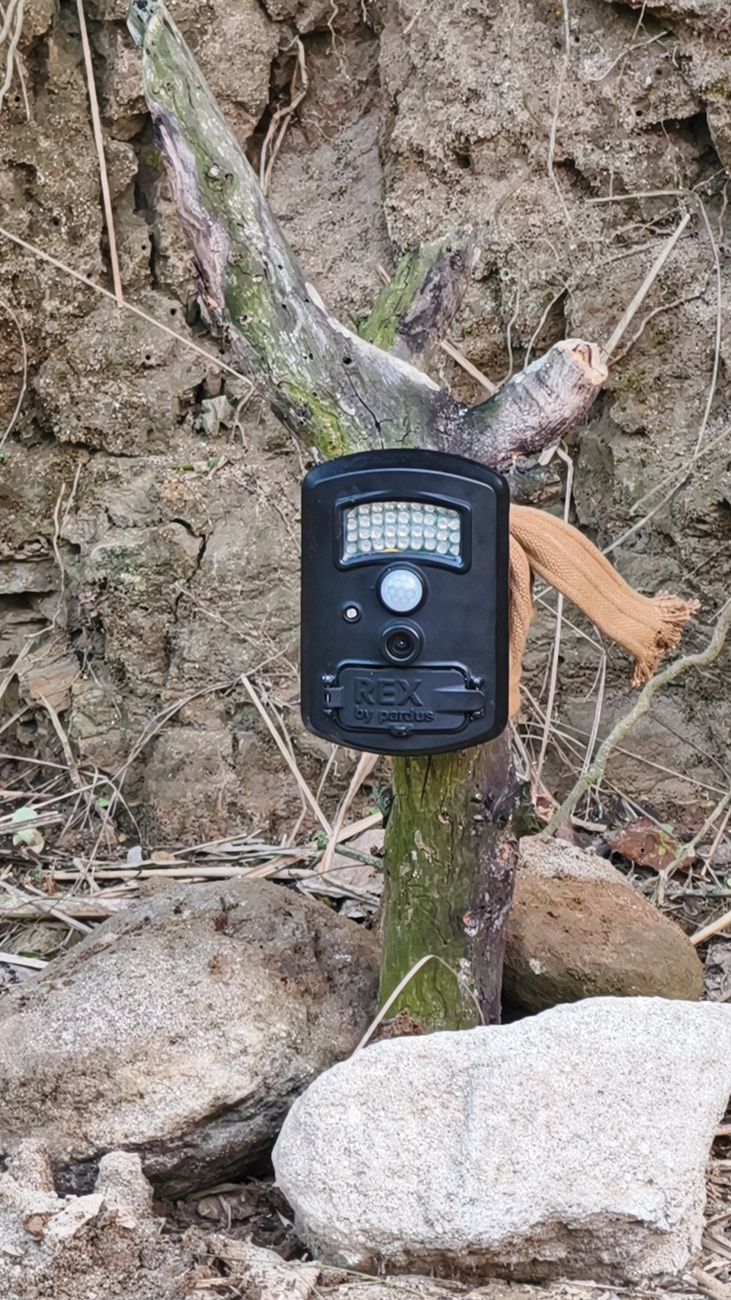
Photo: Dhruvam Desai.
Designing for India means designing for extremes – dry heat in the Thar, sub-zero cold in the high Himalaya, persistent humidity in the northeast, and months of heavy rain across the Western Ghats. A device that works in one landscape often fails in another. Over the next three years, we kept returning to the field – Leh, Garhwal, Assam, Agumbe and even the edges of Mumbai – testing, failing, and reworking. Each deployment revealed something new; each iteration solved a piece of the puzzle. The REX, as it stands today, is a product of that process.
The work is ongoing. We’re now building a higher-resolution version of the system, alongside a low-cost early warning setup for elephant movement with the Keonjhar Forest Department. At the same time, we’re developing lightweight telemetry tools in close collaboration with researchers. This is because in India, conservation technology has to be built here, tested here, and proven here.
Dhruvam Desai is a naturalist, wildlife photographer and the founder of Pardus Wild-tech. Alongside developing conservation technology, he conducts birding and naturalist training programmes, with a focus on building deeper field awareness and engagement with India’s ecosystems.
Building Trust with the Community
By Swastik Indalkar
“Camera traps, like all powerful tools, stand at the intersection of insight and intrusion. In the hands of scientists and conservationists, they quietly unveil the hidden lives of wildlife mapping movements, decoding behaviours, and guiding protection. Yet, without ethical restraint, the same lens can blur boundaries, disturb habitats, or be misused for surveillance and exploitation. The responsibility, therefore, does not lie with the technology, but with the intent behind it, reminding us that conservation is as much about wisdom and sensitivity as it is about innovation.” – Dr. Parvish Pandya
In Guruwahi in Bandhavgarh, camera trapping did not begin with cameras, it began with conversations.
Camera traps are widely accepted as silent wildlife observers, but when introduced without context, they can quickly raise suspicion. Questions around what is being recorded, who is watching, and why the devices are present often become the real challenge more than the weather or correctly finding wildlife.
Recognising this, Sanctuary Nature Foundation’s Jal Vaibhav 2.0, Bandhavgarh team took a different approach. Before installing any cameras, they spent time in the village, engaging with residents and Gram Panchayat members through open, informal discussions. As Forest Beat Guard Narendra Parajapati explains, “Villagers often initially feel fear or suspicion, worrying that cameras are meant to monitor their daily activities such as collecting mahua or firewood.” These interactions created space for dialogue rather than one-sided instruction.
Privacy emerged as a key concern. Chandra Prakash Vishwakarma, a local resident, noted that there was a specific worry about cameras being placed near streams where people bathe, fearing such footage being seen widely. The team addressed this sensitively, clarifying that cameras are strictly for wildlife monitoring and that any accidental human images are deleted or blurred.
The SOP
The main aim of this process is to ensure that the community understands the work and feels comfortable before any camera traps are installed. So far, this has been the approach followed on the ground:
1. The team begins by visiting the village and introducing themselves to local people. They make an effort to meet Gram Panchayat members, elders, and other key individuals to build trust from the start.
2. During these visits, the team clearly explains that camera traps are used only for wildlife monitoring and are not meant to record or observe people. Instead of formal speeches, the focus is on simple, friendly conversations, where villagers can ask questions and share their concerns.
3. Any doubts especially about privacy or the purpose of the cameras are addressed patiently to avoid misunderstandings. The team also distributes pamphlets in the local language so that more people are informed.
4. Importantly, cameras were only installed after the community was fully informed and comfortable with the process. Even after these interactions, the team continues to stay in touch with local people to maintain trust and ensure ongoing cooperation.
By combining awareness meetings, pamphlet distribution, and genuine listening, the process became participatory. Residents shared local knowledge and even helped identify wildlife hotspots. This trust translated into stewardship as a beat guard recounted how a herder had found a camera dragged nearly 50 m. by a bear, and immediately reported it so it could be fixed.
In Guruwahi, this effort reflects a key principle of community-based conservation: respect, transparency, and empathy are as important as technology.
Swastik Indalkar is a Project Associate at the Sanctuary Nature Foundation, working with the Jal Vaibhav 2.0 project in Bandhavgarh.
Paparazzi of the Wild
By Rithwik Sundar
In 2022, a blissfully unaware, chicken-sized bird wandered into the view of a camera trap on a tiny island off Papua New Guinea. The bird, the Black-naped Pheasant Pigeon (above), was simply going about its day, but for science, the moment marked the end of a 140-year wait. Last documented in 1882, the species had long eluded researchers and was close to being declared extinct. After multiple failed expeditions, scientists launched one final search, guided mostly by whispers and local sightings. Then, on one of the many cameras placed deep in the forest, the pigeon finally appeared. Today, the bird remains endangered, but that brief footage captured hope. Through a small, silent device, the world saw a creature many believed would never be seen again.
Camera traps have become our eyes in the jungle. Tough terrain, long treks, countless risks, and the sheer vastness of wild landscapes make it impossible to observe and inspect them every day. Yet a small device quietly captures what we would otherwise miss. Creatures unlikely to ever cross paths with humans wander past carefully placed camera traps, and in a single flash, the cameras capture evidence that drives conservation forward.
The Mishmi takin is one of India’s most elusive and endangered animals, a bulky, rarely seen mountain-dwelling goat-antelope found in the Himalaya. During a study conducted between 2018 and 2019, two researchers documented a population of around 27 Mishmi takins, including calves, in the Mehao Wildlife Sanctuary of Arunachal Pradesh, marking the first such record for the sanctuary. Their camera traps captured more than 200 photographs of the animals, yet the researchers themselves never encountered a single takin, finding mere signs of its presence, such as dung and footprints.
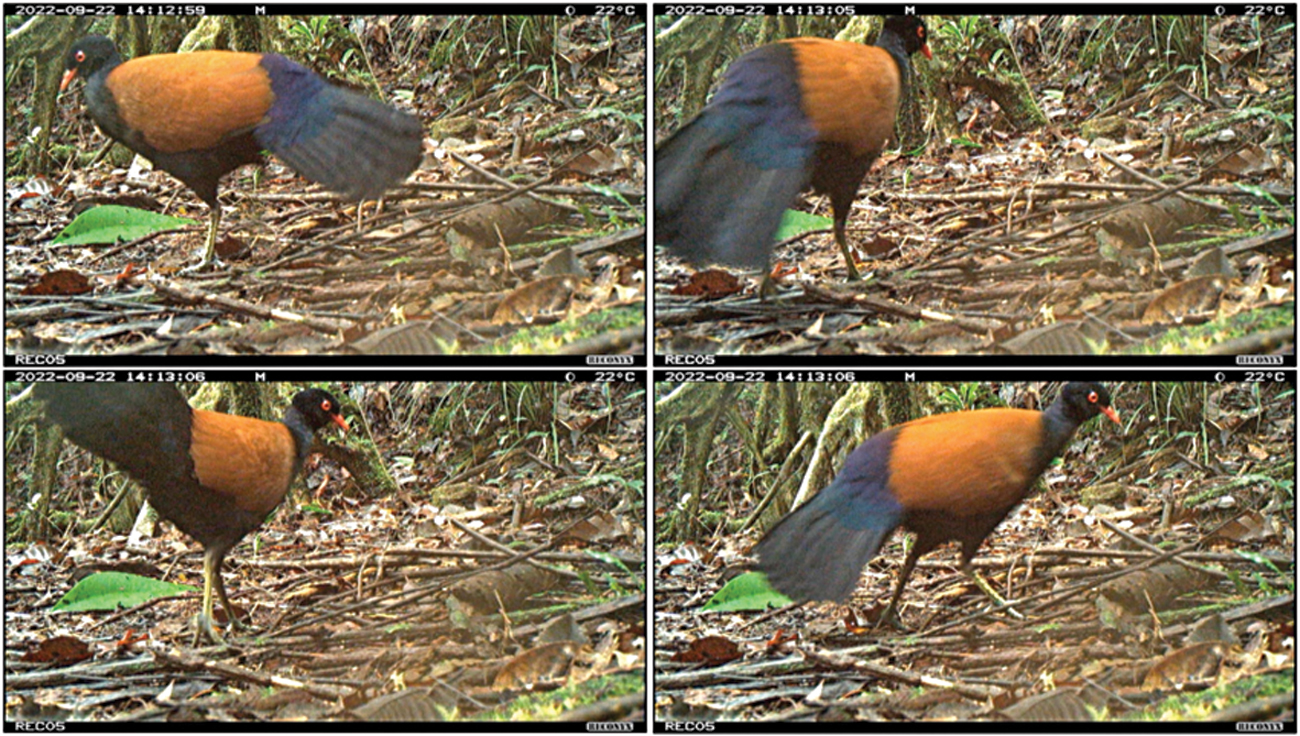
Photo: Doka Nason/CC-By-SA-4.0.
In Nepal’s Jajarkot district, nearly 60,000 camera trap images were captured in 2024. Among them, one photograph surprised researchers: an Asiatic golden cat. That single image extended the known range of the species westward by nearly 400 km. Today, the cat has lost much of its historic range, and its populations have thinned and become fragmented. Yet these rare appearances on camera traps remind us that the species still persists.
What we choose to do with this information, and with these images, may ultimately decide the cat’s future. It was only recently, in 2025, that WWF-India published images from its camera trap survey, providing the first photographic evidence of the Pallas’s cat in Arunachal Pradesh. The survey also captured remarkable images of both the snow leopard and the common leopard using the same scent-marking spot, along with new elevation records for several species. Together, these findings added a wealth of new field insights from one of the harshest and most rugged landscapes in the Himalaya. For this survey, WWF-India had deployed 136 camera traps across 83 locations, covering nearly 2,000 sq. km.
Camera traps continue to make headlines in the conservation world every now and then: a rare species reappears, a new behaviour is recorded, predators are found sharing the same space, and more. Somewhere out there, I imagine, camera traps still lie in wait for species that have remained ‘camera shy’, disappeared without warning, or may one day quietly return.
During one of my bird surveys, I once walked past a camera trap and jolted at the sudden flash. At the base of a tree trunk, I noticed a small green box. I had never seen one before, and for a moment, I secretly hoped I had appeared beside a wild creature that had just passed by.
Rithwik Sundar is an Assistant Editor at Sanctuary Asia.